
What This Synthesis Covers and Why Deployment Context Matters
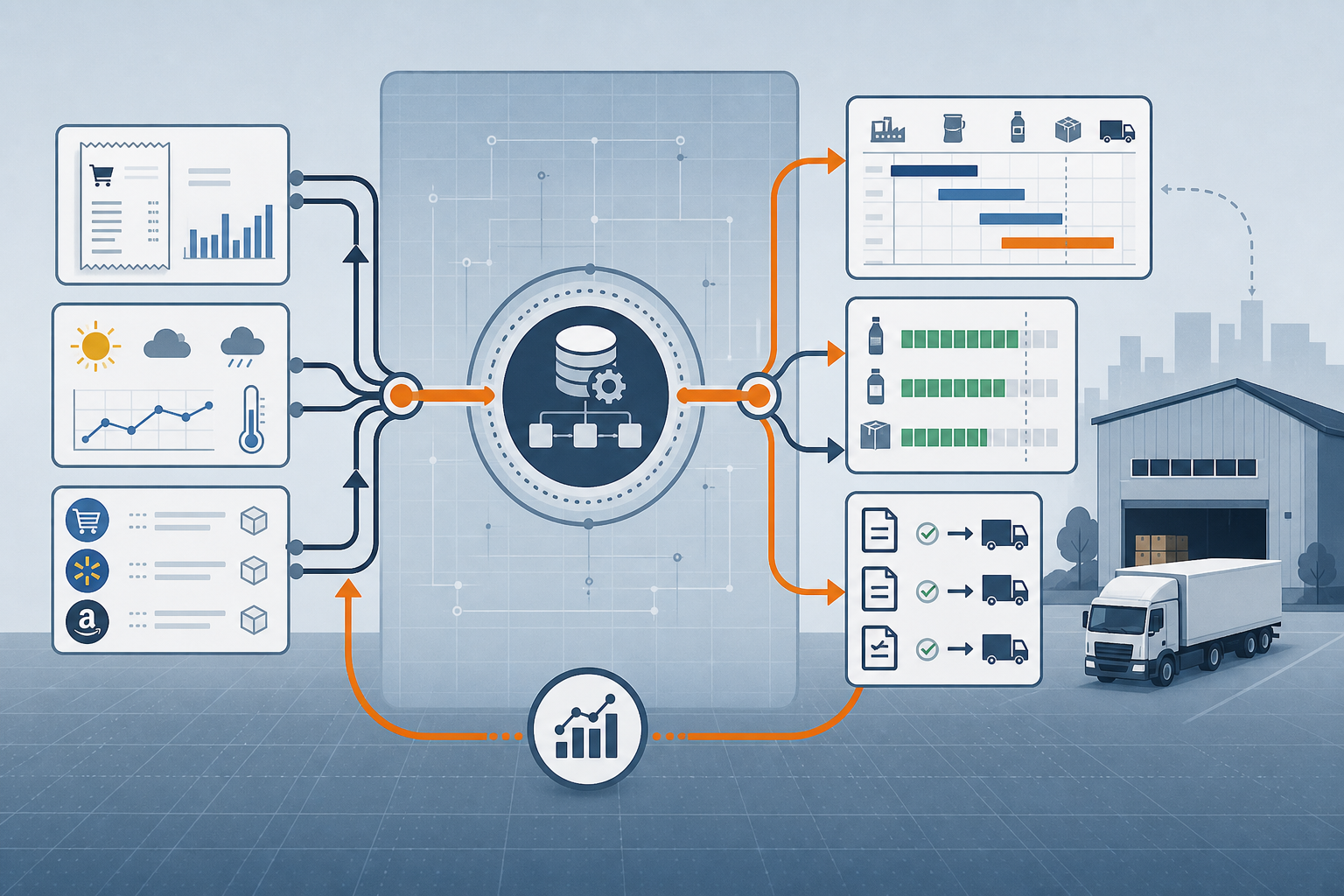
AI demand sensing is a short-horizon ML technique operating on a 0–14 day window. It ingests live point-of-sale signals, weather data, promotional calendars, and other near-real-time feeds to detect demand shifts before they appear in replenishment orders. Demand forecasting, by contrast, operates on a 4–52 week horizon using historical patterns augmented with external variables. These are complementary planning layers, not alternatives. Most mature CPG operations that have moved AI demand sensing into sustained production are running both simultaneously — sensing handles the near-term signal; forecasting handles the medium-term plan.
The distinction matters for deployment planning because the two layers have different data architecture requirements, different integration points, and different failure modes. Conflating them is one of the reasons CPG organizations stall after a promising pilot: they treat a demand sensing proof-of-concept as evidence that the full planning stack is ready for production, when the actual prerequisites for production are substantially more demanding.
This article is written for supply chain directors, demand planning managers, and VP Operations at mid-to-large CPG companies who are past the pilot stage — either evaluating production readiness or trying to understand why a deployment that showed early promise has stalled. The cases referenced here (Unilever Ice Cream, P&G with OMP, Atria with RELEX, and an NTT DATA personal care CPG engagement) are used to ground specific deployment conditions, not to serve as aspirational benchmarks.
Data Prerequisites: The Hard Gates Before Go-Live
The first go/no-go gate for AI demand sensing is not model selection or vendor evaluation. It is POS data consolidation. Granular retailer point-of-sale data — not DC reorder data — is what gives demand sensing its short-term edge. DC reorders reflect what was happening recently; POS data shows how consumers are acting now. A demand sensing model trained on DC reorder signals alone is working with a lagged, aggregated proxy for actual demand, which defeats the purpose of short-horizon sensing.
The challenge is that most CPG companies do not have POS data consolidated into a clean, consistent pipeline. Retailer feeds arrive in different formats, at different latencies, and mapped to different product hierarchies. Aligning those feeds to a consistent time horizon and product taxonomy is a data engineering problem, not an analytics problem — and it must be solved before model training begins, not after.
ERP signal quality is the second gate. If the ERP system cannot provide clean, consistent inventory positions, production schedules, and order data through accessible APIs, the demand sensing output has no reliable downstream anchor. This is particularly acute in organizations running legacy ERP instances without modern API layers — the integration complexity is not a configuration problem; it is an architecture problem that requires resolution before production deployment.
The third gate is external feed integration: weather data, promotional calendars, and syndicated market data all need to be aligned to the same product hierarchy and time horizon as the POS feeds. Without that alignment, models are trained on inputs that don't speak the same language — and the resulting forecasts are numbers planners don't trust.
| Gate | What It Requires | What 'Not Ready' Looks Like |
|---|---|---|
| 1. POS Data Consolidation | Granular retailer POS feeds aligned to consistent product hierarchy and time horizon | Forecasts built on DC reorder data only; retailer feeds arriving in incompatible formats without a normalization pipeline |
| 2. ERP Signal Quality | Clean inventory positions, production schedules, and order data accessible via API | Legacy ERP without API access; data exports via manual file transfer; inconsistent field definitions across plants or regions |
| 3. External Feed Integration | Weather, promotional calendars, and syndicated data aligned to same product hierarchy as POS | External feeds loaded manually; mismatched product codes between syndicated data and internal SKU master; promotional calendars maintained in spreadsheets outside the planning system |
The pattern observed across CPG deployments is that most data quality problems are pipeline problems, not analytics problems. The governance gap — inconsistent definitions, misaligned hierarchies, ungoverned retailer feed formats — is what keeps AI initiatives stuck in pilot. Fixing it at the pipeline level is what makes models production-ready rather than perpetually experimental.
Integration Architecture: Connecting Sensing Output to Production Scheduling
Passing the data readiness gates gets a demand sensing model trained and producing outputs. What determines whether those outputs create operational value is what happens next: whether the sensing signal actually reaches production scheduling and MRP, or whether it stops at the planning dashboard.
This downstream integration step is the most commonly deferred and most costly deferred step in CPG demand sensing deployments. When it is deferred, the forecast improvement stays isolated in the planning layer. Planners see a more accurate short-horizon signal; production scheduling continues to run on the prior static forecast. The sensing capability exists but the operational loop is not closed.
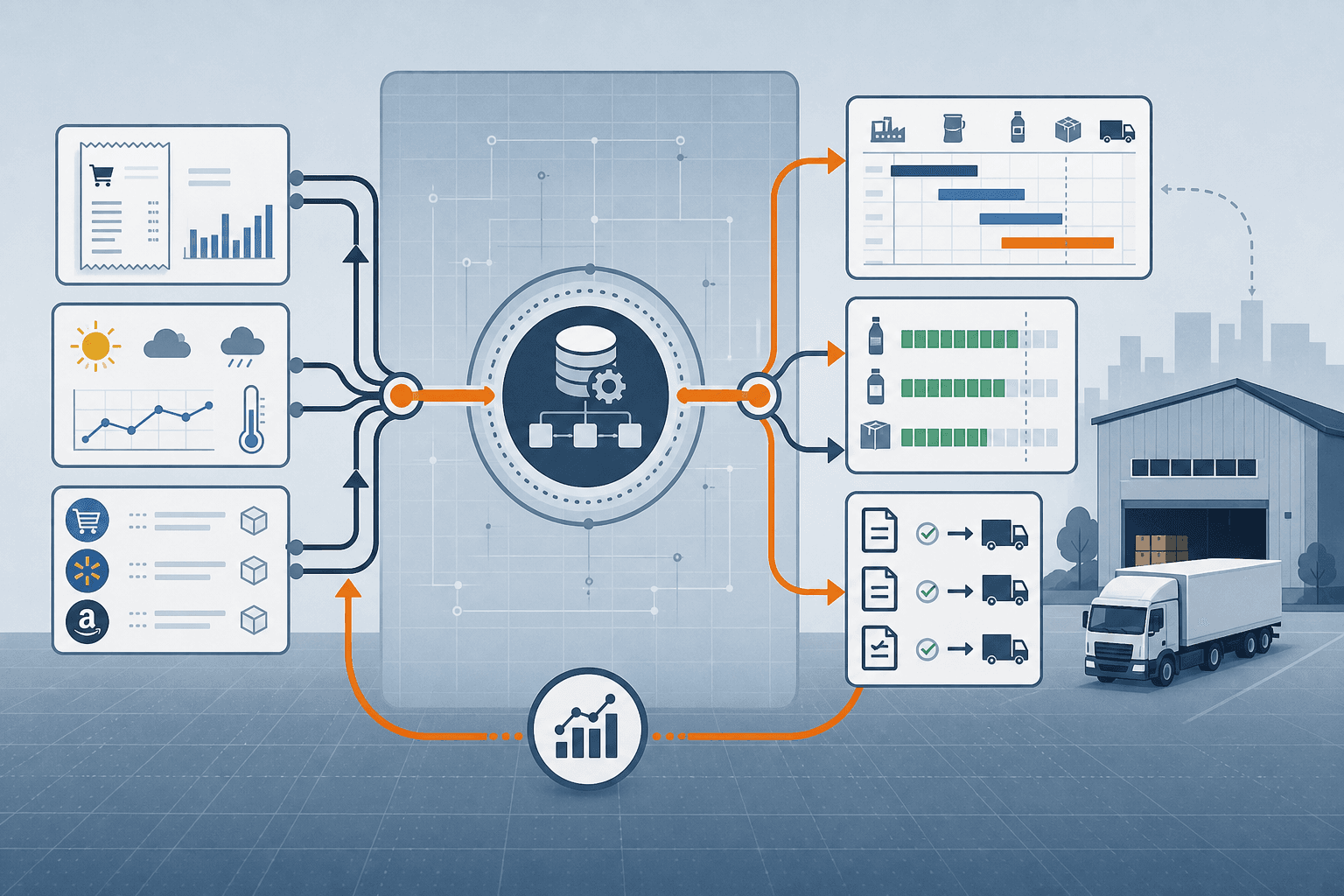
When the integration is complete, the capacity benefit is material. Integrating demand sensing with production scheduling can increase effective capacity by up to 20% without additional capital investment, by minimizing unplanned changeovers and downtime. Some AI optimization systems are running as many as 144,000 models nightly for a single customer to keep production workflows continuously optimized against live demand signals. That level of optimization is only possible when the sensing output is directly wired into the scheduling engine — not when it is a report that schedulers consult.
P&G's transformation with OMP illustrates the prerequisite condition for this integration to work at scale. Before layering in machine learning or advanced forecasting, P&G invested in transforming application-centric data silos into a unified data lakehouse built on harmonized, reusable data. The principle stated in OMP's case study documentation is direct: without that data architecture layer, AI doesn't scale; with it, every planning application becomes smarter over time. The data lakehouse is not a nice-to-have — it is the architectural prerequisite that makes downstream integration tractable.
- Data format normalization across ERP modules, manufacturing execution systems, and planning platforms is required before sensing output can feed scheduling inputs reliably.
- Retailer POS mapping to internal SKU and location hierarchies must be resolved at the pipeline level — mismatches between retailer product codes and internal SKU masters cause silent data gaps that degrade model inputs without surfacing obvious errors.
- Retail partner API approval timelines are external dependencies that fall outside the vendor implementation plan — and are consistently the most common cause of go-live delays beyond vendor estimates.
- MRP and production scheduling system integration requires separate scoping from the demand sensing model itself — vendors who quote a single implementation timeline for both are compressing a two-phase problem into one estimate.
Deployment Sequencing: Phased Rollout Versus Big-Bang
The sequencing decision between phased and full-portfolio rollout is one of the most consequential choices in a CPG demand sensing deployment — and one of the most commonly made incorrectly. Big-bang rollouts across the full SKU portfolio create integration complexity, change management volume, and model validation burden simultaneously. When something goes wrong (and something will), the blast radius is large and attribution is difficult.
Phased approaches — starting with a specific SKU category or a defined geographic region — allow the integration architecture to be validated, the planner trust-building process to run at manageable scale, and model performance to be measured against a clear baseline before expansion. They also produce more durable production outcomes: the model learns on a bounded dataset, the integration issues are contained, and the organization develops the governance habits that production requires before those habits need to operate at full scale.
Unilever's implementation with Solvoyo illustrates what successful phased rollout produces at the output layer. By synchronizing production planning across multiple locations and integrating Distribution Requirements Planning, Master Production Scheduling, and Production Planning and Detailed Scheduling in a structured sequence, the deployment achieved over 95% user acceptance and over 85% output reliability rates. Those figures reflect the end state of a phased synchronized planning approach — not a big-bang deployment outcome.
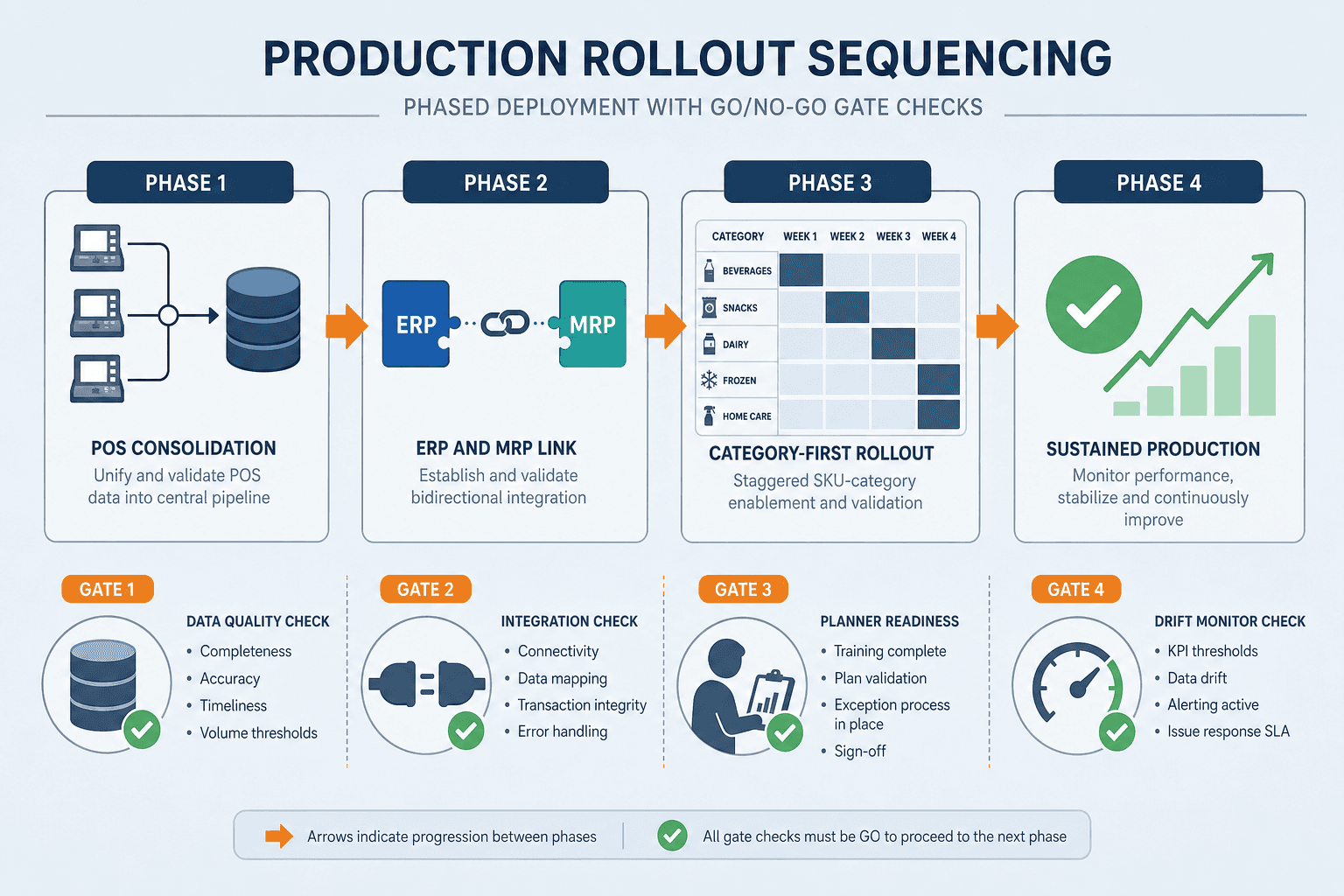
- Phase 1 — POS Data Consolidation: Retailer feeds normalized, product hierarchy aligned, pipeline validated with at least 12 months of clean historical data. Gate: model training inputs pass data quality audit.
- Phase 2 — ERP and MRP Integration: Demand sensing output connected to production scheduling and inventory systems via API. Gate: end-to-end data flow validated in staging environment; retail partner API approvals confirmed.
- Phase 3 — Category-First Production Rollout: Live production on a bounded SKU category or region. Gate: 60-day accuracy benchmark meets or exceeds baseline; planner override rate logged and reviewed; retraining schedule established.
- Phase 4 — Sustained Production and Portfolio Expansion: Governance framework operational; model drift monitoring active; portfolio expansion sequenced by category readiness, not by calendar.
Production Outcomes from Documented Deployments
The outcomes below are drawn from named deployments with explicit source attribution. Each figure is presented with its sourcing context and scope — aggregate numbers from secondary reporting are distinguished from primary disclosures. These are not benchmarks to target; they are reference points for understanding what production-grade deployment produces under specific conditions.
Unilever Ice Cream: Weather-Driven Sensing at Scale
Unilever's ice cream supply chain spans 60 countries and 35 factory production lines. According to Unilever's primary disclosure, AI and digital tools analyzing weather inputs improved forecast accuracy by 10% in Sweden. When an unexpected heatwave hits a market, the inventory system identifies available stock locations and reallocates key products in real time — a capability that requires both the sensing model and the downstream inventory reallocation integration to be operational simultaneously. The company has also rolled out AI-enabled image capture technology in 100,000 freezer cabinets worldwide, which will eventually provide real-time stock insights without parameter-based forecast generation.
Unilever Aggregate: Forecast Error and Safety Stock Reduction
Broader Unilever demand sensing metrics — 30% forecast error reduction, 15% safety stock reduction, approximately $300 million in annual holding cost savings, and 40% faster demand response — are cited in secondary reporting via DocShipper, as referenced by AI in the Chain and SR Analytics. These figures are not primary Unilever disclosures and should be treated as indicative of the scale of impact rather than as verified financial metrics. The $300 million figure reflects the working capital implication of a 15% safety stock reduction across a global portfolio — the arithmetic is plausible, but the sourcing chain is secondary.
P&G with OMP: Data Architecture as the Prerequisite
P&G's transformation with OMP is documented in OMP case study materials. The headline outcomes — greater than 98% shelf availability maintained throughout the transformation, 80% of planning handled touchlessly — are significant. But the more instructive detail for deployment planning is the sequence: P&G unified data architecture into a single lakehouse with harmonized, reusable data before layering in advanced forecasting or machine learning. The company also consolidated from 35 planning processes to 20, and redesigned planner roles around decision-making rather than calculation. The Supply Flow Analyst owns one end-to-end plan; the Supply Flow Engineer owns continuous operating strategy and improvement. That role redesign is what made 80% touchless planning sustainable — not the algorithm.
Atria with RELEX: Accuracy at Short Shelf Life
Atria, a leading food supplier in Northern Europe with approximately €1.5 billion in net sales, deployed RELEX's demand sensing capabilities for highly seasonal goods and meat products with exceptionally short shelf lives. The RELEX-sourced outcome is 98.1% weekly forecast accuracy with a 13% reduction in manual forecasting changes. The 13% reduction in manual changes is a meaningful governance signal: it indicates that planners are trusting the model output enough to act on it without overriding it — a condition that takes deliberate change management to achieve and is often absent in the first 3–6 months of production.
NTT DATA Personal Care CPG: A Forecasting and MRP Reference Case
| Deployment | Key Outcome | Source | Sourcing Note |
|---|---|---|---|
| Unilever Ice Cream (Sweden) | 10% forecast accuracy improvement; real-time inventory reallocation for demand spikes; 100K AI-enabled freezers | Unilever primary disclosure (2025) | Primary source — directly disclosed |
| Unilever Aggregate | 30% forecast error reduction; 15% safety stock reduction; ~$300M annual holding cost savings; 40% faster demand response | Secondary reporting via DocShipper / AI in the Chain / SR Analytics | Secondary sourcing — not primary Unilever financial disclosure |
| P&G with OMP | 98%+ shelf availability maintained throughout transformation; 80% touchless planning | OMP case study materials | Vendor case study — not independently verified financial disclosure |
| Atria with RELEX | 98.1% weekly forecast accuracy; 13% reduction in manual forecasting changes | RELEX source documentation | Vendor-sourced — Atria named, metrics attributed to RELEX deployment |
| NTT DATA Personal Care CPG | Service levels restored from 70% to mid-90s | NTT DATA case study | Demand forecasting + MRP implementation — not AI demand sensing |
Failure Modes and the Conditions That Trigger Them
The five failure modes below are the conditions most consistently associated with CPG demand sensing deployments that stall after pilot or degrade in production. None of them are algorithmic. All of them are detectable before go-live if the right questions are asked.
1. Fragmented POS Data Preventing Clean Model Inputs
When retailer POS feeds arrive in incompatible formats, at inconsistent latencies, or mapped to different product hierarchies, the model training inputs are contaminated before training begins. The model learns on a fragmented representation of actual demand and produces outputs that planners cannot trust — not because the algorithm is wrong, but because the data it was trained on was incomplete. This failure mode is not visible at the dashboard level; it appears as persistent forecast bias that cannot be corrected through model tuning.
2. Model Drift Without Retraining Governance
Demand sensing models degrade silently when the demand environment shifts and the model is not retrained. Seasonal pattern changes, new product introductions, promotional strategy shifts, and retailer assortment changes all alter the demand signal. Without a scheduled retraining cadence and drift monitoring in place, accuracy degrades 6–12 months post go-live without triggering any visible alert. Planners notice that the model is wrong more often and begin overriding it — but without a governance process that logs those overrides, the degradation is invisible to the organization until adoption has already collapsed.
3. Planner Override Rates Without Logging
Planner overrides are not a failure mode in themselves — they are a normal part of human-in-the-loop planning. The failure mode is unlogged overrides. When planners can override the model without recording why, the organization loses the feedback signal it needs to improve the model and loses visibility into whether planners are systematically substituting their own judgment for the model's output. Unlogged overrides create shadow forecasting: the model produces one number, planners use another, and the organization has no way to measure which is more accurate or why the divergence is occurring.
4. ERP and Retail Partner API Integration Complexity
ERP integration is harder than the model itself. Data format normalization, retailer POS mapping, and API approval from retail partners are the integration steps most consistently underestimated in vendor implementation timelines. Retail partner API approvals in particular are external dependencies that fall entirely outside the vendor's control — and they routinely add weeks to go-live timelines. Organizations that scope integration complexity separately from model implementation, and that begin retail partner API conversations early, consistently achieve faster go-lives than those that treat integration as a post-model task.
5. Deferred Production Scheduling Integration
When production scheduling integration is deferred — often because it requires a separate scoping effort and a longer timeline — the demand sensing signal improvement stays isolated in the planning layer. Planners see better short-horizon outputs. Production scheduling continues on the prior static forecast. The sensing investment produces dashboard value but not operational value. This is the most common form of CPG demand sensing underperformance: the model works, the integration doesn't reach the floor, and the organization concludes that demand sensing didn't deliver — when the actual problem was that it was never fully deployed.
Which CPG Profiles Benefit Most — and Which Face the Steepest Barriers
AI demand sensing is not uniformly applicable across CPG. The deployments that produce durable production outcomes share a set of organizational and portfolio characteristics. The deployments that stall or underperform share a different set — and most of those conditions are identifiable before the project starts.
Profiles That Benefit Most
- High SKU count with significant demand variability across the portfolio — sensing provides the most value where static forecasts produce the most error.
- Short shelf life products — food and beverage, fresh, ice cream, meat — where the cost of over-stock (waste) and under-stock (lost sales) is high and the tolerance for forecast error is low. Atria's deployment in meat products and Unilever Ice Cream's deployment both reflect this condition.
- High promotional intensity — organizations running frequent trade promotions where lift patterns are complex and promotional timing creates short-horizon demand spikes that static forecasts systematically miss.
- Retail partners willing to share granular POS data — the model's short-horizon edge depends on live POS signals; organizations without retail data-sharing agreements are forecasting from DC reorders, which eliminates the core sensing advantage.
Profiles Facing the Steepest Barriers
- Fragmented retail data environments — organizations selling through many small or independent retailers who do not share POS data, or whose data arrives through syndicated sources with significant latency.
- Legacy ERP without API access — organizations running ERP systems that cannot expose inventory, production, and order data through modern APIs face an architecture problem that must be resolved before demand sensing integration is feasible.
- Organizations without a unified data architecture baseline — P&G's experience is instructive here: without a data lakehouse or equivalent unified data layer, AI doesn't scale. Organizations that have not yet unified their data architecture are building on a foundation that will constrain production-grade deployment regardless of the model quality.
Poor data quality is consistently cited as the primary barrier to AI scaling in large enterprises. A Forrester 2024 finding referenced by SR Analytics identifies poor data quality as the primary barrier to AI scaling in a majority of large enterprises. The implication for CPG demand sensing is direct: the data readiness assessment is not a preliminary step before the real work begins — it is the real work. Organizations that treat it as a checkbox before vendor selection consistently encounter it again as a production blocker.
| Characteristic | Benefits Most | Faces Steepest Barriers |
|---|---|---|
| SKU Portfolio | High SKU count, high demand variability | Low SKU count, stable demand — sensing adds limited value over static forecast |
| Shelf Life | Short shelf life (fresh, ice cream, meat, beverage) | Long shelf life, low perishability — cost of sensing error is lower |
| Promotional Intensity | High — frequent trade promotions with complex lift patterns | Low — minimal promotional activity, limited short-horizon demand spikes |
| Retail Data Access | Retail partners sharing granular POS data via API | Fragmented retail environment; no POS data sharing agreements; syndicated data only |
| ERP Architecture | Modern ERP with API layer; unified data architecture | Legacy ERP without API access; siloed planning data across plants or regions |
| Data Foundation | Unified data lakehouse or equivalent; governed pipelines | Data silos; inconsistent product hierarchies; no pipeline governance |
The organizational condition that most consistently determines adoption durability is how the AI is positioned relative to the planner. CPG companies that deploy demand sensing as a planner replacement — where the model makes decisions and planners are expected to execute them — see higher override rates, lower adoption, and worse outcomes than companies that position it as the calculation engine with humans as the judgment layer. The planner's role does not disappear; it shifts from calculation to decision-making. That shift requires deliberate role redesign, as P&G's experience with the Supply Flow Analyst and Supply Flow Engineer role structure illustrates. Organizations that skip the role redesign find that planners revert to their prior methods within 6–12 months of go-live — not because the model failed, but because the organizational structure was never aligned to support it.
Comments
Join the discussion with an anonymous comment.