
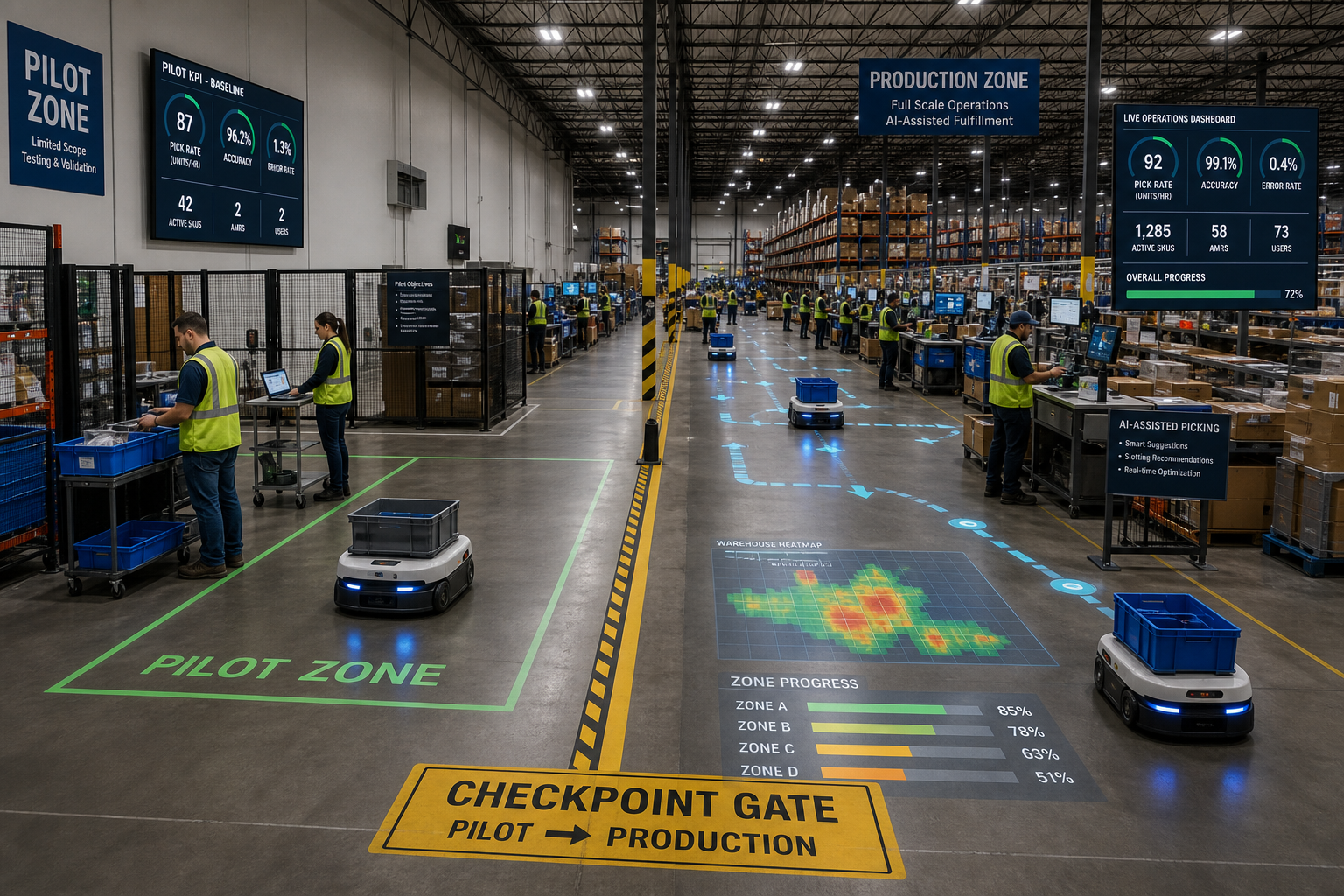
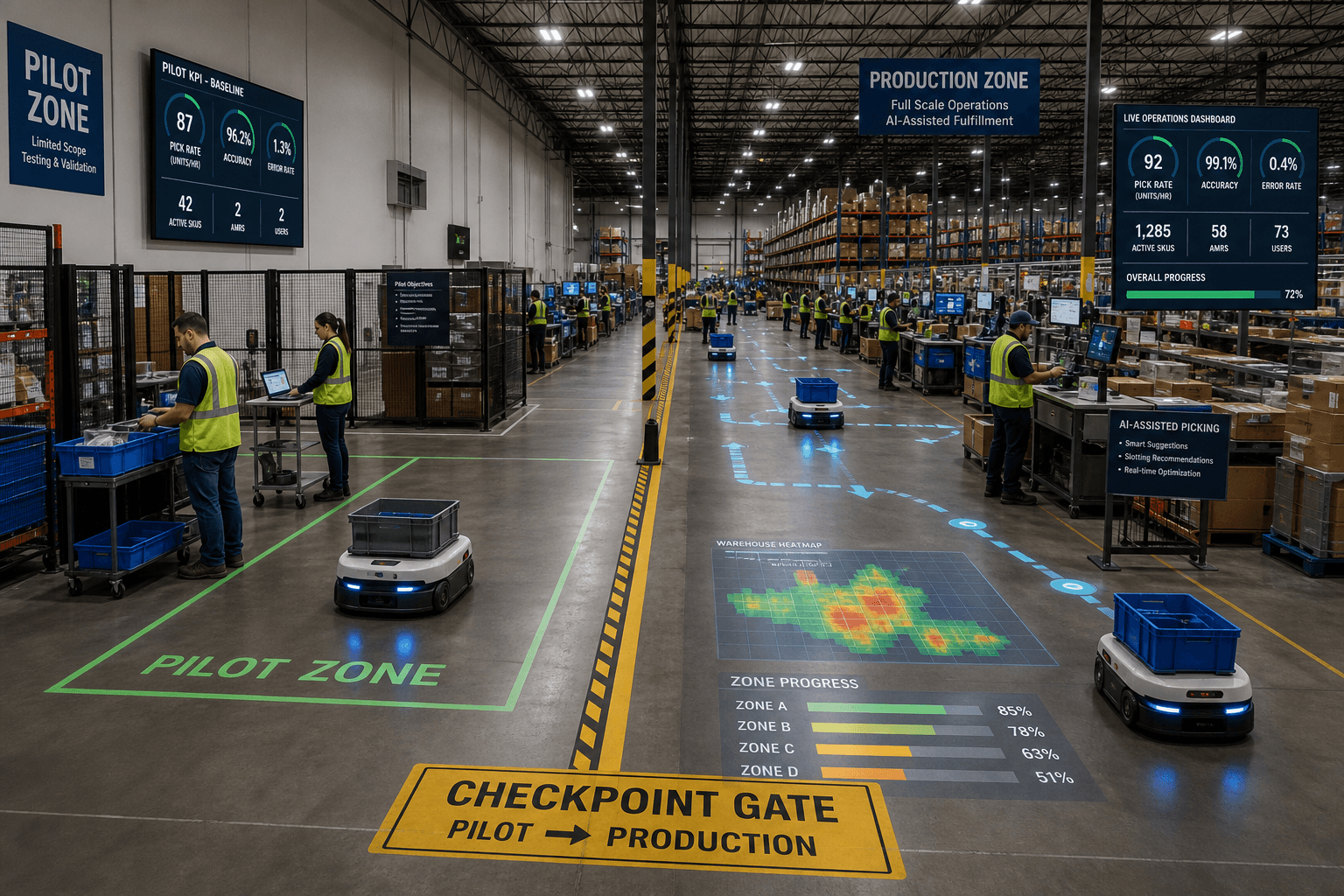
Why Warehouse AI Pilots Stall Before Production
The production-scaling gap in warehouse AI is not a technology problem. IDC research conducted with Lenovo found that 88% of AI proof-of-concepts never reach wide-scale deployment — for every 33 pilots a company launches, only four graduate to production. The cause, per IDC, is "the low level of organizational readiness in terms of data, processes and IT infrastructure" — not model performance.
A separate MIT NANDA initiative report published in 2025 — drawing on 150 leader interviews, 350 employee surveys, and 300 public deployment analyses — found that roughly 95% of enterprise AI pilots deliver little to no measurable P&L impact. The report identifies the core failure as a "learning gap" in enterprise integration, not a deficiency in the underlying AI models themselves.
Prologis research anchors these statistics in warehouse-specific reality: despite roughly $40 billion invested in enterprise AI, only 5 to 7% of U.S. warehouse facilities have meaningful automation — mobile robots or automated storage and retrieval systems. The constraint is never the technology. It is the organization's readiness to operate at scale.
This guide assumes you have already committed to warehouse AI and have either completed or are running a pilot. The question this framework addresses is not whether to adopt AI — it is how to sequence the move from a controlled pilot to a production deployment that holds under real operating conditions.
Why Warehouse AI Sequencing Differs from Generic Enterprise AI Deployment
Generic enterprise AI rollout frameworks — the kind that apply equally to a marketing personalization model and a demand forecasting engine — do not account for the physical and operational constraints that define warehouse environments. Four constraints make warehouse AI sequencing categorically different.
- WMS data latency dependency. Legacy warehouse management systems batch-process data every 4 to 6 hours. ML-based AI applications — pick-path optimization, dynamic slotting, AMR routing — require near-real-time data feeds. The gap between batch-cycle data and AI-ready data is not a configuration problem; it is an architectural one that must be resolved before deployment, not during it.
- Physical infrastructure constraints. Floor layout, ceiling height, dock configuration, aisle width, and racking type all determine which AI-driven automation is physically deployable. Prologis notes these factors can add 10 to 15% to project budget when not assessed upfront. A pilot run in a purpose-built test zone may not replicate in the actual operating environment.
- Shift-based workforce dynamics and tribal knowledge risk. In high-performing warehouse sites, operational advantage often lives in experienced workers — their routing intuitions, exception-handling habits, and informal process shortcuts. When those workers leave or resist change, performance can drop sharply. This creates a scaling risk that generic AI deployment frameworks do not model.
- Multi-system orchestration complexity. Warehouse AI does not operate in isolation. It must integrate with WMS, ERP, labor management systems (LMS), and material handling equipment (MHE) control systems simultaneously. Integration debt across these systems — not any single AI model — is the real scaling bottleneck.
Phase 0: Pre-Pilot Readiness Conditions
Phase 0 is not a planning activity. It is a verification gate. The conditions below must be confirmed as met — not assumed or aspirationally targeted — before any pilot begins. Skipping Phase 0 is the most common cause of pilot-to-production failure, because pilots that launch on unverified foundations produce results that cannot be replicated at scale.
Data Quality Thresholds
The relevant question is not whether data exists. It is whether the data is structured, timely, and consistent across systems in a form that AI can actually use. Three minimum thresholds apply before ML-based warehouse AI can function as described by any vendor:
| Data Dimension | Minimum Threshold | Why It Matters |
|---|---|---|
| Inventory accuracy | ≥98% | AI pick-path and slotting models produce incorrect recommendations when inventory positions are unreliable — errors compound at scale |
| Location accuracy | ≥99% | AMR routing and directed putaway require precise location data; below this threshold, physical collisions and mislocation rates increase |
| Pick accuracy | ≥99.5% | Baseline pick accuracy must be verified before AI-assisted picking is introduced, or attribution of errors becomes impossible |
| Data latency | Near-real-time (sub-minute for most use cases) | Batch cycles of 4–6 hours render AI recommendations stale before they can be acted upon in a live operation |
System Architecture Readiness
WMS API access must be confirmed, not assumed. Many legacy WMS deployments lack documented APIs or carry years of customization that makes integration non-trivial. Operations running heavily customized legacy WMS often discover that removing those customizations is a prerequisite for AI adoption — which can represent a separate multi-month project before pilot launch is feasible.
- Confirm WMS API availability and data-feed latency capability (can the system push data in near-real-time or only in batch cycles?)
- Assess integration debt: how many custom WMS modifications exist, and which would conflict with AI vendor integration requirements?
- Validate ERP and LMS connectivity: AI warehouse applications that touch labor planning or replenishment require bidirectional data flow across systems
- Confirm IT capacity to support a 5x data load increase at production scale — not just at pilot volume
Organizational Readiness
Two organizational conditions must be verified before pilot launch: team AI fluency and change capacity. AI fluency does not mean technical expertise — it means that the operations team can interpret model outputs, understand when to override recommendations, and distinguish between a model error and an operational anomaly. Change capacity means the organization has bandwidth to manage a structured transition without deferring it to a post-go-live activity.
Phase 1: Pilot Scoping and Gate-Entry Criteria
A pilot that is too broad fails because it cannot be controlled. A pilot that is too narrow fails because its results cannot be extrapolated. The scoping discipline in Phase 1 is to find the smallest unit of operation that is genuinely representative of the production environment.
Scope Containment Principle
Start with one process, one shift, one defined zone. Not one building. Not one department. One process — for example, directed putaway in a single receiving zone — run on one shift with a defined crew. This scope is narrow enough to control variables and broad enough to generate statistically meaningful performance data within a 90-day window.
Tiger Team Composition
The pilot team should be six people with specific roles — not a project committee. Each role serves a distinct function in producing a reliable gate decision at the end of the pilot:
| Role | Function in the Pilot |
|---|---|
| Operations lead | Owns the pilot scope, daily execution decisions, and escalation authority |
| IT architect | Manages WMS integration, monitors data feed quality, and validates system stability metrics |
| Finance analyst | Tracks cost inputs and calculates the ROI gate metrics against pre-established baselines |
| Floor supervisor | Bridges between model recommendations and crew execution; flags operational friction in real time |
| Top picker (high performer) | Establishes performance ceiling and provides a benchmark for AI-assisted vs. unassisted comparison |
| Skeptical veteran | Stress-tests the AI outputs against operational experience; surfaces constraint gaps the model may not know about |
KPI Baselining and Minimum Success Bar
Before the pilot begins, establish documented baseline measurements for every metric you intend to use in the gate decision. Baselines measured after the pilot starts are not baselines — they are post-hoc rationalizations. The minimum success bar for advancing to Phase 2 is a 20% or greater improvement on the primary KPI. Pilots that show 8 to 12% improvement are not failures to be pushed through — they are signals that either the use case was wrong, the data was not ready, or the scope was too narrow to show real signal.
Phase 2: Pilot Execution and the Three-Gate Production-Readiness Assessment
The pilot window is fixed at 90 days. At day 90, a scaling decision is made: advance to Phase 3, refactor and extend, or abort. Pilots that drift past 90 days without a formal gate review are not extended pilots — they are organizational failures that consume resources and erode confidence in the AI program.
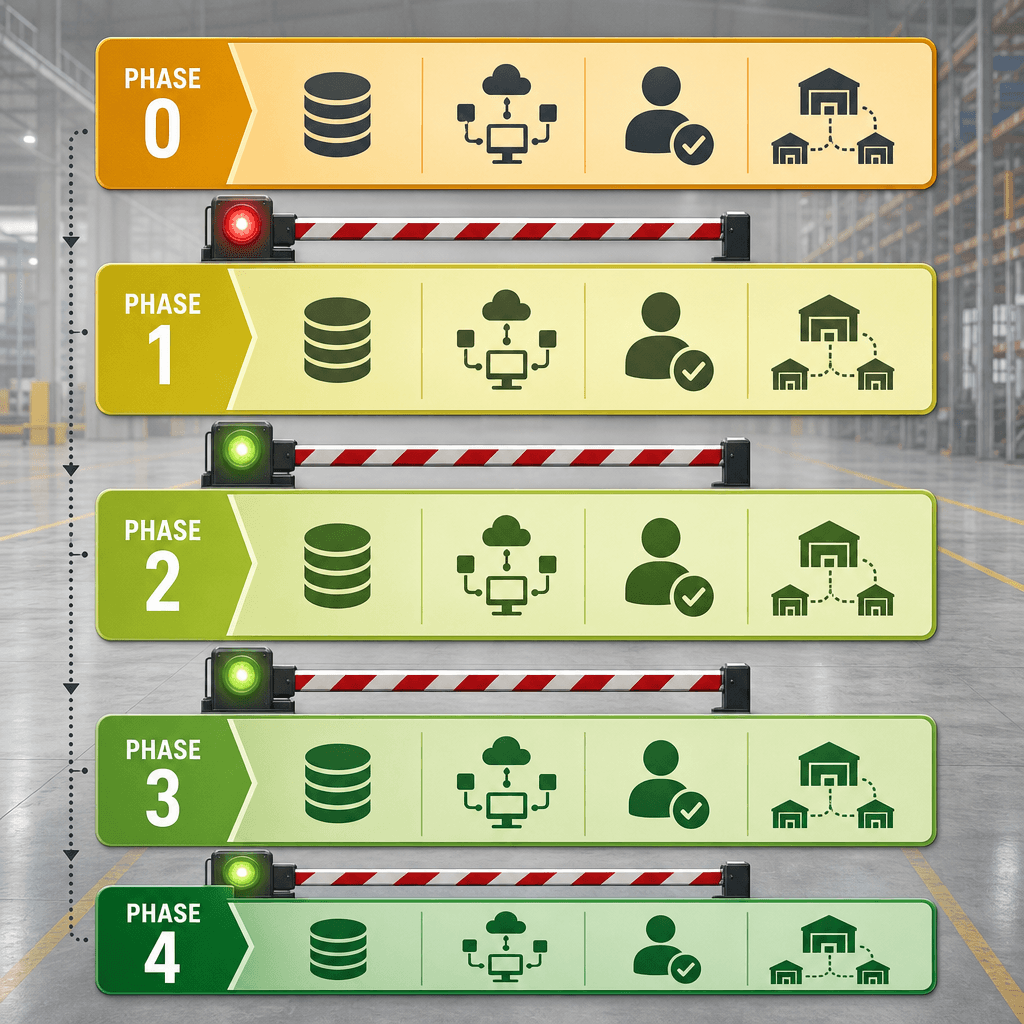
Three gates must all pass before Phase 3 begins. A single gate failure stops the advance, regardless of performance on the other two.
Gate 1: ROI
| Criterion | Pass Threshold | Notes |
|---|---|---|
| Primary KPI improvement | ≥20% | Measured against pre-pilot baseline; must be sustained across the full 90-day window, not a peak reading |
| Payback period | <12 months | Calculated on total project cost including integration — not just software license cost |
| Benefits-to-cost ratio | ≥3:1 | Integration costs typically consume 30–50% of total project budget; ensure these are included in the denominator |
Gate 2: Workforce Adoption
| Criterion | Pass Threshold | Notes |
|---|---|---|
| Adoption rate | ≥80% | Percentage of eligible workers actively using the AI-assisted workflow as designed — not just trained on it |
| Feedback ratio | ≥3:1 positive | Structured feedback collection from floor crew; informal sentiment does not substitute for a documented measure |
| Productivity sabotage | Zero incidents | Any deliberate circumvention of the AI workflow — however minor — is a gate failure requiring root cause resolution before advancing |
Workforce resistance is not a cultural problem to be managed around — it is a gate criterion to be resolved before advancing. A documented case from SkuNexus implementations illustrates the resolution pattern: a 20-year warehouse veteran who was blocking AMR paths was promoted to AMR fleet manager with a 30% pay increase. The resistance ended. The lesson is not that pay increases solve resistance — it is that role redesign that gives experienced workers ownership of the new system converts skeptics into advocates. The tiger team's skeptical veteran role in Phase 1 exists precisely to surface this dynamic early enough to resolve it before the adoption gate.
Gate 3: Systems Stability
| Criterion | Pass Threshold | Notes |
|---|---|---|
| AI recommendation error rate | <5% | Errors include incorrect picks, mislocation instructions, and routing conflicts — not system downtime |
| WMS integration reliability | Functioning without manual workarounds | If integration requires daily human intervention to maintain, it has not passed this gate |
| IT load capacity | Confirmed to support 5x current pilot volume | Scale-up to Phase 3 will immediately stress test this — verify before advancing, not after |
KPMG's analysis of supply chain AI failures identifies four patterns that cause pilots to stall at the gate review: data signals that lack enterprise trust ("an AI forecast is useless if the underlying data is in question"), operational constraints that the model ignores, unclear decision ownership when exceptions arise, and adoption that hits a wall when the tool is disconnected from daily workflows. Each of these maps directly to one of the three gates. If any pattern is present at day 90, treat it as a gate failure — not a post-production tuning item.
Phase 3: Controlled Production Rollout — 25% to 50% to 100%
Passing all three gates at day 90 authorizes Phase 3. It does not authorize full deployment. The first production increment is 25% of the operation — one shift, one zone, one workflow type — not the entire facility.
This distinction matters because the production environment introduces variables the pilot did not stress-test: full volume across all shifts, exception handling at scale, seasonal demand spikes, staff turnover during rollout, and integration behavior under load. A controlled 25% increment surfaces these variables in a recoverable context. Full deployment surfaces them in a context where rollback is operationally costly.
Increment Advancement Criteria
- 25% increment: Run for a minimum of four weeks. All three gate criteria from Phase 2 must hold at this volume. If any gate criterion degrades — error rate climbs above 5%, adoption drops below 80%, or ROI trajectory shifts — freeze scope expansion and diagnose before continuing.
- 50% increment: Add a second shift or a second zone, not both simultaneously. Maintain parallel operations on the non-AI portion of the facility during this increment to preserve fallback capacity. Run for a minimum of four weeks before advancing.
- 100% deployment: Full deployment is authorized only after the 50% increment has held gate criteria for a full four-week period across both shifts. At this point, parallel operations can be retired.
Phase 3 is also where the distinction between the pilot environment and the production environment becomes operationally significant. Pilots are typically run with selected crews, controlled volumes, and heightened management attention. Production introduces the full range of shift variability, crew rotation, equipment downtime, and exception volume that the pilot was designed to avoid. Expect performance to dip 5 to 10% at the 25% increment before stabilizing — this is normal and does not constitute a gate failure unless it persists beyond the first two weeks.
Phase 4: Multi-Site Scaling Conditions
Full production at the first site does not automatically qualify the deployment for multi-site expansion. Site-by-site custom integrations do not compound into a scalable platform — they compound into a maintenance burden. Phase 4 requires a different set of prerequisites than Phases 1 through 3.
Prologis poses five questions that multi-site operators must answer before beginning expansion. These are not aspirational questions — they are binary gate conditions:
| Pre-Scaling Question | What a 'No' Means for Timing |
|---|---|
| Is data structured for AI use, or just stored? | Data remediation must precede site expansion — adding sites before this is resolved multiplies the data quality problem |
| Can systems communicate in real time across sites? | A centralized data model and integration architecture must be in place before site 2 begins — not built in parallel with site 2 deployment |
| Can best-site performance be replicated without its best people? | If performance advantage lives in specific operators, document and systematize their practices before expansion or the performance ceiling travels with them |
| Are repeating processes being standardized across sites? | Site-specific process variations require site-specific AI tuning — which does not scale. Standardize first, then deploy |
| Has change management been budgeted as rigorously as technology? | Multi-site rollout multiplies workforce change complexity, not just technical complexity. Under-resourcing change management at site 1 is recoverable; at site 3, it is not |
The Tribal Knowledge Problem
The Prologis research makes a specific observation that multi-site operators frequently underestimate: in high-performing warehouse sites, the performance advantage often lives in people — experienced operators with routing intuitions, exception-handling habits, and informal process knowledge that is never documented. When those operators are promoted, transferred, or leave, performance drops and the AI system cannot compensate because it was trained on a data environment shaped by those operators.
The Phase 4 prerequisite is not to eliminate tribal knowledge — it is to systematize it. Before expanding to a second site, document the operational practices that distinguish your best-performing site and encode them into the process design that the AI system operates within. If you cannot replicate best-site performance without its best people, you do not yet have a scalable deployment — you have a high-performing site.
Change Management as a Gate Criterion, Not a Workstream
The most common structural mistake in warehouse AI programs is treating change management as a parallel workstream — something that runs alongside the technical deployment and is addressed in communications plans, training schedules, and town halls. This framing consistently produces the adoption wall that KPMG identifies as a primary failure pattern.
Change management must be embedded as a pass/fail criterion within each phase gate. The 80% adoption threshold in Gate 2 is not a change management metric — it is a production-readiness metric. If it fails, the deployment is not production-ready, regardless of ROI or systems stability performance.
A McKinsey study cited in Prologis's readiness research found that 70% of large-scale transformation initiatives fail primarily because of employee resistance and lack of management support — not technology failure.
The MIT NANDA research adds a specific finding relevant to warehouse AI: empowering line managers — not central AI labs or technology teams — to drive adoption is a key differentiator between programs that scale and programs that stall. In warehouse operations, this means floor supervisors must have the authority to make real-time decisions about AI workflow adherence, override protocols, and exception handling — not just report issues upward to a central project team.
- Phase 0: Verify change capacity as a readiness condition — not just data and systems. If the operations team does not have bandwidth to manage a structured transition, the pilot will be under-resourced from day one.
- Phase 1: Include the skeptical veteran on the tiger team explicitly to surface resistance early. Unresolved skepticism at pilot scale becomes active resistance at production scale.
- Phase 2: Gate 2 adoption criteria are non-negotiable. An adoption rate of 75% at day 90 is a gate failure — not a gate pass with a note to monitor.
- Phase 3: Each increment advance requires re-verification of adoption rate, not just technical performance. Adding shifts or zones resets the adoption baseline for the new population.
- Phase 4: Budget change management for each new site as a separate line item — not as a replication of site 1's change program. Site-specific workforce dynamics require site-specific adoption strategies.
Gate Failure Decision Tree: Pivot, Pause, or Abort
When a gate fails, the decision is not whether to continue — it is which response is appropriate. Three outcomes are available: pivot, pause, or abort. The choice depends on which gates failed, what the root cause is, and whether the root cause can be addressed without rescoping the deployment.
| Gate Failure Pattern | Decision | Conditions |
|---|---|---|
| One gate fails; root cause is identifiable and addressable within 30 days without rescoping | Pivot | Extend the pilot window by 30 days, address the specific root cause, and re-evaluate the failed gate only. Do not re-run all three gates. |
| Two gates fail, or one gate failure requires architectural rework (e.g., WMS integration is fundamentally incompatible with near-real-time data requirements) | Pause | Stop the pilot. Conduct a structured root cause review. Determine whether the underlying issue is addressable within the current project scope or requires a new Phase 0 assessment. |
| All three gates fail, or Phase 0 conditions were not actually met at pilot launch | Abort | End the pilot. Document the failure conditions and root causes. Do not attempt to recover the pilot by extending the window — the conditions for production readiness are not present. |
Most abort conditions trace back to Phase 0 prerequisites that were not actually verified before the pilot began. Inventory accuracy that was reported as 98% but measured as 94%. WMS API access that was confirmed on paper but turned out to require a six-month vendor engagement to implement. Change capacity that was assumed but was never assessed against the actual bandwidth of the operations team.
The phase-gate framework works only if Phase 0 is treated as a genuine verification gate — not a checklist to complete quickly in order to reach the pilot. The readiness stack — data quality, system integration, workforce change capacity, and infrastructure consistency — is, as Prologis frames it, the actual competitive moat. The AI technology is available to any operator who can pay for it. The readiness to deploy it at scale is not.
Comments
Join the discussion with an anonymous comment.