


What Made Q2 2026 Distinct in Supply Chain AI
Most quarters in supply chain AI produce incremental updates — a new integration, a refreshed dashboard, a capability that was already available under a different label. Q2 2026 was different. The quarter produced a cluster of releases that collectively reset performance expectations across logistics execution, inventory intelligence, and warehouse automation.
The backdrop matters. Modex 2026 set records across every dimension — 50,000 registered visitors from 132 countries, 1,057 exhibitors covering 630,000 net square feet. That scale is not an exhibitor directory entry; it is an urgency signal. Fortune 1000 companies, top-100 retailers, and top-100 consumer goods firms sent delegations because they are no longer in exploratory mode.
The sentiment data released at Modex reinforces the shift. The 2026 MHI/Deloitte Annual Industry Report found that 48% of supply chain leaders now rate AI's disruptive impact as significant or greater — a 25-percentage-point increase from 2025. That is not a marginal shift in perception; it is a compressed adoption window.
Tariff-driven volatility is adding pressure from outside the technology stack. Organizations that had multi-year vendor evaluation timelines are compressing them because planning assumptions are changing faster than traditional procurement cycles can accommodate. The result: buyers are making consequential platform decisions with less preparation time than the complexity of these systems warrants.
Logistics AI: The Agentic Closed-Loop Benchmark Is Now Set
On June 3, 2026, C.H. Robinson announced the Lean AI Engineer — and the announcement deserves more than a feature-list reading. The system autonomously handles 92% of 4PL shipments globally across trucking, ocean, air, and rail, from order creation through tendering, routing, exception management, and carrier payment. That figure matters because it exceeds the ceiling that traditional automation systems could reach: prior to agentic approaches, 50–60% autonomous handling was the practical limit for complex multi-modal freight.
What distinguishes this from previous automation claims is the closed feedback loop. The system does not generate alerts and wait for human action — it detects problems, adjusts, and heals the operation without requiring a human to notice something first.
"The breakthrough here is that it's one closed-loop AI system. It will run continuously, improve the operation it's running and heal itself when something breaks — without an alert or a human noticing a problem first." — Jordan Kass, President of Managed Solutions, C.H. Robinson
The organizational implications are as significant as the technical ones. Earlier in Q2, CHR VP Mark Albrecht described the workforce model that agentic AI produces: a shift from pyramid-shaped organizations — many execution workers, few strategists — to diamond-shaped ones, where fewer employees handle direct execution while more staff oversee AI agents, conduct higher-level exception reviews, and focus on strategy. Buyers planning agentic logistics deployments need to model this transition explicitly; it is not a headcount reduction exercise, it is a role redistribution that requires deliberate change management.
Amazon ASCS: AI-Native Logistics Infrastructure Opens to All Shippers
On May 5, 2026, Amazon opened its Supply Chain Services to businesses of all sizes — extending the full portfolio of freight, distribution, fulfillment, and parcel shipping that Amazon built for its own operations. The AI capabilities embedded in that infrastructure are substantial: demand forecasting across more than 400 million products daily (per Amazon's own disclosures), freight routing that integrates satellite imagery with road networks and delivery history, and inventory processing via the Sequoia system running 75% faster than prior-generation infrastructure.
Early adopters include P&G, 3M, Lands' End, and American Eagle. The market-structure signal is clear: for the first time, any shipper can access AI-native end-to-end logistics infrastructure at a scale that previously required building it internally or assembling it from multiple vendors.
The competitive framing — Amazon doing to supply chain what AWS did to IT infrastructure — is directionally accurate but incomplete as a buyer evaluation framework. The more important signal for buyers is the data-control dimension that the infrastructure model creates.
"The party that controls the data controls the relationship." — Paul Tonsager, CEO, IMS Advisory
Every shipper that onboards to ASCS provides Amazon with granular visibility into their inbound materials, cross-channel demand patterns, returns velocity, and fulfillment SLA performance. That is a level of operational intelligence that incumbent 3PLs and TMS vendors never had access to. Buyers evaluating ASCS must weigh the capability gains against the strategic dependency this creates — not just with Amazon but as a model for evaluating any logistics AI platform that requires deep data integration.
- What data does the platform require access to, and what does the vendor retain rights to use?
- What are the data portability terms if the relationship ends?
- Does the vendor's AI model improve using your operational data — and if so, who benefits from that improvement?
- What visibility does the vendor gain into your competitive positioning through fulfillment and demand data?
Inventory and Forecasting AI: Operational Results, Not Pipeline Claims
Most Q2 2026 inventory AI coverage focused on vendor announcements. Target's Q1 2026 earnings report offers something more useful: a practitioner proof point at production scale. Inventory turns improved 10% year-over-year, with EVP and COO Lisa Roath attributing the gains to improved connectivity between upstream and downstream processes, AI and ML investment in demand forecasting, and new network capacity additions.
The Houston Receive Center processes approximately 25 million cartons annually and gives Target the flexibility to hold long lead-time import seasonal inventory upstream, then distribute it closer to actual demand timing. The Colorado food distribution center adds regional capacity. Together, these investments show that AI-driven inventory intelligence requires physical network infrastructure to be actionable — the forecasting capability and the network capacity are co-investments, not alternatives.
Warehouse AI: Capability Consolidation Signals for Buyers
Three acquisitions in the warehouse automation segment define a pattern buyers should factor into their multi-year infrastructure planning. The individual deals are less important than what they collectively signal: vendors are assembling integrated AI-plus-hardware stacks, and the modular best-of-breed assumption that underpinned many warehouse automation architectures is becoming harder to sustain.
| Transaction | Timing | Capability Added | Buyer Signal |
|---|---|---|---|
| Symbotic acquires Fox Robotics | Closed Q1 2026 (Q2 market implications) | Autonomous forklift capability added to mixed-case palletizing stack — loading dock now covered | Symbotic can now offer end-to-end automation from dock to storage; evaluate combined stack continuity in multi-year contracts |
| Comau plans acquisition of Invent | Announced May 18, 2026; closing expected Q3 2026 pending regulatory approval | AI-driven e-commerce intralogistics software added to hardware portfolio; Latin America and U.S. mid-market presence expanded | Hardware vendors acquiring software AI capabilities; assess integration roadmap before assuming software features are production-ready post-close |
| Interroll acquires Royal Apollo Group | Signed and closed May 7, 2026 | Spiral conveyor technology closes portfolio gap; aftermarket services and spare parts business strengthened | Lifecycle services coverage improving; factor into total cost of ownership models for conveyor-heavy facilities |
The direction of warehouse AI software is also clarifying. Howard Turner of St. Onge Company describes the emerging agentic Warehouse Execution System model as digital co-workers that can orchestrate operations — but with an important constraint: these agents currently operate within human-in-the-loop frameworks where actions are suggested and require human approval before execution. That constraint is not a limitation to work around; it is a governance design that buyers should evaluate explicitly when assessing WES vendors.
The Readiness Gap: Why 83% of Organizations Are Still Incremental
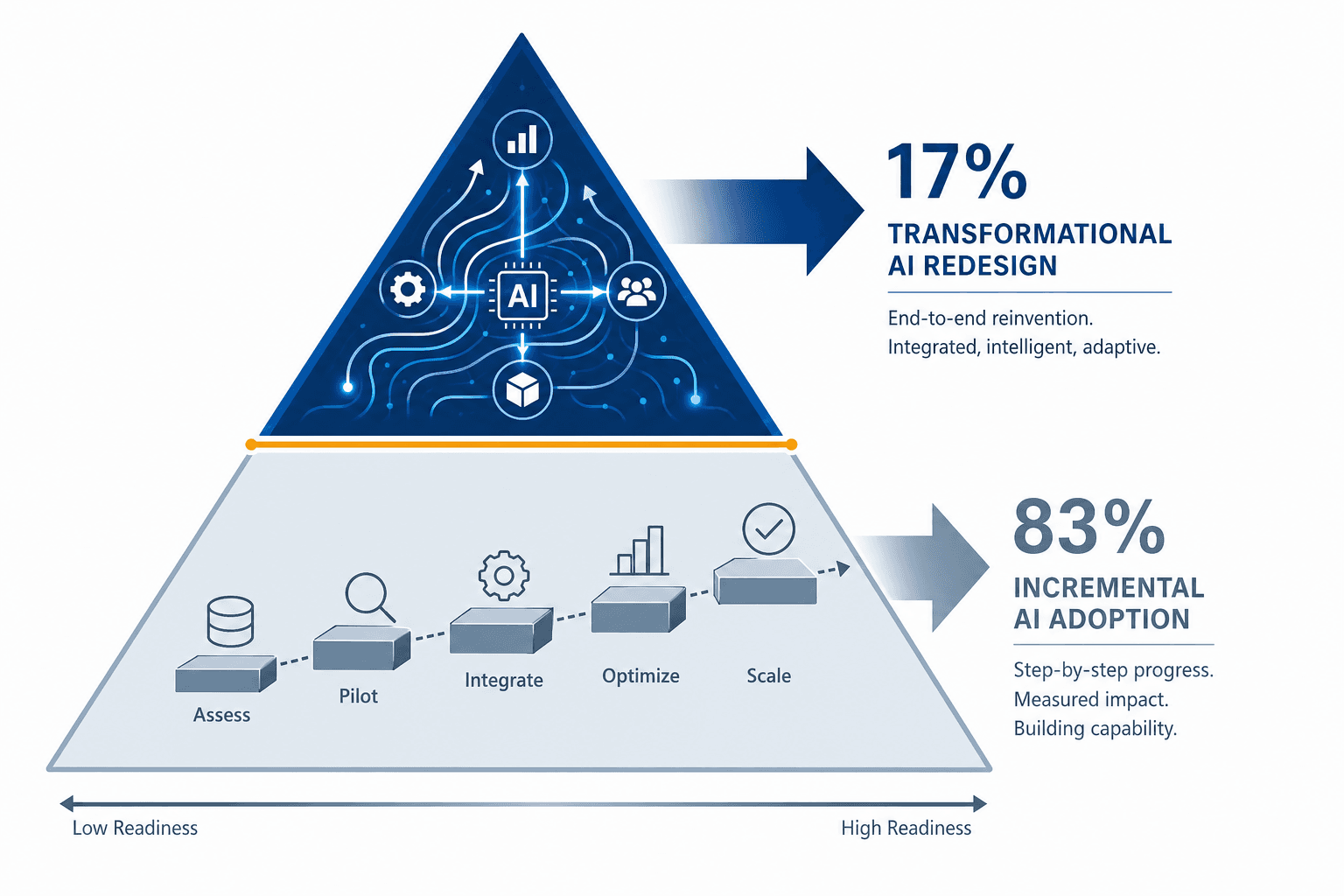
A Gartner survey of 140 senior supply chain leaders, conducted in November 2025 and published in May 2026, found that only 17% of organizations are pursuing immediate transformational redesign of processes and workflows. The remaining 83% are applying AI incrementally — either to specific use cases or gradually scaling it into integrated processes.
This data predates several of the Q2 product releases analyzed here — notably the CHR Lean AI Engineer, announced June 3. It should be read as reflecting organizational readiness entering Q2, not as a concurrent response to those releases. The gap it documents is structural, not reactive.
"Persistent volatility is driving interest in evaluating AI-orchestrated capabilities, but investment remains constrained by foundational readiness. Even among leading supply chain organizations that have demonstrated success with performance gains and ROI on their AI investments, few have truly embedded AI into their core operations." — Caleb Thomson, Senior Director Analyst, Gartner
The Gartner barriers list is specific: fragmented vendor landscape, data quality gaps, inconsistent partner data, human upskilling requirements, and process maturity deficits. These are organizational constraints, not technical ones. The Kenco 2026 Innovation Report — based on a survey of 150+ North American supply chain executives — surfaces what it calls the innovation paradox: 83% of respondents have a dedicated 2026 innovation budget, but 51% cite cost constraints and 45% cite workforce challenges as their biggest implementation barriers.
The paradox is real: organizations are funding innovation while simultaneously lacking the operational foundation to absorb it. Organizational misalignment across Operations, IT, HR, Risk, and Legal is identified as a common cause of delays — reinforcing that the bottleneck is governance and process, not budget or technology availability.
"The most common failure mode is treating AI as a technology experiment rather than an operational capability... What's slowing broader adoption is the operating model, not the technology. Siloed data, disconnected systems, and weak governance around operational metrics remain the primary barriers." — Nathanael Powrie, MainePoint
- Data quality and accessibility: AI models require clean, accessible, consistently structured operational data. Most organizations have it in fragments across systems that were never designed to interoperate.
- Process maturity: Agentic systems require well-defined processes to automate. Organizations with inconsistent or undocumented workflows cannot hand off decision authority to an AI system without first standardizing what the system is supposed to decide.
- Governance gaps: Autonomous or semi-autonomous AI actions require accountability frameworks — who is responsible when the system makes a wrong call? Most organizations have not built these frameworks.
- Partner data dependencies: Supply chain AI that requires upstream supplier or carrier data is constrained by the data quality and sharing practices of those partners, not just internal systems.
- Upskilling requirements: The diamond-shaped organizational model that agentic AI produces requires staff who can oversee AI agents, interpret model outputs, and manage exceptions — skills that are not present in most current execution roles.
How to Read Q2 Releases as a Buyer: An Evaluation Framework
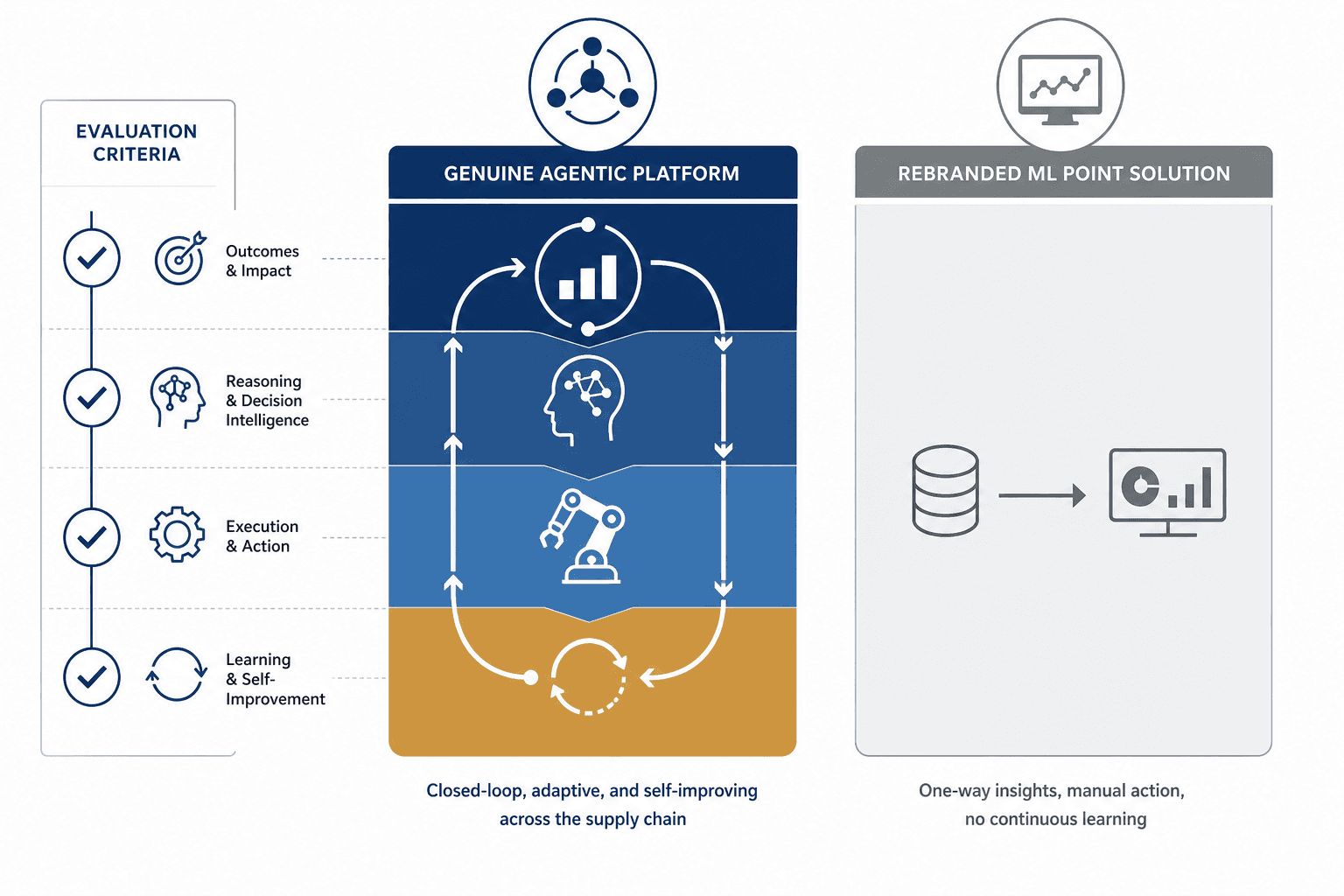
Q2 2026 product releases provide concrete material for vendor evaluation conversations that were previously harder to anchor. The CHR benchmark, the ASCS data-control question, and the warehouse consolidation pattern each translate into specific RFP criteria. The following framework derives from the specific signals documented in this article.
One important context: the 2026 Technology Roundtable includes a direct warning from Tom Bonkenburg of St. Onge Company: vendors are rebranding existing ML tools as agentic AI for marketing purposes, creating confusion and unrealistic expectations. That warning should frame every vendor conversation about agentic capability in Q2 and beyond.
| Evaluation Question | What a Strong Answer Looks Like | Red Flag |
|---|---|---|
| Does the platform operate as a closed feedback loop? | Vendor can document the feedback mechanism: how outputs from execution feed back into model updates, and how exceptions are resolved without requiring human initiation | Vendor describes analytics dashboards and execution tools as separate products that integrate — this is not a closed loop |
| What is the verified automation rate at production scale? | Vendor cites a specific percentage with customer attribution, volume context, and mode or function scope (not a pilot figure) | Vendor references pilot results or uses ranges without specifying production conditions |
| How does the platform handle data ownership and portability? | Contract terms specify that operational data remains customer property; model improvements derived from customer data are disclosed; data export is available at contract termination | Data portability is addressed only in legal fine print or described as 'standard industry practice' without specifics |
| Is the product genuinely agentic or relabeled ML? | Vendor can describe the reasoning layer: how the system evaluates options, selects actions, and adapts based on outcomes — not just pattern-matching or rule-based automation | Vendor uses 'agentic' interchangeably with 'automated' or 'AI-powered' without describing decision logic |
| Does the vendor address organizational readiness, not just technical integration? | Vendor has documented implementation prerequisites, offers organizational change support, and can reference deployments that include process redesign alongside technology deployment | Vendor's implementation scope is limited to technical integration; change management is treated as the customer's problem |
| For alert-based risk tools: does the platform move from alerts to action? | Platform can show how risk signals translate into prioritized recommended actions with decision support, not just notifications | Platform generates risk alerts without prioritization or action guidance, requiring human interpretation of every signal |
H2 2026 Outlook: Where the Next Moves Are Likely
The directional signals from Q2 point toward four developments that supply chain technology evaluators should track entering H2 2026.
- Agentic WES frameworks moving toward broader autonomous action. Current agentic warehouse systems operate within human-in-the-loop approval models. As these frameworks mature and confidence intervals improve, expect vendors to offer configurable autonomy thresholds — allowing buyers to expand autonomous action within defined operational boundaries. The governance design for that expansion needs to be in place before the capability arrives.
- Continued AI-plus-hardware stack consolidation. The Symbotic/Fox Robotics and Comau/Invent patterns are unlikely to be isolated events. Buyers evaluating warehouse automation vendors should expect further consolidation and should pressure-test integration architecture assumptions in any multi-year contract — specifically, which capabilities are native to the platform versus dependent on acquired entities still in integration.
- Tariff-driven urgency continuing to compress evaluation windows. Sourcing diversification requirements driven by trade policy volatility are forcing faster decisions on logistics AI and inventory planning tools. Organizations that have not completed data readiness assessments before entering vendor selection will face a choice between delayed deployment and premature commitment.
- Organizational readiness as the binding constraint. The Gartner data, the Kenco innovation paradox, and the practitioner framing from the 2026 Technology Roundtable all point to the same conclusion: the technology is ahead of most organizations' capacity to absorb it. Buyers who use H2 to close data governance, process documentation, and upskilling gaps will be better positioned to act on H2 releases than those who wait for the next product announcement to drive urgency.
Comments
Join the discussion with an anonymous comment.