Formal Definition
Multi-Echelon Inventory Optimization (MEIO) is a supply chain planning discipline that simultaneously determines optimal inventory placement and quantity targets across every node in a supply network — from raw material suppliers through manufacturers, distribution centers, and on to end customers. Rather than calculating stock policies for each location in isolation, MEIO treats the entire network as one interconnected system and solves for a globally optimal inventory policy across all nodes at once.
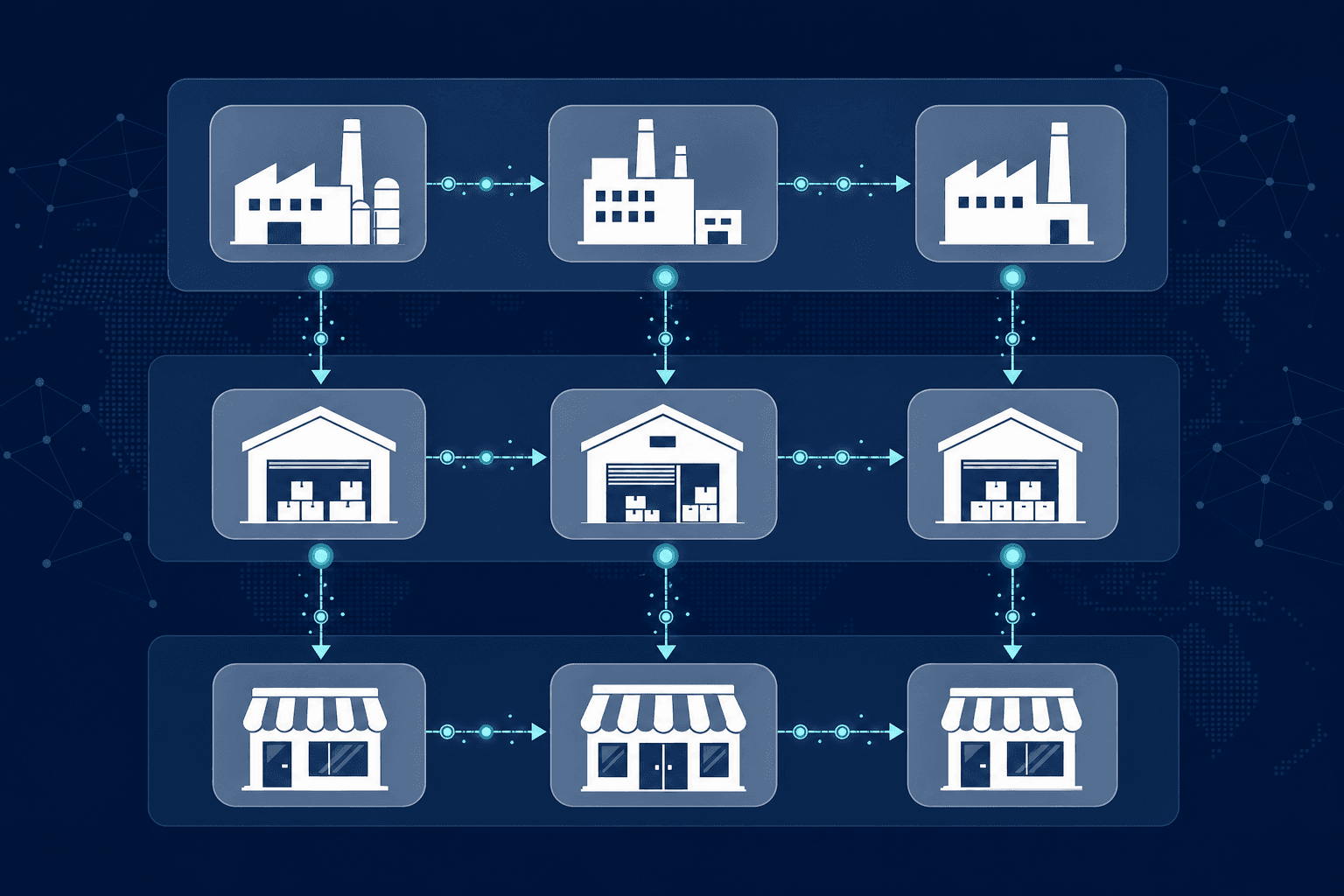
The defining characteristic of MEIO is the scope of the optimization objective. Every location's stocking policy is determined in relation to every other location's policy. A distribution center's safety stock target, for example, is not set independently — it is set in the context of what upstream suppliers can provide and what downstream stores require. This interdependence is what distinguishes MEIO from conventional inventory management approaches, where each node is optimized as if the rest of the network does not exist.
Anatomy of a Multi-Echelon Network
A supply chain echelon is a distinct tier in the network through which product flows before reaching the end customer. Most networks contain three primary echelon levels:
- Upstream — Suppliers, raw material sources, and manufacturing plants. These nodes produce or procure inventory and feed it forward into the network.
- Midstream — Regional distribution centers, central warehouses, and cross-docking facilities. These nodes aggregate, sort, and redistribute inventory across the network.
- Downstream — Retail locations, last-mile fulfillment centers, hospitals, dealers, or end customers. These nodes consume inventory and generate the demand signal that drives the entire network.
The topology — how nodes connect across and within echelons — determines the complexity of the optimization problem. Four standard network types are recognized in MEIO literature and commercial platforms:
| Network Type | Structure | Typical Example |
|---|---|---|
| Serial | Each node has exactly one upstream supplier and one downstream customer | Linear production-to-retail chain |
| Assembly | Each node has one downstream customer but draws from multiple upstream suppliers | Manufacturing with multi-component BOM |
| Distribution (Divergent) | Each node has one upstream supplier but serves multiple downstream customers | Central DC serving multiple regional warehouses or stores |
| General | Nodes have multiple upstream and downstream connections in both directions | Complex omnichannel or global distribution networks |
Identifying your network type before evaluating MEIO solutions matters because different platforms have different strengths across topologies. A tool optimized for divergent distribution networks may not handle assembly structures — with their upstream component interdependencies — with equal effectiveness.
Single-Echelon vs. Multi-Echelon Optimization: When MEIO Is Warranted
Single-Echelon Inventory Optimization (SEIO) calculates the optimal stocking policy for one node at a time, treating each location as independent. The result is locally rational but globally inefficient: each node adds its own safety stock buffer to protect against uncertainty, and those buffers stack across echelons without coordination.
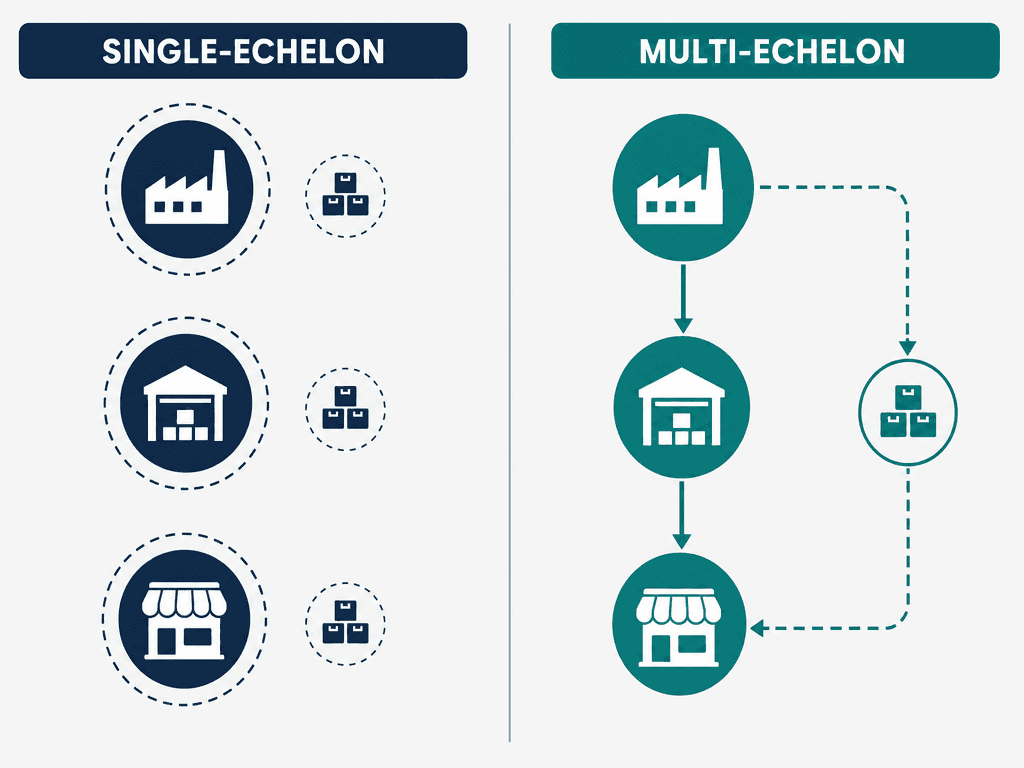
| Dimension | Single-Echelon (SEIO) | Multi-Echelon (MEIO) |
|---|---|---|
| Optimization scope | One node at a time | All nodes simultaneously |
| Safety stock logic | Each node buffers independently | Buffers shared and positioned strategically across the network |
| Policy type | Locally optimal, globally suboptimal | Globally optimal across the network |
| Bullwhip effect | Amplified — demand variability grows upstream | Reduced through centralized coordination |
| Computational complexity | Low | High — requires network-aware solver |
| Typical inventory outcome | Excess stock at some nodes, stockouts at others | Lower total inventory with maintained or improved service levels |
MEIO is warranted when at least one of the following conditions is present in your network:
- Service levels vary significantly across locations — some nodes are overstocked while others experience frequent stockouts.
- Excess inventory coexists with stockouts at the same time across different nodes in the same network.
- Multi-tier interdependencies exist — for example, a DC's replenishment lead time depends on a plant's production schedule, which depends on supplier availability.
- Safety stock is being duplicated at multiple echelons without a clear rationale for which tier should carry the buffer.
- The bullwhip effect is amplifying demand variability upstream, inflating supplier-facing inventory requirements.
Mathematical Foundations: GSM and SSM in Practitioner Terms
Two foundational mathematical frameworks underpin MEIO modeling. Understanding the difference between them helps practitioners evaluate vendor claims and identify which model fits their network's behavior.
| Model | Core Assumption | Backorder Behavior | Commercial Adoption |
|---|---|---|---|
| Guaranteed Service Model (GSM) | Service times at each node are bounded — every node guarantees delivery within a maximum committed lead time | Backorders do not propagate; demand is always met within the committed window | Assumed by most commercial MEIO platforms; easier to parameterize from standard ERP data |
| Stochastic Service Model (SSM) | Service times are random variables; demand that cannot be filled immediately creates backorders that propagate upstream | Backorders ripple through the network, increasing upstream demand uncertainty | More theoretically accurate for networks with meaningful backorder behavior; computationally harder to solve at scale |
Under the GSM, each node in the network commits to a maximum service time — the longest it will take to fulfill a downstream request. The optimization problem becomes: given these committed service times, what base-stock level at each node minimizes total holding cost while meeting service commitments? This formulation can be decomposed into subproblems for each node, which is why it scales well enough for commercial software.
The classical solution approach for both models relies on base-stock policies — maintain inventory up to a target level, replenish by the amount consumed — combined with decomposition-aggregation heuristics that break the network problem into manageable subproblems, solve each, and then reconcile the solutions. These heuristics work well for stable, well-parameterized networks but struggle when demand patterns shift rapidly, network topology changes, or data quality is poor. This is precisely where AI methods create measurable value.
How AI and Machine Learning Augment MEIO
Classical MEIO solvers are powerful but static: they optimize against a fixed set of parameters and recalculate on a scheduled basis (weekly, monthly). AI and machine learning change this in several specific and measurable ways.
Probabilistic Forecasting as a Richer Input
Classical MEIO typically consumes a single point forecast — an expected demand value — for each node. Probabilistic forecasting replaces this with a full distribution of possible demand outcomes: the 10th, 50th, and 90th percentiles, for example. When MEIO receives a demand distribution rather than a single number, it can set safety stock levels that are precisely calibrated to the actual uncertainty at each node rather than applying a uniform buffer. The result is tighter inventory positioning without sacrificing service levels.
For the CPG and seasonal product context where probabilistic forecasting has the most documented value, see the ChainSignal use-case entry on probabilistic demand forecasting for seasonal CPG supply chains. For the underlying ML forecasting methods that generate these distributions, see the Demand Forecasting AI glossary entry — this MEIO entry treats probabilistic forecasting as an input rather than re-defining it.
Continuous Adaptive Recalculation
ML-powered MEIO platforms can recalculate inventory policies continuously as new demand signals, supply events, and lead time updates arrive — rather than waiting for the next scheduled planning cycle. This matters because supply chain conditions change faster than weekly or monthly recalculation cycles can track. A port delay, a promotional spike, or a supplier quality hold can render yesterday's optimal policy suboptimal within hours. Continuous recalculation closes this gap.
Deep Reinforcement Learning for Complex Network Optimization
Deep reinforcement learning (DRL) approaches the MEIO problem differently from classical solvers. Instead of solving an analytical model, a DRL agent learns inventory policies by simulating the network over many iterations and receiving feedback on the cost of each policy decision. A peer-reviewed study applying the PPO (proximal policy optimization) algorithm to three multi-echelon network structures found that DRL consistently outperformed classical benchmark heuristics: 16.4% cost improvement for a linear network, 11.3% for a divergent network, and 6.6% for a real-world general network (Geevers et al., Central European Journal of Operations Research, 2024).
The continuous action space used in these DRL approaches is particularly important for scalability: discrete action spaces grow exponentially as network size increases, making them impractical for real-world deployments. Continuous action spaces sidestep this problem.
IMARL: Addressing Dimensionality and Non-Stationarity
Standard multi-agent RL (MARL) approaches to MEIO face two structural problems: the state and action space grows exponentially with network size (dimensionality), and agents trained simultaneously can destabilize each other's learning because the environment changes as each agent updates its policy (non-stationarity). Iterative Multi-Agent Reinforcement Learning (IMARL) addresses both by training agents sequentially rather than simultaneously — each agent optimizes its policy while the others are held fixed, cycling through the network until convergence.
A 2025 preprint study (Ziegner et al., arXiv:2503.18201) tested IMARL across 13 multi-echelon supply chain scenarios of increasing complexity. IMARL achieved 6%–14% cost savings over benchmark heuristics across these scenarios, with consistent performance as network complexity increased — a scalability advantage that standard SARL and MARL approaches do not demonstrate. The paper also confirmed the widely cited finding that MEIO reduces inventory by 10%–35% compared to SEIO (citing Vandeput, 2020).
Graph Neural Networks for Network Structure Capture
Graph neural networks (GNNs) represent the supply chain as a graph where nodes are locations and edges are the flows between them. This allows the model to learn relational patterns — for example, that a particular DC's inventory behavior is correlated with a specific upstream supplier's lead time variability — that tabular ML models cannot capture. GNNs are an emerging technique in AI-augmented MEIO, particularly relevant for general network topologies with complex interdependencies.
Quantified Benefits and ROI Benchmarks
The financial case for MEIO rests on two levers: reducing the inventory capital tied up in the network, and improving service levels that drive revenue. Inventory carrying costs — including capital cost, storage, obsolescence, and handling — typically represent 20%–60% of inventory value annually in manufacturing firms, making even modest inventory reductions materially significant.
| Outcome Metric | Reported Range | Source / Attribution |
|---|---|---|
| Inventory reduction vs. SEIO | 10%–35% | Vandeput (2020), cited by Ziegner et al. (arXiv, 2025) and ToolsGroup (2025) |
| Safety stock reduction | 15%–30% | ToolsGroup (vendor-reported, 2025) |
| Service level achievable with reduced inventory | 98%+ | ToolsGroup (vendor-reported, 2025) |
| DRL cost savings over classical heuristics — linear network | 16.4% | Geevers et al. (peer-reviewed, Central European Journal of Operations Research, 2024) |
| DRL cost savings over classical heuristics — divergent network | 11.3% | Geevers et al. (peer-reviewed, 2024) |
| DRL cost savings over classical heuristics — general network | 6.6% | Geevers et al. (peer-reviewed, 2024) |
| IMARL cost savings over benchmark heuristics | 6%–14% across 13 scenarios | Ziegner et al. (preprint, arXiv:2503.18201, 2025) |
| MEIO market size (2025) | $2.69 billion | WiseGuyReports (April 2026) |
| MEIO market projected size (2035) | $5.2 billion at 6.9% CAGR | WiseGuyReports (April 2026) |
Applicable Industries and Adoption Maturity
MEIO has documented deployment across four primary industry verticals, each with distinct drivers for adoption:
- Pharmaceuticals and Life Sciences — Patient-critical service requirements, high carrying costs on temperature-sensitive products, and regulatory constraints on inventory positioning make MEIO high-stakes and high-reward. A documented pharmaceutical deployment involved building an AI-driven MEIO model connecting testing cycles, lead times, service targets, and production constraints across all echelons — releasing tens of millions in working capital after inventory had doubled to over 200 Days of Supply post-pandemic. Life sciences organizations face a structured maturity journey before MEIO is viable: organizational maturity (planners extending visibility beyond local nodes), system maturity (tools capable of processing network-wide signals), data maturity (harmonized data across the network), and process maturity (validated input parameters and aligned outcomes).
- CPG and FMCG — Seasonal demand spikes and promotional variability create wide swings in demand distribution that single-echelon methods handle poorly. MEIO allows CPG companies to centralize safety stock at upstream hubs during predictable demand periods and position it downstream ahead of promotional events — a dynamic that requires the network-level view MEIO provides.
- Automotive — Multi-tier bill-of-materials dependencies and part criticality (a single missing component can halt an assembly line) create exactly the interdependency conditions where MEIO outperforms SEIO. Pooling high-value component safety stock across plants rather than duplicating it at every location is a primary automotive MEIO use case.
- Retail — Dynamic rebalancing across regions and channels — particularly in omnichannel environments where the same SKU must be available for in-store, ship-from-store, and direct-to-consumer fulfillment — requires MEIO's network-level coordination. Regional demand imbalances that would cause stockouts in one market and excess in another can be preemptively corrected by repositioning inventory across the network.
Adoption maturity has expanded beyond large enterprises. Cloud-based and modular MEIO solutions — including ToolsGroup's mid-market offerings and GAINS Systems' plugin architecture that sits above existing ERP and APS systems — have lowered the implementation barrier for organizations that lack the data infrastructure or internal operations research capability to deploy enterprise-grade MEIO platforms. The MEIO software market was valued at $2.69 billion in 2025 and is projected to reach $5.2 billion by 2035 at a 6.9% CAGR, per WiseGuyReports (April 2026), reflecting continued expansion into mid-market segments and new geographies.
Representative Vendors
The following vendors have documented MEIO capabilities as of Q2 2026. This is a representative list for orientation purposes; it is not a comparison scoring or a capability assessment. Detailed vendor profiles and head-to-head comparisons are covered in separate ChainSignal sections.
| Vendor | MEIO Positioning | Notable Capability or Recent Development |
|---|---|---|
| ToolsGroup | Probabilistic forecasting-native MEIO; mid-to-enterprise | Claims 15–30% inventory reduction and 98%+ service levels using full demand distribution modeling rather than point forecasts; continuous policy recalculation |
| e2open | Network-wide MEIO with agentic AI integration | Real-time disruption response across the full trading partner network; positions MEIO within broader supply chain visibility and execution platform |
| GAINS Systems | MEIO plugin architecture above existing ERP/APS | SKU-level stocking policy optimization; automatically cleanses input data and feeds results back into the APS execution environment; lower implementation barrier |
| o9 Solutions | Digital Brain platform integrating planning and MEIO | Unified planning and inventory optimization on a single data model; positions MEIO as part of integrated business planning (IBP) transformation |
| Blue Yonder | Enterprise-grade AI-powered MEIO suite | Strategic partnership with IBM announced March 2025 to co-develop AI-powered MEIO integrating Blue Yonder's Luminate Platform with IBM capabilities |
| Kinaxis | MEIO within concurrent planning platform | Expanded RapidResponse with enhanced MEIO capabilities announced October 2024; positions MEIO within concurrent supply chain planning rather than as a standalone module |
Readers evaluating MEIO platforms in the context of a broader planning transformation should also consider how these platforms integrate with S&OP and IBP processes. For a structured comparison of IBP and S&OP frameworks and how AI fits into each, see the ChainSignal glossary entry on IBP vs S&OP: Definitions, Differences, and How AI Fits Into Each.
Implementation Requirements and Common Failure Modes
MEIO's value is directly proportional to the quality and completeness of its inputs. Before evaluating platforms, practitioners should assess whether their organization can provide the four core data requirements:
- Clean demand forecasts — Historical demand data disaggregated by node and SKU, with outlier events (promotions, stockouts, COVID-period distortions) flagged or cleansed. MEIO amplifies forecast quality: a better forecast produces a better inventory policy, but a poor forecast produces a confidently wrong one.
- Service level targets — Defined per node, per product segment, or per customer tier. MEIO cannot optimize without a clear objective function; undefined or inconsistent service targets produce arbitrary results.
- Transportation lead times — Both mean and variability, by lane and mode. Lead time uncertainty is a primary driver of safety stock; if lead time data is stale or averaged across dissimilar lanes, MEIO will misposition buffers.
- Holding and carrying costs — By product, location, and echelon. MEIO makes trade-offs between holding costs and service levels; without accurate cost inputs, it cannot make those trade-offs correctly.
Primary Failure Modes
Practitioners and vendors consistently identify the same set of failure modes in MEIO implementations:
- Data fragmentation across ERP and WMS systems — This is the most frequently cited barrier. When demand data lives in one system, lead times in another, and inventory positions in a third — with different data models, update frequencies, and quality standards — the data integration effort before MEIO can run is substantial. Organizations that underestimate this consistently experience delayed or failed implementations.
- Legacy system incompatibility — Older ERP instances may not expose the APIs or data granularity that MEIO platforms require. This is particularly common in manufacturing environments running ERP systems more than a decade old.
- Organizational change management — Planners accustomed to managing inventory at a single node — with full visibility and control over that node — must shift to a model where their node's policy is determined by a network-level optimization that they do not directly control. This is a significant behavioral and trust challenge that is consistently underestimated in MEIO projects.
- Supplier coordination gaps — MEIO policies that shift safety stock positioning upstream require suppliers to accept different replenishment patterns and lead time commitments. Without supplier alignment, the upstream echelon cannot deliver the service time guarantees that the GSM requires.
- Overcomplicating the model before data governance is mature — Deploying a sophisticated AI-augmented MEIO platform before the organization has clean, consistent data and validated input parameters produces precise but incorrect recommendations. Data and process maturity must precede model complexity.
Related Glossary Terms
The following terms and topics are closely related to MEIO and are covered in dedicated ChainSignal entries:
- Safety Stock (AI Safety Stock Optimization) — The single-echelon safety stock calculation is an input to MEIO; this entry covers the AI-augmented formulas and methods for calculating it at the node level before MEIO coordinates positioning across the network.
- Demand Forecasting AI — Probabilistic and ML-based demand forecasting is the primary input that differentiates AI-augmented MEIO from classical MEIO; this entry defines the forecasting methods that generate the demand distributions MEIO consumes.
- Reinforcement Learning for Supply Chain Replenishment — DRL and IMARL are the most advanced AI techniques applied to MEIO; this entry covers the algorithm-level mechanics of PPO, DQN, and actor-critic methods that power these approaches.
- Digital Twin Supply Chain — Digital twins often serve as the simulation layer for MEIO scenario testing, allowing planners to evaluate the impact of different inventory policies under various demand and disruption scenarios before committing to live changes.
- IBP vs S&OP — MEIO optimization outputs feed into S&OP and IBP processes; understanding the planning framework that consumes MEIO recommendations is essential for organizations embedding MEIO within a broader supply chain transformation.
- Probabilistic Demand Forecasting for Seasonal CPG — A concrete use-case application of the probabilistic forecasting input that powers AI-augmented MEIO in high-variability CPG environments.