
Why These Three Acronyms Get Conflated — and Why It Matters
S&OP, IBP, and CPFR appear side by side in vendor slide decks, job postings, and RFP templates as though they describe the same category of thing. They do not. Using them interchangeably produces real architectural errors — assigning an external collaboration standard to an internal process layer, or selecting a tool built for one framework to serve the needs of another.
The most important axis for disambiguation is not planning horizon or organizational scope — it is the organizational boundary. S&OP and IBP both operate within a single legal entity. CPFR operates between two separate legal entities. That distinction determines which process belongs at which layer of any planning architecture, which data flows where, and which governance model applies.
Quick-Reference Comparison: S&OP, IBP, and CPFR
| Dimension | S&OP | IBP | CPFR |
|---|---|---|---|
| Scope | Internal enterprise | Internal enterprise | External — between two separate legal entities |
| Organizational boundary | Within one company | Within one company | Crosses company boundary (retailer ↔ manufacturer) |
| Planning horizon | Up to 18 months rolling (some definitions extend to 36 months) | Beyond 18 months; long-term strategic horizon | Typically aligned to retailer-manufacturer joint business plan cycle |
| Origin / governing body | 1980s; attributed to Richard Ling at Oliver Wight; defined by APICS/ASCM | Evolved from S&OP; no single governing body; SAP and consulting firms have popularized the term | 1995 CFAR initiative (Walmart + Benchmarking Partners); formalized by VICS in 1998; trademark of GS1 US |
| Key participants | Sales, marketing, operations, finance, procurement | All of the above plus HR, R&D, executive leadership, financial planning | Retailer (buyer) and manufacturer (seller); consumer demand as the driver |
| Primary output | Integrated operational plan balancing demand and supply | Unified strategic, financial, and operational plan | Joint business plan, shared sales and order forecasts, replenishment orders |
S&OP: Internal Cross-Functional Demand-Supply Balancing
APICS defines S&OP as "the function of setting the overall level of manufacturing output (production plan) and other activities to best satisfy the current planned levels of sales, while meeting general business objectives of profitability, productivity, competitive customer lead times, etc." The ISM adds a cross-functional dimension: working across internal business units to forecast anticipated demand, inventory, supply, and customer lead times based on the sales forecast, actual demand, and capacity forecast.
S&OP is a tactical, monthly process. Its planning horizon typically extends up to 18 months on a rolling basis, operating at the product family or SKU level. The term and its modern meaning were developed in the 1980s and are attributed to Richard Ling at Oliver Wight.
The five core steps of a standard S&OP cycle:
- Data gathering — collecting actuals, forecasts, and inventory positions
- Demand planning — building the unconstrained demand view
- Supply planning — evaluating capacity and supply constraints against the demand plan
- Pre-meeting — reconciling gaps between demand and supply plans before executive review
- Executive meeting — leadership sign-off on the integrated operational plan
Participants span sales, marketing, operations, finance, and procurement — all internal functions. The output is a single integrated operational plan that aligns the organization's near-term production and inventory decisions to its sales and financial commitments.
For a deeper treatment of S&OP definitions, the APICS/ASCM standards, and how AI tools are reshaping the S&OP process, see IBP vs S&OP: Definitions, Differences, and How AI Fits Into Each.
IBP: S&OP Extended to Financial and Strategic Planning
IBP evolved from S&OP to address what practitioners and consultants identified as gaps in the original framework — primarily the absence of financial planning integration and long-horizon strategic alignment. SAP describes IBP as pushing S&OP "further by unifying strategic and financial planning from all departments."
The four dimensions by which IBP expands S&OP scope:
- Wider time horizon — extends beyond the S&OP 18-month window to encompass long-term enterprise objectives
- Broader cross-functional scope — brings HR, R&D, and financial planning into the process as full participants, not just recipients of the output
- Richer data scope — incorporates real-time financial and operational metrics, not only supply/demand KPIs
- Enhanced scenario planning — structured capability to model and compare alternative futures before committing to a plan
For practitioners evaluating AI tools in the context of S&OP versus IBP, the tooling implications and implementation sequencing are covered in How AI Changes the IBP vs. S&OP Calculus: Mechanism Differences, Prerequisites, and Implementation Sequencing. That article addresses where AI platforms like SAP IBP, o9 Solutions, and Kinaxis fit within each framework — a question this glossary entry intentionally does not re-cover.
CPFR: External Collaboration Between Trading Partners
CPFR is categorically different from both S&OP and IBP. It is not an internal planning process. It is an external inter-company collaboration standard between a retailer and a manufacturer — and that distinction is the defining feature, not a secondary characteristic.
CPFR is a trademark of GS1 US. It originated in 1995 as CFAR (Collaborative Forecasting and Replenishment), co-developed by Walmart and Benchmarking Partners with funding from IBM, SAP, and Manugistics. Warner-Lambert served as the first pilot partner. VICS — the Voluntary Interindustry Commerce Standards Association — subsequently renamed the initiative CPFR, adding "Planning" to the acronym at Procter & Gamble's suggestion. The first VICS CPFR Voluntary Guidelines were published in 1998.
In the CPFR model, the retailer fills the buyer role, the manufacturer fills the seller role, and consumer demand drives the entire chain. The nine-step CPFR process:
- Develop Front End Agreement — establish the terms and scope of the collaboration
- Create Joint Business Plan — align on category goals, promotions, and product introductions
- Create Sales Forecast — generate a shared view of expected consumer demand
- Identify Exceptions for Sales Forecast — flag items where actual or projected sales deviate from plan
- Resolve / Collaborate on Exception Items — jointly determine corrective action for flagged exceptions
- Create Order Forecast — translate the sales forecast into a replenishment order projection
- Identify Exceptions for Order Forecast — flag order-level deviations requiring attention
- Resolve / Collaborate on Exception Items — resolve order-level exceptions with the trading partner
- Order Generation — convert the agreed order forecast into actual purchase orders
The Critical Dimension: Internal vs. External Organizational Boundary
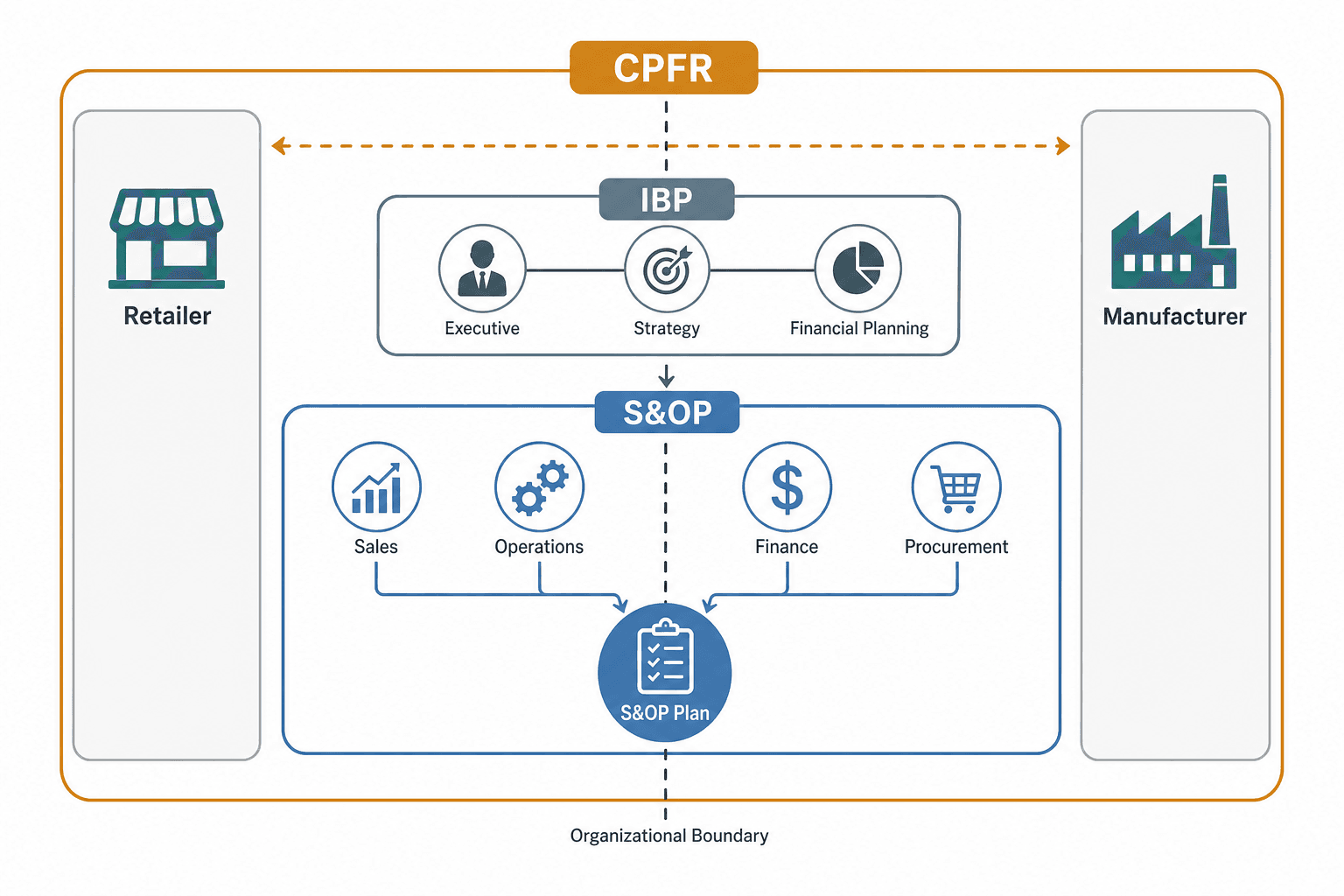
The line that matters most is not between S&OP and IBP — it is between both of those frameworks and CPFR. S&OP and IBP are intra-enterprise processes: they involve internal functions coordinating within a single legal entity to produce a unified plan. CPFR is an inter-enterprise process: it requires two separate legal entities to jointly agree on forecasts, plans, and replenishment actions.
This boundary has direct architectural implications. Internal processes can be governed by a single organization's policies, data systems, and decision rights. Inter-company processes require negotiated agreements, shared data standards, and governance structures that neither party controls unilaterally. Treating CPFR as just another planning process layer inside the enterprise misses this entirely.
How S&OP, IBP, and CPFR Coexist in a Single Enterprise
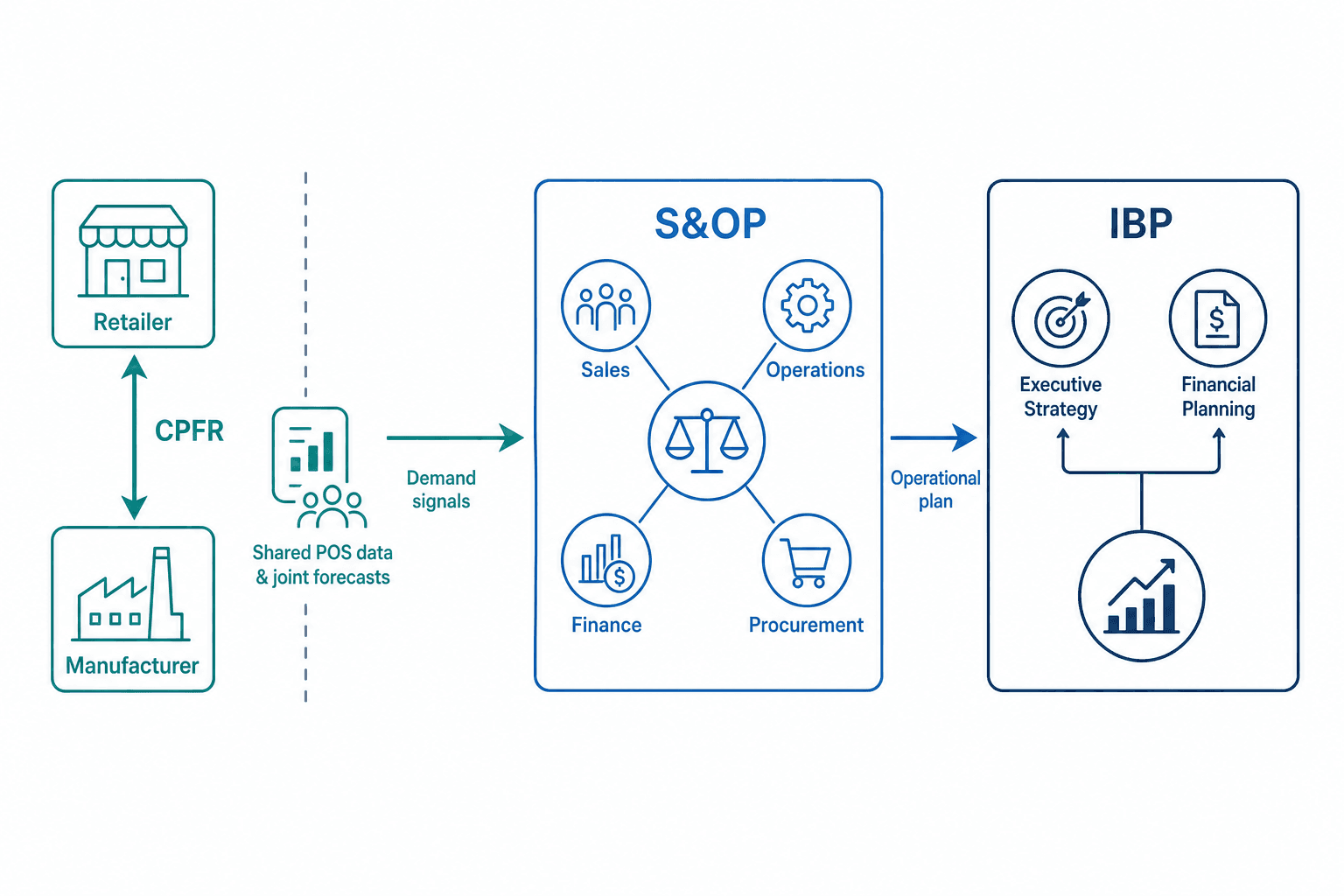
A manufacturer selling through major retail accounts can operate all three frameworks at the same time without conflict — because each operates at a different layer and serves a different purpose.
- CPFR with retail trading partners: The manufacturer and retailer share point-of-sale data, jointly build sales forecasts, resolve exceptions, and generate replenishment orders. This produces external demand signals that reflect actual shelf movement rather than internal order history.
- S&OP internally: The manufacturer's internal functions — sales, operations, finance, procurement — meet monthly to balance production and inventory against the demand plan. The demand signals from CPFR (along with other inputs such as demand sensing and demand forecasting) feed into this process as inputs to the demand planning step.
- IBP at the executive layer: The integrated operational plan produced by S&OP feeds upward into IBP, where it is reconciled with financial plans, strategic initiatives, and long-horizon product portfolio decisions. IBP closes the loop between operational execution and enterprise strategy.
The data flow runs in one direction through this stack: CPFR generates external demand signals → S&OP translates those signals into an integrated operational plan → IBP aligns that plan with financial and strategic commitments. Each layer depends on the one below it, but each operates under a different governance model and serves a different organizational purpose.
For practitioners who want to understand how AI-enhanced demand forecasting methods fit into this stack as S&OP inputs, that topic is covered separately.
Common Misconceptions and Definitional Debates
Misconception 1: IBP and S&OP are synonyms
This is the most widely debated conflation, and the evidence supports treating it as a live controversy rather than a settled question. A 2015 survey found that roughly one-third of practitioners saw no practical difference between the two terms, and one-fifth had no position. Patrick Bower's "marketing hoax" characterization reflects a practitioner view that IBP is S&OP rebranded to justify consulting engagements. The Supply Chain Trend view — that IBP is S&OP evolved, not replaced — is the more charitable framing and is consistent with how many organizations actually operate: they run what they call "IBP" on a monthly cadence that is structurally identical to classical S&OP.
The practical implication: if a job posting or vendor deck uses IBP and S&OP interchangeably, that may be an accurate reflection of how the organization actually operates, not a definitional error. For a full treatment of where the two frameworks genuinely differ and where they converge, see IBP vs S&OP: Definitions, Differences, and How AI Fits Into Each.
Misconception 2: CPFR is an internal planning process
This conflation is less common in practitioner conversation but appears frequently in vendor documentation that lists CPFR alongside S&OP and IBP as if they are parallel alternatives for the same planning layer. They are not. CPFR cannot be implemented unilaterally — it requires a willing trading partner, a front-end agreement, and shared data infrastructure. A company cannot "do CPFR" internally any more than it can negotiate a contract with itself.
Misconception 3: AI planning platforms resolve the S&OP/IBP/CPFR distinction
Modern AI-enabled planning platforms — including the SAP IBP product, o9 Solutions, and Kinaxis — integrate tactical S&OP and strategic IBP capabilities in a single tool, which blurs the process boundary further. A platform named "SAP IBP" does not mean the customer is running IBP rather than S&OP; it means the tool can support either or both, depending on how the organization configures and uses it.
On the CPFR side, the collaborative principles of the nine-step model — shared forecasting, exception management, joint replenishment planning — are increasingly embedded in supply chain control tower platforms and VMI tools rather than implemented as standalone CPFR programs. The label has changed; the inter-company collaboration logic has not. Practitioners evaluating control tower or VMI platforms should recognize that CPFR's external-collaboration intent is often present even when the CPFR trademark is not.
Glossary Quick Reference
| Term | What it is | Organizational scope | Origin / governing body | Primary output |
|---|---|---|---|---|
| S&OP | A monthly, cross-functional internal process that balances demand and supply across an 18-month rolling horizon at product family or SKU level. | Internal — operates within a single legal entity | 1980s; attributed to Richard Ling at Oliver Wight; formally defined by APICS/ASCM | Integrated operational plan aligning production, inventory, and sales commitments |
| IBP | An evolution of S&OP that adds financial planning integration, strategic long-horizon planning, and product portfolio management. Definition remains contested; many organizations use IBP and S&OP interchangeably. | Internal — operates within a single legal entity | Evolved from S&OP; no single governing body; popularized by consulting firms and platform vendors including SAP | Unified strategic, financial, and operational plan reconciled across all business functions |
| CPFR | An external inter-company collaboration standard between a retailer (buyer) and a manufacturer (seller) for jointly managing forecasts, plans, and replenishment. A trademark of GS1 US. | External — crosses the organizational boundary between two separate legal entities | 1995 CFAR initiative (Walmart + Benchmarking Partners); formalized as VICS CPFR Guidelines in 1998; trademark of GS1 US | Joint business plan, shared sales and order forecasts, collaboratively generated replenishment orders |
The three frameworks are not alternatives — they operate at different layers and across different organizational boundaries. A company that runs all three simultaneously is not over-engineering its planning architecture; it is covering the internal operational layer (S&OP), the internal strategic and financial layer (IBP), and the external trading-partner collaboration layer (CPFR) as three distinct but connected processes.