
Canonical Definition
A supply chain control tower AI is a centralized intelligence architecture that aggregates real-time data from across supply chain operations, applies progressively sophisticated analytical and AI techniques to that data, and—at higher maturity levels—executes or recommends decisions autonomously. The term describes a layered capability system, not a single software product.
At its foundation, a control tower consolidates data from internal systems—ERP, WMS, TMS, IoT sensors—and external signals such as carrier data, weather feeds, and macroeconomic indicators into a unified operational view. AI techniques are then applied to that consolidated data to move beyond passive reporting toward anticipation, recommendation, and, at the most advanced deployments, self-directed action.
The term originates from air traffic control, where a centralized command center monitors all aircraft movements, anticipates conflicts, and issues corrective instructions in real time. The supply chain analogy holds at the conceptual level—but the AI-enabled version goes further: rather than a human dispatcher interpreting data and issuing instructions, the AI layer increasingly interprets, recommends, and executes without waiting for a human intermediary.
Why AI Changes the Control Tower Concept
Pre-AI control towers were fundamentally reactive. They aggregated data from connected systems, surfaced exceptions via rule-based alerts, and presented KPI dashboards for human review. A planner would see a shipment delay flagged in red, assess the downstream impact manually, and decide on a corrective action. The system watched; the human acted.
AI fundamentally changes this dynamic at each capability level. The specific shifts are:
- From rule-based alerting to ML-driven anomaly detection: instead of triggering an alert when inventory falls below a fixed threshold, a machine learning model identifies statistically abnormal patterns before they breach thresholds—anticipating the problem rather than flagging it after the fact.
- From historical reporting to forward-looking prediction: ML forecasting models continuously ingest demand signals, supplier lead time variability, and logistics performance data to project future states—enabling planners to act on probable outcomes, not confirmed ones.
- From manual scenario analysis to generative AI simulation: at the prescriptive level, generative AI models can rapidly construct and evaluate multiple what-if scenarios—rerouting a shipment, repositioning inventory, switching a supplier—and surface the recommended action with supporting rationale in natural language.
- From human-initiated action to autonomous execution: at the most advanced deployments, agentic AI systems—networks of specialized AI agents coordinating across procurement, logistics, and inventory functions—execute corrective actions within defined governance guardrails, without waiting for human approval on routine decisions.
The conceptual shift is from a dispatcher watching a board to an active decision partner that anticipates, recommends, and increasingly acts. The degree to which an organization has made that shift determines where it sits on the capability spectrum.
The Four-Level Capability Spectrum
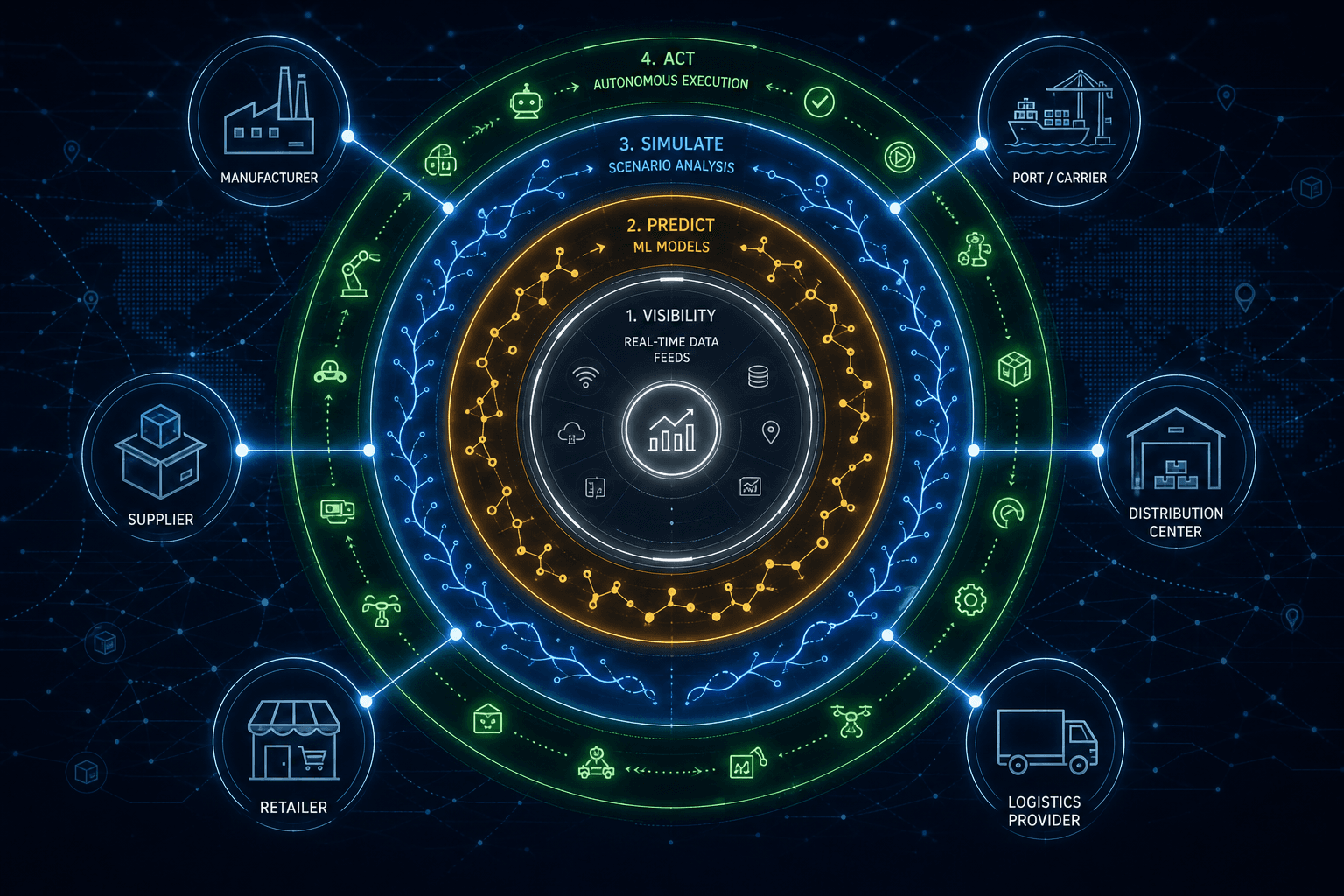
Industry analysis from Logistics Management, Deloitte, Siemens, and ABI Research converges on a four-level maturity framework for supply chain control tower AI. Each level is defined by the AI technique applied and the type of operational value it delivers.
| Level | Label | Primary AI Technique | Operational Output | Typical Human Role |
|---|---|---|---|---|
| 1 | Descriptive | Real-time data aggregation, rule-based alerting | Unified visibility dashboard; threshold-triggered alerts | Reviews alerts, decides on response |
| 2 | Predictive | ML forecasting, statistical anomaly detection | Forward-looking risk flags; demand and supply projections | Reviews predictions, approves action |
| 3 | Prescriptive | Generative AI what-if simulation, NLP exception triage | Ranked recommended actions with rationale; scenario comparisons | Selects from recommended options |
| 4 | Autonomous | Agentic AI multi-agent orchestration, reinforcement learning | Self-executing corrective actions within governance guardrails | Sets policy, reviews exceptions, audits outcomes |
At the descriptive level, the control tower is primarily an integration and visualization layer. Value comes from eliminating data silos—a single operational picture replacing dozens of disconnected system views. Rule-based alerts notify planners when predefined conditions are met.
At the predictive level, ML models continuously ingest and process the aggregated data to project future states. Demand signals—including those produced by demand sensing models (see the demand sensing, forecasting, and demand planning glossary entry)—feed the predictive layer alongside supplier lead time data, logistics performance history, and external risk signals. Anomaly detection flags deviations from expected patterns before they escalate.
At the prescriptive level, generative AI models simulate alternative courses of action and surface recommended responses with supporting rationale. Natural language interfaces allow planners to query the system conversationally—asking, for example, what the cost and service impact would be of rerouting a shipment via an alternative carrier. The system generates and ranks options; the human selects.
At the autonomous level, agentic AI systems—networks of specialized agents coordinating across functions—execute decisions within defined governance boundaries. Inventory rebalancing, carrier substitution, and supplier order adjustments can be initiated and completed without human approval on each transaction. Reinforcement learning techniques underpin the most advanced autonomous replenishment and inventory positioning workflows (see the reinforcement learning for supply chain replenishment optimization glossary entry for the underlying methodology).
Core Technical Architecture
A supply chain control tower AI is not a single application but a stack of interconnected capabilities. The architecture typically comprises five functional layers:
- Data ingestion layer: Connects to internal operational systems (ERP, WMS, TMS, manufacturing execution systems, IoT sensors) and external data sources (carrier APIs, weather services, port status feeds, macroeconomic indicators, supplier risk databases). The quality and breadth of this layer directly determines the ceiling of every capability above it.
- Analytics layer: Applies descriptive and diagnostic models to the ingested data—aggregating, cleansing, and structuring it into a unified operational picture. This is the layer most organizations have partially implemented; it produces the dashboards and alerts characteristic of the descriptive maturity level.
- ML stack: Continuously refined machine learning models for demand forecasting, supply variability prediction, lead time modeling, and anomaly detection. Graph neural network models at this layer can map the supply network as a connected graph and predict how a disruption at one node propagates to others—see the graph neural networks for supply chain disruption prediction glossary entry for the methodology. Cognitive control towers at this level can process more than 200 external data signals, including vessel positioning, carrier schedule changes, and macroeconomic indicators.
- GenAI and NLP layer: Generative AI models that produce scenario simulations, natural-language exception summaries, and ranked recommended actions. This layer is distinct from the ML stack: ML refines forecasts and detects anomalies; generative AI generates scenario outputs and human-readable rationale. NLP interfaces allow planners to interact with the system through conversational queries rather than structured report navigation.
- Agentic AI orchestration layer: Multi-agent systems in which specialized AI agents—each responsible for a defined decision domain such as carrier selection, inventory positioning, or purchase order adjustment—coordinate to execute multi-step workflows. This layer operates within governance guardrails that define which decisions can be executed autonomously and which require human approval.
Distinction from Adjacent Terms
Four terms are consistently conflated with supply chain control tower AI in vendor materials and analyst reports. Each represents a distinct concept with a different architectural role.
| Term | Primary Function | Prescriptive Layer? | Real-Time Execution? | Scope |
|---|---|---|---|---|
| Supply Chain Control Tower AI | Centralized intelligence and decision orchestration across supply chain operations | Yes (at Level 3–4) | Yes | Cross-functional: procurement, inventory, logistics, fulfillment |
| Supply Chain Visibility Platform | Transportation and shipment tracking; carrier data aggregation | No | Tracking only | Primarily logistics and transportation |
| Digital Twin | Computational simulation and modeling of supply network state | Simulation only | No (models scenarios, does not execute) | Network modeling and scenario analysis |
| TMS / WMS | Functional execution systems for transportation or warehouse operations | No | Within function only | Single-function operational execution |
| S&OP / IBP System | Structured planning cadence: demand, supply, and financial reconciliation | No | No (periodic planning cycles) | Strategic and tactical planning horizon |
The distinction between a control tower and a digital twin deserves particular precision. A digital twin creates a computational model of the supply network—simulating how the network would behave under different conditions, such as a port closure or a demand spike. It is a modeling and scenario-analysis tool. A supply chain control tower AI, by contrast, orchestrates real-time decision execution across live operations—it acts on the network, not merely models it. The two are complementary: digital twin outputs can feed control tower prescriptive scenarios. For a full treatment of digital twin methodology and applications, see the Digital Twin Supply Chain: Definition and Operational Applications glossary entry. For the planning-layer intersection between digital twins, S&OP, and control tower orchestration, see Connecting Factory Digital Twins to S&OP.
Control Tower Typology
Control tower deployments are not monolithic. Organizations typically begin with a narrowly scoped implementation focused on one operational domain, then expand scope as data integration and governance mature. Five documented types exist, organized by operational scope:
- Logistics and Transportation: Focused on advance shipping notifications, carrier tracking, in-transit visibility, and exception management for shipments in motion. This is the most common starting point for organizations new to control tower implementations.
- Fulfillment: Covers package shipments, order status, cost-to-serve analysis, and last-mile performance. Typically deployed in retail and e-commerce contexts where customer-facing delivery commitments require granular visibility.
- Inventory: Focused on stock-out prevention, safety stock optimization, and inventory positioning across distribution networks. At higher maturity levels, this type incorporates ML-driven replenishment recommendations and autonomous reorder execution.
- Supply Assurance: Monitors supply availability across the supplier base, tracking supplier risk indicators, component availability, and lead time variability. Particularly relevant for industries with complex multi-tier supplier networks, such as automotive and electronics.
- End-to-End (E2E): Provides cross-system and cross-department visibility spanning procurement, manufacturing, logistics, and fulfillment. This is the most architecturally complex type and typically the last stage of a phased implementation roadmap.
Most production deployments begin with the logistics or inventory type before expanding toward E2E scope. Organizations that attempt E2E scope at the outset without resolving data integration and governance prerequisites are among the most common sources of the 'enhanced KPI dashboard' failure mode described in the implementation section below.
Adoption Reality: Where Most Organizations Stand
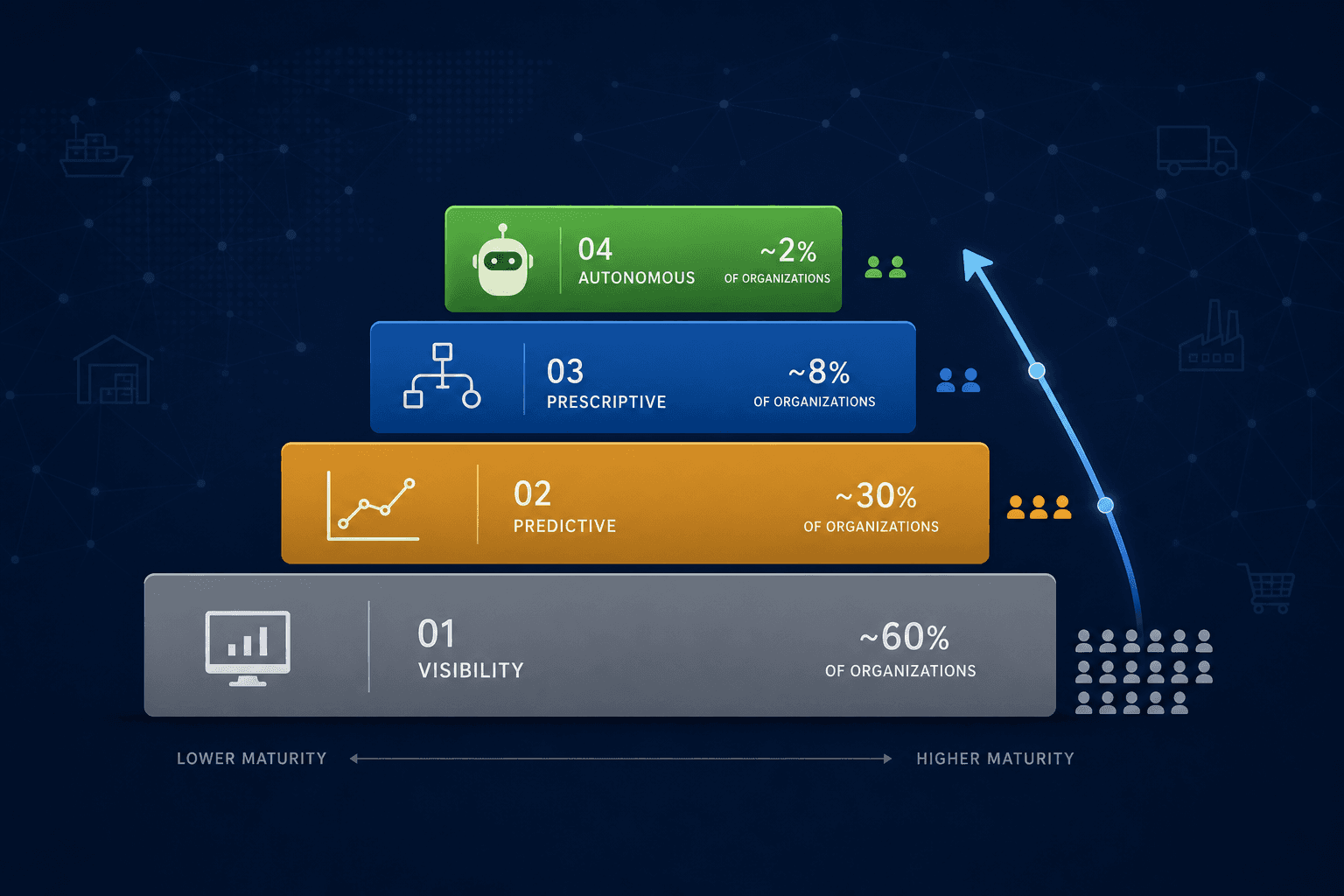
The gap between the capability spectrum described above and the operational reality of most deployments is significant. Industry benchmark data from late 2025 and early 2026 paints a consistent picture of organizations concentrated at the lower maturity levels despite years of investment.
80% of organizations still lack fully implemented visibility platforms. 70% can collect data in near real-time, but only 40% can perform predictive or prescriptive analytics.
These figures, from ABI Research analysis published by Siemens Digital Logistics in December 2025, indicate that the majority of organizations have not yet fully implemented even the descriptive level of control tower capability. The 60% that have not implemented digital twins reflects a separate but related data point: the simulation and modeling infrastructure that feeds prescriptive scenarios remains underdeveloped at most organizations.
| Benchmark | Figure | Source | Date |
|---|---|---|---|
| Organizations lacking fully implemented visibility platforms | 80% | ABI Research via Siemens Digital Logistics | December 2025 |
| Organizations collecting near-real-time data | 70% | ABI Research via Siemens Digital Logistics | December 2025 |
| Organizations capable of predictive or prescriptive analytics | 40% | ABI Research via Siemens Digital Logistics | December 2025 |
| AI use cases remaining in pilot mode (not in production) | ~90% | SAP / McKinsey / WEF | June 2026 |
| Enterprise adoption of agentic AI in SCM software (2025) | ~5% | Gartner | April 2026 |
| Enterprise adoption of agentic AI in SCM software (2030 forecast) | ~60% | Gartner | April 2026 |
| SCM software with agentic AI: market size 2025 | <$2 billion | Gartner | April 2026 |
| SCM software with agentic AI: market size 2030 forecast | $53 billion | Gartner | April 2026 |
The forward-looking picture is substantially different. Gartner's April 2026 forecast projects SCM software with agentic AI capabilities growing from under $2 billion in 2025 to $53 billion by 2030, with enterprise adoption rising from 5% to 60% over the same period. Gartner notes that enterprise deployment will lag software availability due to gaps in data management maturity, workforce AI-readiness, and the network-centricity required for cross-functional orchestration.
Leading implementations that have reached the prescriptive or autonomous level demonstrate measurable operational results. McKinsey and World Economic Forum research cited by SAP indicates agentic AI implementations have reduced inventory by 20–30% and logistics costs by 5–20% in advanced deployments. One automotive electronics firm, after centralizing ordering orchestration across approximately 30 plants, cut disruption response times by roughly 95%.
Representative Vendor Positioning by Capability Tier
Vendor platforms cluster across the four capability tiers based on their core architectural investments. The following characterizations are illustrative of how the market is organized—not an evaluation ranking or implementation recommendation.
Descriptive-tier platforms emphasize data connectivity and integration breadth—the number of ERP, TMS, WMS, and carrier systems they can ingest from, the quality of their real-time event processing, and the configurability of their alerting rules. These platforms deliver value primarily through data consolidation.
Predictive-tier platforms layer ML forecasting and anomaly detection on top of the visibility foundation. Differentiation at this level comes from the quality of the underlying models, the range of external signals ingested, and the accuracy of disruption prediction across multi-tier supplier networks.
Prescriptive-tier platforms incorporate generative AI for scenario simulation and natural-language exception triage. Vendors at this level are investing heavily in LLM integration and what-if modeling capabilities that allow planners to evaluate trade-offs without building manual models.
Autonomous-tier platforms—the smallest and most nascent category—incorporate agentic AI orchestration frameworks. A small number of agricultural and manufacturing firms have deployed more than 1,000 AI agents for coordinated orchestration, scenario planning, and value chain visibility, though most are still defining governance boundaries for autonomous execution.
Implementation Prerequisites and Common Failure Modes
The gap between the capability spectrum and the adoption reality described above has a documented cause. Analysis across multiple sources identifies a consistent failure pattern: organizations invest in control tower initiatives and end up with enhanced KPI dashboards—more connected, more real-time, but still reactive and still requiring human interpretation at every decision point.
The prerequisites for moving beyond this failure mode are:
- Data quality and integration completeness: The ML and generative AI layers can only produce reliable outputs if the data ingestion layer is comprehensive and clean. Partial ERP integration, missing TMS data, or inconsistent IoT feeds create blind spots that degrade model accuracy and erode planner trust in system outputs.
- Cross-functional governance: Control towers that are owned by a single function—typically logistics or IT—without cross-functional buy-in from procurement, inventory planning, and commercial teams cannot achieve prescriptive or autonomous capability. Decisions at higher maturity levels cross functional boundaries; governance must match.
- Incremental scope expansion: Organizations that attempt end-to-end scope at the outset before resolving data integration and governance prerequisites consistently encounter the dashboard failure mode. Starting with logistics or inventory scope, demonstrating value, and expanding scope progressively is the documented path to higher maturity.
- Change management investment: Planners and operations managers must understand what the system is doing and why, and must trust its outputs enough to act on recommendations or accept autonomous actions. Explainability—the system's ability to communicate its reasoning in terms practitioners understand—is a prerequisite for trust, and trust is a prerequisite for moving beyond Level 1.
- Strategic program framing: Treating a control tower initiative as an IT infrastructure project rather than a strategic operational transformation program is a documented root cause of scope failure. IT delivers the integration layer; the operational value requires supply chain leadership ownership.
The path to autonomy is incremental by design. As described in SAP's June 2026 analysis of leading deployments, organizations first use the control tower to augment human decision-making—surfacing better information faster. They then automate routine and semi-structured decisions as governance frameworks, data maturity, and organizational trust develop. Full autonomous execution for complex, high-stakes decisions remains the final stage, not the starting point.
Related Terms
- Digital Twin Supply Chain — Computational simulation and modeling of supply network state. Architecturally distinct from a control tower: digital twins simulate; control towers orchestrate real-time execution. Domain: Supply Chain Planning / AI/ML Methodology. Maturity: Established.
- Demand Sensing, Demand Forecasting, and Demand Planning — The hierarchy of demand signal generation and planning processes. Demand sensing outputs serve as inputs to the control tower's predictive analytics layer. Domain: Demand Planning. Maturity: Established (forecasting), Emerging (demand sensing with ML).
- Reinforcement Learning for Supply Chain Replenishment Optimization — The AI methodology underlying autonomous inventory rebalancing and self-healing replenishment workflows at the control tower's autonomous capability level. Domain: AI/ML Methodology / Inventory Management. Maturity: Emerging.
- Graph Neural Networks for Supply Chain Disruption Prediction — ML models that represent the supply network as a connected graph to predict how disruptions propagate across nodes. Relevant to the predictive and prescriptive layers of the control tower ML stack. Domain: AI/ML Methodology / Supply Chain Risk. Maturity: Emerging.
- Connecting Factory Digital Twins to S&OP — Analysis of the planning-layer intersection between digital twins, S&OP processes, and control tower orchestration in manufacturing contexts. Domain: Planning Frameworks / Editorial. Related terms: digital twin, S&OP, IBP.