
The Ambition-Execution Gap in AI Demand Planning
The gap between intent and outcome in AI demand planning is not a technology problem. It is a readiness problem — and the data makes that distinction hard to ignore.
According to PwC's 2026 Digital Trends in Operations survey of 767 operations and supply chain leaders, 89% say their technology investments have not fully delivered expected results. The leading culprit: 87% cite poor data quality as a direct barrier to achieving value from digital initiatives. Only 27% have fully embedded an AI strategy across business units. Among those who do report success, 63% attribute it to significant improvement in data quality — the clearest signal that readiness, not platform selection, drives outcomes.
The ambition side of this gap is equally stark. 94% of supply chain companies plan to use AI or generative AI for decision support within two years (ABI Research, 2025). Yet only 23% of supply chain organizations — including those already deploying AI — have a formal AI strategy (Gartner, 2025). Only 29% have built the capabilities needed for future readiness.
This assessment framework is built on a single premise: the organizations that achieve durable AI demand planning ROI are not the ones that selected the best platform. They are the ones that entered vendor engagement with clean data, stable systems, mature planning processes, prepared teams, and defined success metrics. This checklist is designed to help you determine whether you are in that group — and if not, what to fix first.
Why Generic AI Readiness Checklists Fall Short for Demand Planning
Enterprise AI readiness frameworks — such as the 11-step Lumenalta model covering technology infrastructure, security audits, governance standards, and cross-functional task forces — address the general organizational prerequisites for AI adoption. They are useful starting points but insufficient for demand planning specifically.
Demand planning imposes requirements that no generic framework addresses. A security audit will not tell you whether your transactional data distinguishes zero-sales periods caused by stockouts from periods of genuinely zero demand. A cross-functional task force charter will not reveal whether your S&OP cycle is mature enough to incorporate AI-generated consensus forecasts. A pilot project framework will not surface whether your ERP master data is stable enough to avoid model drift after go-live.
| Generic AI Readiness Item | Why It Is Insufficient for Demand Planning | What Demand Planning Requires Instead |
|---|---|---|
| Evaluate data readiness | Treats data as a binary yes/no question | Minimum 24–36 months of granular, stockout-flagged transactional history by SKU, location, channel, and date |
| Technology infrastructure assessment | Covers cloud and compute readiness generically | ERP stability and adoption maturity as a prerequisite; API read/write capability for inventory and replenishment |
| Build a cross-functional task force | Organizational alignment without process specificity | S&OP cycle maturity: defined planning horizon, cycle frequency, cross-functional consensus workflow |
| Develop a pilot project | Scope and success criteria left undefined | Baseline MAPE and forecast bias measurement before go-live; agreed KPI targets with ownership |
| Plan change management | General awareness and training framing | Override and feedback loop workflow design; planner skill readiness in statistics and AI-augmented workflows |
The five dimensions in this assessment replace those generic items with demand-planning-specific criteria. Each dimension has checklist items, a scoring rubric, and a readiness threshold.
How to Use This Assessment: Scoring Model and Maturity Stages
Before working through the five dimensions, understand how to score and interpret results. Each checklist item is rated on a three-point scale: 0 (not in place), 1 (partially in place or inconsistently applied), 2 (fully in place and consistently applied). Dimension scores are summed and mapped to a maturity level. An overall readiness classification is derived from the lowest-scoring dimension — because AI demand planning readiness is limited by its weakest prerequisite, not its average.
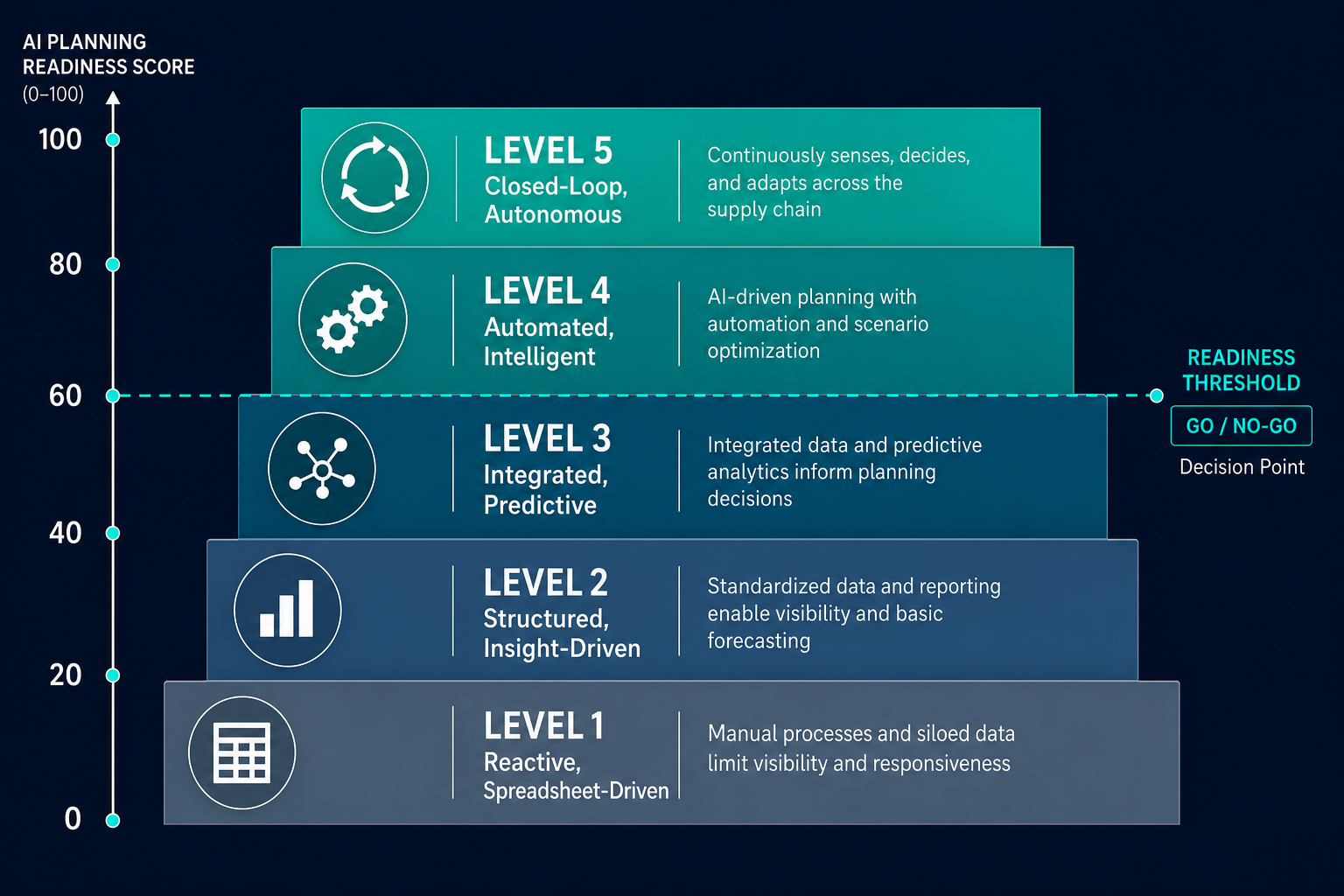
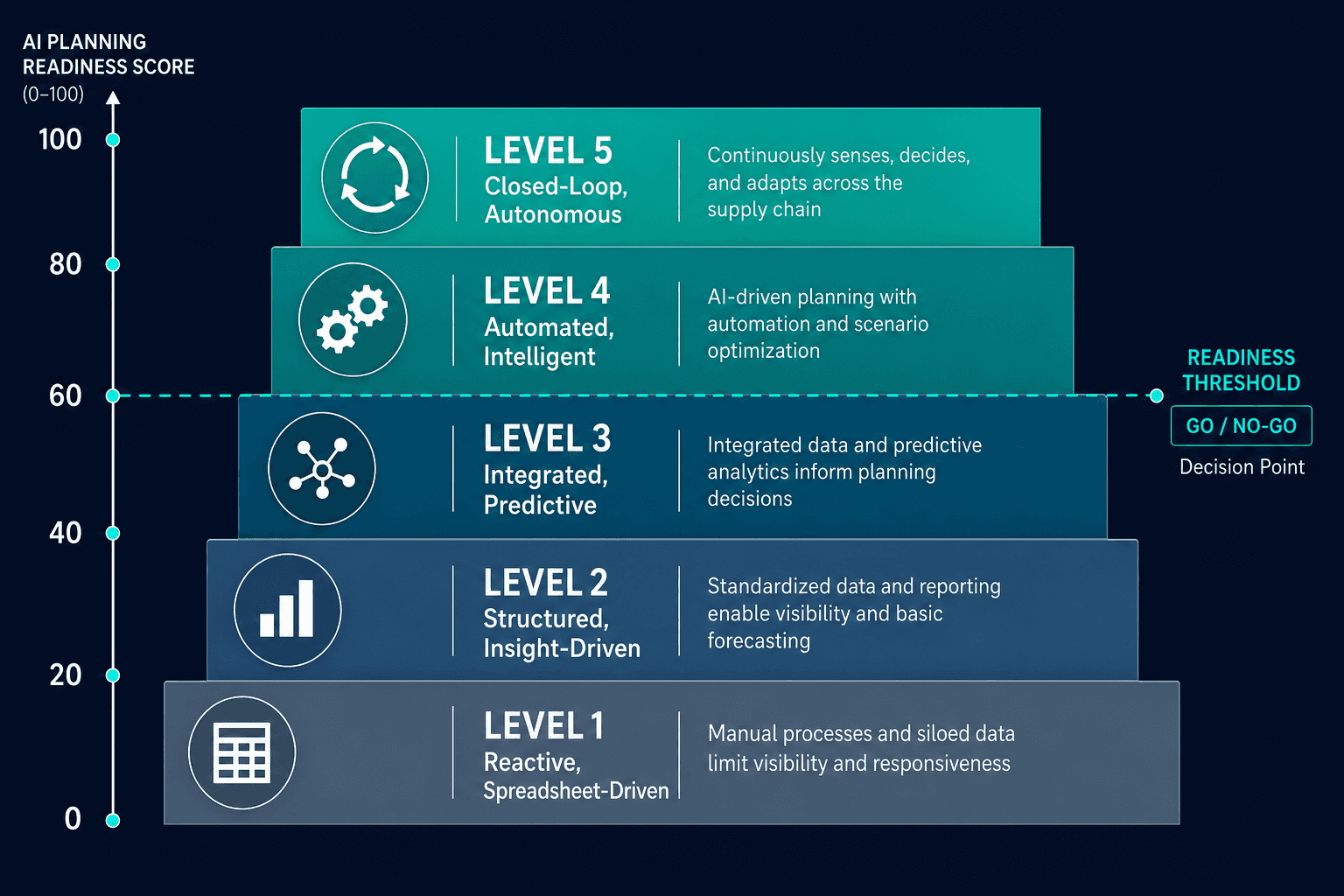
The maturity model used here draws on the five-level framework described in the Umbrex AI-Driven Planning Maturity Model, adapted for pre-implementation assessment purposes:
| Level | Label | Characteristics | AI Implementation Readiness |
|---|---|---|---|
| 1 | Reactive / Spreadsheet-Driven | Siloed data, deterministic single-number forecasts, rule-of-thumb inventory decisions, no defined S&OP cadence | Not ready. Foundational data and process work required before vendor engagement. |
| 2 | Digitized Baselines | Consolidated demand history, statistical forecasting at scale, defined S&OP cadence, ERP in place but inconsistently adopted | Partially ready. Data and ERP gaps must be addressed; process and organizational work can begin in parallel. |
| 3 | Advanced Analytics and Probabilistic Planning | Probabilistic forecasts for key segments, causal drivers incorporated, formalized short-cycle planning, cross-functional S&OP | Minimum threshold for AI implementation readiness. Vendor engagement can begin with clear gap remediation plan. |
| 4 | Integrated AI and Optimization | Ensembled models with automated monitoring, constraint-aware optimization, tight S&OP/IBP linkage, override workflows defined | Ready. Full vendor evaluation and pilot design appropriate. |
| 5 | Closed-Loop / Autonomous-with-Guardrails | Self-tuning models, autonomous execution for routine decisions, responsible AI controls, continuous feedback loops | Advanced. Focus shifts to governance, model drift monitoring, and optimization. |
Dimension 1: Data Readiness
Data readiness is the highest-leverage dimension in this assessment. 87% of operations leaders in PwC's 2026 survey cite poor data quality as a direct barrier to digital value. No AI model compensates for incomplete, ungranular, or mislabeled demand history. The checklist items below represent the minimum data prerequisites for reliable AI demand planning output.
Transactional History Depth and Granularity
- Minimum 24 months of transaction-level sales data is available. 36 months or more is strongly preferred for any SKU with seasonal demand patterns. Models trained on less than two years of history cannot reliably detect annual seasonality cycles.
- Data is available at SKU, customer or channel, location, and date granularity. Aggregated weekly or monthly data at the product-family level is insufficient for AI models that need to distinguish demand patterns at the stocking unit level.
- Stockout periods are explicitly flagged in the data. This is the most frequently overlooked data requirement. Zero sales during a stockout period represents unmet demand, not zero demand. An AI model that treats stockout zeros as true demand zeros will systematically underforecast recovery periods and perpetuate the stockout cycle.
- Returns and cancellations are tracked separately from gross sales. Netting returns against sales in the demand signal inflates apparent demand variability and distorts the model's understanding of true consumption patterns.
- Promotional calendar and event history is documented and linked to the demand record. Price promotions, trade events, and marketing campaigns create demand spikes that models will misinterpret as baseline trend shifts unless the causal event is labeled in the training data.
Data Infrastructure and Governance
- A data warehouse or data lake consolidates demand history, inventory records, and master data in a single accessible environment. AI demand planning platforms require a reliable, queryable data layer. Extracting training data from multiple disconnected ERP modules or flat-file exports is not a sustainable foundation.
- Master data — SKU attributes, location hierarchies, customer segmentation — is clean, deduplicated, and consistently maintained. Inconsistent product codes, merged SKUs, or location mismatches in master data propagate directly into model error.
- External demand signal data is identified and accessible. Macroeconomic indicators, point-of-sale data, weather data, or syndicated market data relevant to your demand drivers should be identified and their data feeds evaluated before vendor selection, not after.
- Data quality monitoring processes exist and produce documented quality metrics. If your organization cannot currently measure data completeness, latency, and accuracy against defined thresholds, you do not yet have the governance foundation to maintain AI model input quality over time.
| Data Readiness Item | Score 0 | Score 1 | Score 2 |
|---|---|---|---|
| Transaction history depth | Less than 18 months available | 18–24 months available, some gaps | 24+ months clean (36+ for seasonal SKUs) |
| SKU/location/channel granularity | Product family or aggregate only | SKU-level but missing location or channel | Full SKU × location × channel × date granularity |
| Stockout period flagging | No flagging; zeros not distinguished | Some flagging; inconsistent coverage | All stockout periods flagged in demand record |
| Returns and cancellations tracking | Netted against sales | Tracked separately but not consistently | Tracked separately, consistently, and accessible |
| Promotional calendar documentation | Not documented or not linked to demand data | Documented but not linked to demand record | Documented and linked to demand record by SKU and date |
| Data warehouse / data lake | No consolidated data layer | Partial consolidation; manual extracts required | Unified data layer with automated refresh |
| Master data quality | Significant duplication and inconsistency | Mostly clean with known exceptions | Clean, deduplicated, consistently maintained |
| External signal availability | Not identified | Identified but not yet accessible | Identified, accessible, and feed-ready |
Dimension 2: Technology and ERP Integration Readiness
An AI demand planning layer sits on top of your existing technology stack. If that stack is unstable, poorly adopted, or architecturally disconnected, the AI layer will inherit and amplify those problems. As the ToolsGroup vendor evaluation framework notes, integration is "often underestimated during vendor evaluation, yet heavily influences long-term success." ERP stability, in particular, must be assessed before adding any AI planning layer on top of it.
ERP Stability and Adoption
- The ERP system is stable and consistently adopted across the planning organization. An ERP that is mid-migration, inconsistently used, or maintained with significant customization debt is not a stable foundation for AI model training. Unstable master data produces model drift and erratic forecast overrides that planners will correctly distrust.
- No major ERP upgrade, migration, or re-implementation is planned within 18 months of the AI go-live target. ERP transitions invalidate training data continuity and integration architecture simultaneously. Attempting an AI demand planning implementation concurrent with an ERP migration is a documented failure pattern.
- The ERP has API capabilities for reading inventory positions and writing replenishment suggestions. Batch file exports are an acceptable interim state, but the absence of API connectivity significantly limits real-time planning responsiveness and increases integration maintenance burden.
Data Pipeline and Infrastructure
- ETL pipelines for regular data refresh are automated and monitored. Manual data extraction processes introduce latency and error. AI models require consistent, timely data feeds to maintain forecast accuracy. Assess whether your current pipelines can support the refresh cadence the AI platform requires — typically daily or near-real-time.
- Cloud infrastructure is available and approved for the AI planning workload. Most enterprise AI demand planning platforms are cloud-native SaaS. If your IT policy requires on-premise deployment or has significant cloud approval lead times, factor that into your readiness timeline.
- Data governance policies define ownership, access controls, and quality standards for planning data. Without documented governance, data quality degradation after go-live is predictable. Platforms should provide transparency around data sources and timing — but the governance framework that enforces quality upstream must exist within your organization.
- Integration architecture with WMS and TMS systems is documented where relevant. For organizations where inventory positioning and transportation constraints directly affect demand fulfillment, these integrations are planning inputs, not optional enhancements.
| Technology Readiness Item | Score 0 | Score 1 | Score 2 |
|---|---|---|---|
| ERP stability and adoption | ERP in migration or inconsistently adopted | ERP stable but with significant customization debt or partial adoption | ERP stable, consistently adopted, no major changes planned |
| ERP API capability | No API; batch file exports only | API available but limited or poorly documented | Full read/write API for inventory and order data |
| ETL pipeline automation | Manual extracts; no automated pipelines | Some automation; significant manual steps remain | Fully automated, monitored pipelines with alerting |
| Cloud infrastructure readiness | No cloud infrastructure; on-premise only | Cloud available but approval process lengthy | Cloud infrastructure approved and available for AI workloads |
| Data governance policies | No formal governance | Governance documented but not consistently enforced | Governance policies defined, enforced, and audited |
| WMS/TMS integration documentation | Not documented | Partially documented | Fully documented with data flow diagrams |
Dimension 3: S&OP and Process Maturity
AI demand planning does not fix a broken S&OP process. It amplifies whatever process it is layered on top of. Panorama Consulting's analysis of demand planning failures identifies disconnected planning — where sales forecasts aggressively, operations builds conservatively, and finance aligns to neither — as a root cause that technology cannot resolve. Before an AI layer can generate value, the planning process it serves must be functional.
Planning Structure and Cycle Mechanics
- A defined planning horizon is established and consistently applied. AI models require a specified horizon for forecast generation. If your organization does not currently plan to a consistent horizon — or if different functions use different horizons — the AI output will not map to any operational decision.
- Forecast review cycles occur at a defined, regular cadence. Monthly S&OP is the minimum. For high-velocity or high-volatility categories, weekly demand review cycles are required to capture the short-cycle planning signals that AI models can generate.
- Forecast granularity is defined and matches the operational decision it informs. A forecast at the product-family level cannot drive SKU-level replenishment decisions. Confirm that the planning granularity your process currently operates at is the granularity at which AI output will be consumed.
- A documented statistical baseline forecast process exists, even if it is spreadsheet-based. Organizations that currently have no systematic forecasting process — relying entirely on planner judgment or sales-team inputs — face a steeper process change management challenge when introducing AI. The absence of a current baseline also makes it impossible to measure improvement after go-live.
Cross-Functional Collaboration and Forecast Ownership
- A structured consensus process exists across Sales, Marketing, Finance, and Supply Chain. AI-generated forecasts require human consensus review to incorporate market intelligence that models cannot capture. Without a functioning cross-functional review process, AI forecasts will be overridden arbitrarily or ignored entirely.
- Forecast ownership is clearly assigned — one function is accountable for the consensus number. Misaligned incentives — sales inflating forecasts, operations sandbagging, finance applying top-down adjustments — are a documented failure driver. If no single function owns the forecast, accountability gaps will persist regardless of the AI platform deployed.
- Override decisions are documented with rationale. Undocumented overrides prevent model improvement and create accountability gaps. A functioning override workflow is both a process maturity indicator and a prerequisite for AI model retraining.
| S&OP Maturity Item | Score 0 | Score 1 | Score 2 |
|---|---|---|---|
| Planning horizon definition | No consistent horizon defined | Horizon defined but inconsistently applied across functions | Consistent horizon applied across all functions |
| Forecast review cadence | Ad hoc or annual only | Monthly S&OP but no short-cycle demand review | Monthly S&OP plus weekly demand review for high-velocity categories |
| Forecast granularity alignment | Family or aggregate level only | SKU level but not aligned to replenishment decisions | SKU × location granularity aligned to operational decisions |
| Statistical baseline process | None; judgment-only forecasting | Informal statistical methods; spreadsheet-based | Documented statistical baseline process with defined methodology |
| Cross-functional consensus process | No structured consensus; each function forecasts independently | Consensus meeting exists but participation is inconsistent | Structured consensus process with defined inputs from all functions |
| Forecast ownership accountability | No single owner; contested across functions | Ownership nominally assigned but not enforced | Clear ownership with defined accountability and escalation path |
| Override documentation | Overrides made without documentation | Some documentation; inconsistent | All overrides documented with rationale and tracked |
Dimension 4: Organizational and Change Management Readiness
The organizational dimension is consistently underweighted relative to technical investment in AI demand planning implementations. Panorama Consulting's research finds that even the most advanced demand planning systems underperform when users do not trust them — and planners revert to spreadsheets without structured training. The technology is only as effective as the organization using it.
Executive Sponsorship and Budget Authority
- A named executive sponsor with budget authority is identified and actively engaged. Sponsorship at the VP or C-suite level is required to resolve cross-functional conflicts, maintain investment through the 2–4 year ROI horizon, and signal organizational priority to the planning team.
- Budget is allocated not just for platform licensing but for implementation services, data preparation, and training. Platform license cost is frequently the smallest line item in a successful AI demand planning implementation. Data preparation, integration work, and change management typically exceed it.
Demand Planner Skill Readiness and Training
- Demand planners have baseline statistical literacy — understanding of MAPE, forecast bias, and variance. Planners who cannot interpret forecast error metrics cannot evaluate AI output quality, provide meaningful overrides, or identify model degradation. This is a prerequisite for productive human-in-the-loop operation.
- A structured training and upskilling plan for AI-augmented workflows is defined before go-live. Training delivered only at go-live is insufficient. Planners need time to develop confidence in AI-generated forecasts before they are expected to act on them in production. Plan for a training period that begins during the pilot phase.
- Internal AI champions are identified within the planning team. Peer advocates who understand both the planning function and the AI tool accelerate adoption more effectively than top-down mandates. Identify these individuals early and involve them in the implementation design.
Override Workflow and Feedback Loop Design
The override workflow is where human judgment and AI output interact. A well-designed override process captures planner corrections, documents rationale, and feeds that signal back into model retraining. A poorly designed override process — or the absence of one — produces undocumented adjustments that degrade model quality over time and create accountability gaps.
- An override workflow is designed before go-live, specifying who can override, at what level, and with what documentation requirement.
- Override data feeds back into model retraining on a defined schedule. A model that cannot learn from planner corrections will not improve. Confirm that the platform supports feedback loop integration and that the operational process to execute it is defined.
- Incentive alignment across Sales, Operations, and Finance is assessed and addressed where misaligned. If sales teams are compensated on quota attainment with no accountability for forecast accuracy, they will continue to inflate forecasts regardless of AI output. Incentive misalignment is a process and HR problem that technology cannot solve.
| Organizational Readiness Item | Score 0 | Score 1 | Score 2 |
|---|---|---|---|
| Executive sponsorship | No named sponsor; initiative is IT-led only | Sponsor identified but limited budget authority | Named executive sponsor with budget authority and active engagement |
| Implementation budget scope | Platform license only; no budget for data prep or training | Budget includes implementation services but not training | Budget covers platform, data preparation, integration, and training |
| Planner statistical literacy | No baseline statistical understanding | Some planners understand MAPE; inconsistent across team | Team-wide baseline in forecast error metrics and AI-augmented workflows |
| Training plan | No training plan defined | Training planned for go-live only | Structured training program beginning in pilot phase |
| Internal AI champions | None identified | Informal advocates exist but not formally engaged | Named champions involved in implementation design |
| Override workflow design | No override process defined | Override process exists but undocumented | Override workflow documented with rationale requirement and feedback loop |
| Incentive alignment assessment | Not assessed | Assessed but no remediation plan | Assessed and misalignments addressed with HR and finance stakeholders |
Dimension 5: Business Case and Success Metric Definition
Pre-implementation decisions compound over the ROI horizon. Deloitte research cited by Open Sky Group shows that only 6% of organizations see AI ROI in under one year; most achieve satisfactory returns within 2–4 years. The baseline you establish before go-live, the KPIs you define before vendor selection, and the financial model you build before committing budget are the reference points against which that 2–4 year ROI will be measured. If those foundations are weak, the initiative will be difficult to defend at the 18-month review.
Baseline Measurement and KPI Definition
- Current forecast accuracy is measured and documented before go-live. MAPE (Mean Absolute Percentage Error) and forecast bias are the standard baseline metrics. If your organization cannot currently produce these figures, you have no reference point for measuring AI improvement — and no credible basis for an ROI business case.
- Baseline inventory levels, service levels, and planner time allocation are documented. AI demand planning ROI is typically realized across three vectors: inventory reduction, service level improvement, and planner productivity. Establish current-state baselines for all three before go-live.
- KPI targets are agreed across functions and assigned to named owners before vendor engagement. KPIs defined after vendor selection tend to be shaped by vendor-provided benchmarks rather than organizational priorities. Define your own targets first.
Financial Impact Modeling and ROI Timeline
- A financial impact model ties forecast accuracy improvement to inventory reduction and working capital release. This model does not need to be precise, but it must be defensible. A 5-point MAPE improvement should map to a specific inventory day reduction, which maps to a specific working capital figure, which maps to a cost-of-capital savings. Build this chain before committing to a platform.
- The ROI timeline expectation is set at 2–4 years, not 12 months. Unrealistic ROI timelines — driven by vendor sales cycles or executive impatience — are a documented cause of premature initiative cancellation. Set the expectation correctly in the business case, before stakeholder commitments are made.
- Total cost of ownership includes ongoing model retraining, data maintenance, and change management costs. AI demand planning is not a one-time implementation. Models require periodic retraining, data pipelines require maintenance, and planners require ongoing upskilling as the system evolves. These costs must appear in the business case.
- A governance process for reviewing model performance against KPIs is defined before go-live. Without a scheduled review cadence and defined performance thresholds, model degradation goes undetected until it produces visible operational failures.
| Business Case Item | Score 0 | Score 1 | Score 2 |
|---|---|---|---|
| Baseline forecast accuracy measurement | MAPE and bias not currently measured | Measured informally or inconsistently | MAPE and forecast bias measured, documented, and available by segment |
| Inventory and service level baselines | Not documented | Partially documented | Fully documented current-state inventory levels, service levels, and planner time allocation |
| KPI targets and ownership | Not defined | Defined but not assigned to owners | Defined, assigned to named owners, and agreed across functions before vendor engagement |
| Financial impact model | No financial model | Qualitative ROI narrative only | Quantified model linking forecast accuracy improvement to inventory reduction and working capital |
| ROI timeline expectation | Expectation set at under 12 months | Expectation set at 12–18 months | Expectation set at 2–4 years with milestone checkpoints |
| Total cost of ownership scope | Platform license only | Implementation costs included; ongoing costs not modeled | Full TCO including platform, implementation, retraining, maintenance, and change management |
| Model performance governance | No review process defined | Ad hoc review planned | Scheduled review cadence with defined performance thresholds and escalation path |
Readiness Scoring Summary and Maturity Stage Classification
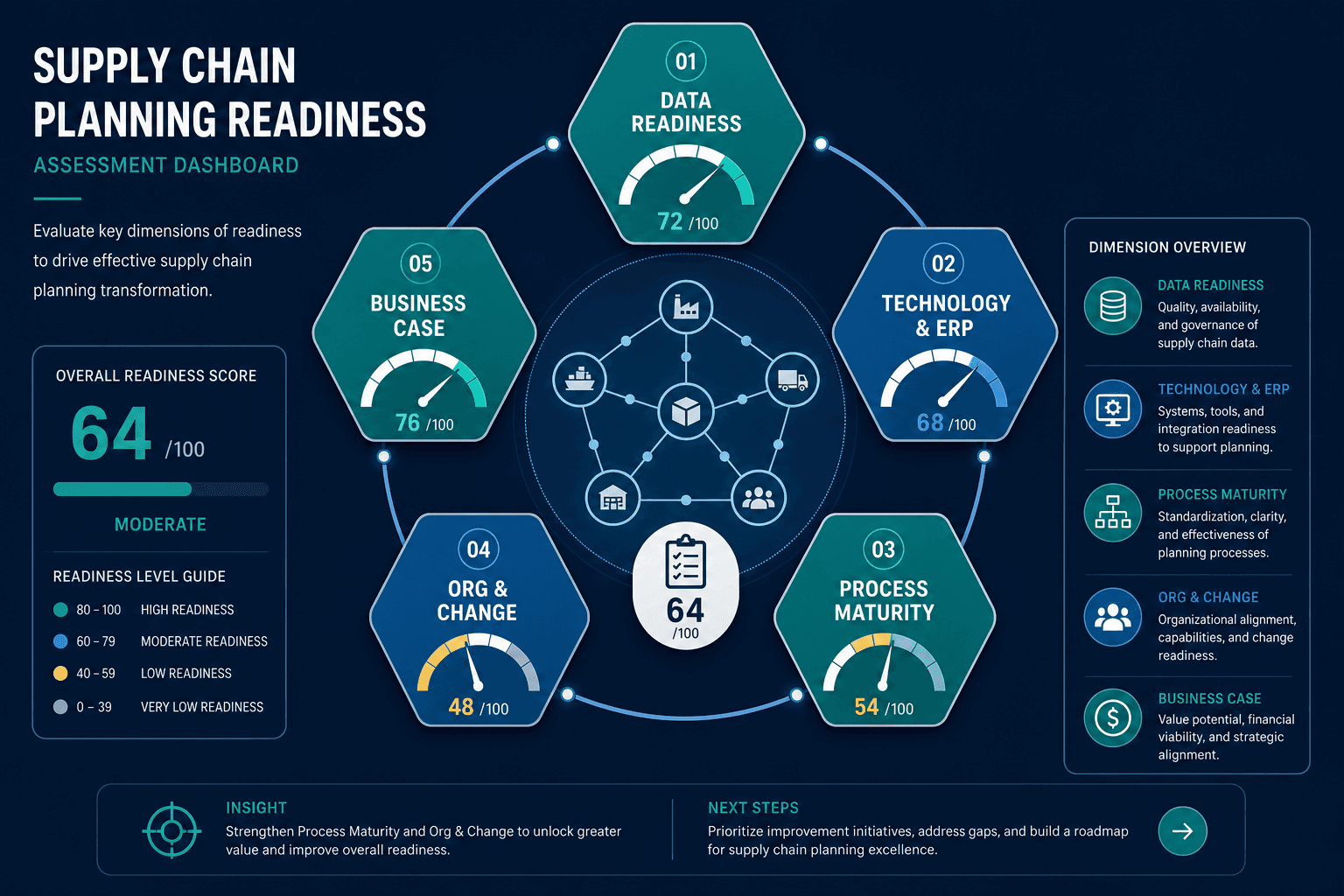
Complete all five dimension scorecards, then consolidate results using the summary below. Record scores by SKU tier, region, or business unit where your organization operates heterogeneously — a single enterprise-wide score will obscure the segment-level gaps that matter most.
| Dimension | Maximum Score | Your Score | Threshold for Readiness | Maturity Level Indicated |
|---|---|---|---|---|
| 1. Data Readiness | 16 | — | ≥10 | Below 10: Level 1–2 / Above 10: Level 3+ |
| 2. Technology & ERP Integration | 12 | — | ≥7 | Below 7: Level 1–2 / Above 7: Level 3+ |
| 3. S&OP and Process Maturity | 14 | — | ≥8 | Below 8: Level 1–2 / Above 8: Level 3+ |
| 4. Organizational & Change Readiness | 14 | — | ≥8 | Below 8: Level 1–2 / Above 8: Level 3+ |
| 5. Business Case & Success Metrics | 14 | — | ≥8 | Below 8: Level 1–2 / Above 8: Level 3+ |
| Overall Readiness Classification | — | — | All dimensions ≥ threshold | Determined by lowest-scoring dimension |
Sequencing Gap Remediation Before Vendor Engagement
Not all gaps can be remediated in parallel. The sequencing of remediation work is as important as identifying the gaps themselves. The Umbrex maturity model names the failure pattern directly: "technology-first sequencing — buying platforms before fixing data and process leads to expensive shelfware." The remediation sequence below reflects the dependency structure between dimensions.
- Data and ERP stability first. Stockout flagging, historical data cleaning, master data deduplication, and ERP stabilization must be addressed before any other dimension work produces durable value. Process improvements built on dirty data will not survive model training.
- S&OP process and data governance in parallel. Once data foundations are stable, S&OP process formalization and data governance policy development can proceed simultaneously. These are organizational work streams that do not depend on each other but both depend on data stability.
- Organizational readiness and business case development in parallel. Executive sponsorship, planner training planning, and financial modeling can begin as soon as the S&OP process work is underway. These do not require data or ERP work to be complete — they require organizational clarity about what the initiative is and why it matters.
- Vendor engagement only after Dimensions 1 and 2 meet thresholds. Beginning vendor evaluation before data and ERP prerequisites are met produces vendor selection decisions that cannot be validated — you have no reliable data on which to run a meaningful proof of concept.
Gaps that can be addressed in parallel: S&OP process formalization and planner training planning can proceed simultaneously with data cleaning. Business case development can proceed alongside ERP assessment. Gaps that are strictly sequential: data cleaning must precede model architecture decisions; ERP stabilization must precede integration design; override workflow design must precede pilot launch.
When You Are Ready: Trigger Criteria for Moving to Vendor Selection
Readiness for vendor engagement is not a feeling. It is a set of verifiable conditions. Spinnaker SCA's framing is precise: organizations are most ready for AI when they have usable data, connected systems, clear business priorities, executive alignment, and teams equipped to support adoption and change. The following trigger criteria translate that framing into verifiable go/no-go conditions.
- Data trigger: A minimum of 24 months of clean, granular, stockout-flagged transactional data is available in a queryable data environment. Stockout periods are documented. Returns are tracked separately from gross sales.
- Technology trigger: The ERP is stable, consistently adopted, and not scheduled for major change within 18 months. Automated ETL pipelines are in place or in active development. Cloud infrastructure is approved.
- Process trigger: A functioning S&OP cycle with defined horizon, cadence, and cross-functional participation is operating. Forecast ownership is assigned. A documented statistical baseline forecast exists.
- Organizational trigger: A named executive sponsor with budget authority is engaged. A planner training plan is drafted. An override workflow design is in progress. Incentive misalignments have been identified and are being addressed.
- Business case trigger: Current-state MAPE and forecast bias are measured and documented. KPI targets are defined and owned. A financial impact model with a 2–4 year ROI horizon is approved by the executive sponsor.
Comments
Join the discussion with an anonymous comment.