
Why Most AI Demand Forecasting Pilots Never Reach Production
Demand planning leads who have invested months preparing data pipelines and evaluating vendors are often blindsided when their AI forecasting initiative stalls after a promising pilot. The problem is rarely the model.
A 2026 study by GEP and the University of Virginia Darden School of Business — covering 180 supply chain executives — found that even in demand planning and forecasting, the most mature AI function in the study, only 10% of organizations reported successful scaled deployment. The failures were not primarily technical. They were operational: fragmented approval processes, inconsistent workflows between business units, and lack of clear ownership once AI-generated recommendations began moving across functions.
What distinguishes the organizations that scaled was not better algorithms — it was operational discipline. They standardized workflows, clarified governance, and resolved integration constraints before scaling. The technology followed the organizational readiness, not the other way around.
How to Use This Checklist
This checklist is designed for demand planning leads at Director or Senior Manager level who own or significantly influence AI forecasting deployment decisions. It is most useful in the period before vendor engagement — when you are deciding whether your organization is structurally ready to deploy, or whether specific blockers need to be resolved first.
Each of the four dimensions contains a structured set of assessment items. For each item, assign one of three statuses:
- Green — condition is met and documented.
- Amber — condition is partially met or in progress, with a known remediation path.
- Red — condition is not met and no remediation is underway.
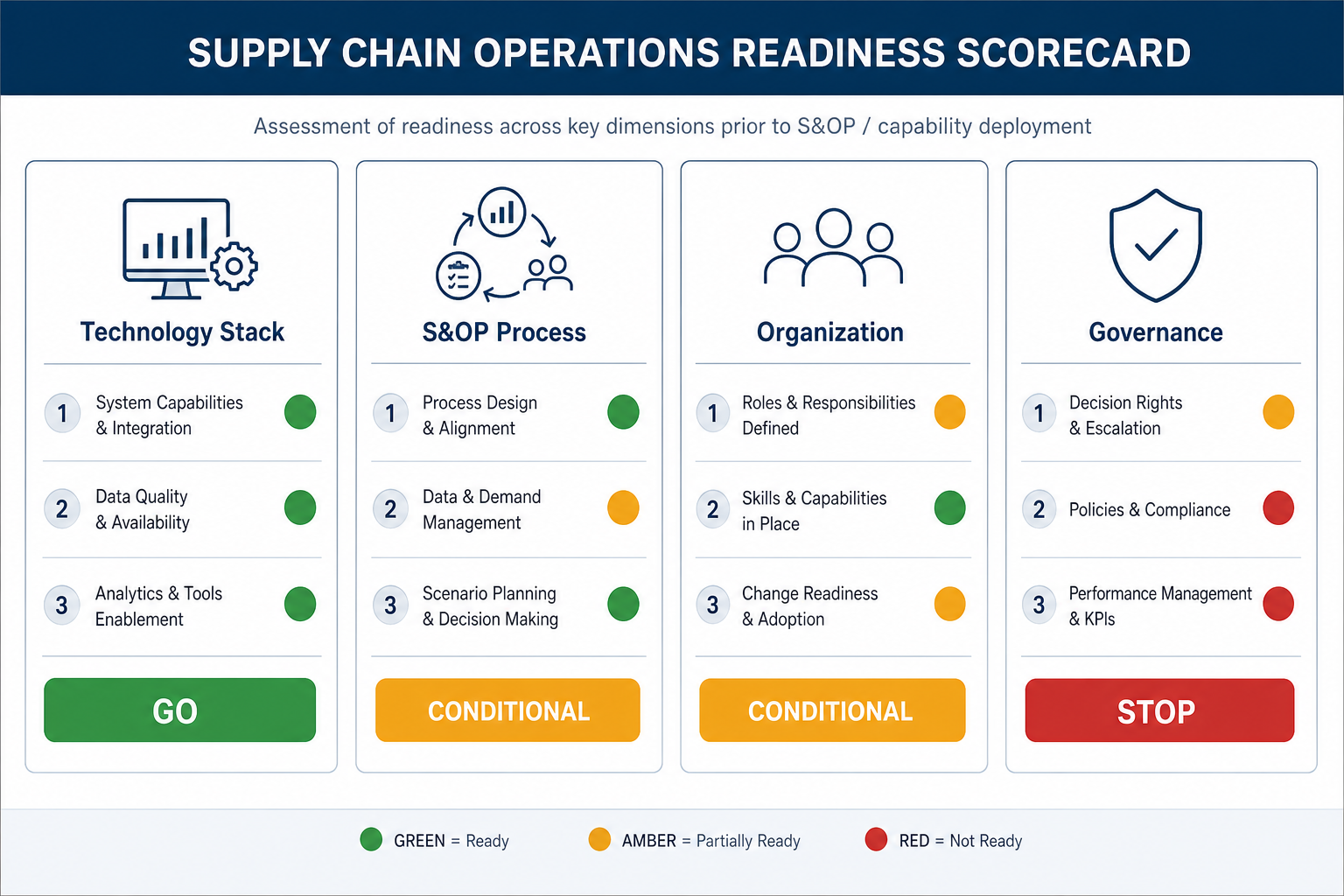
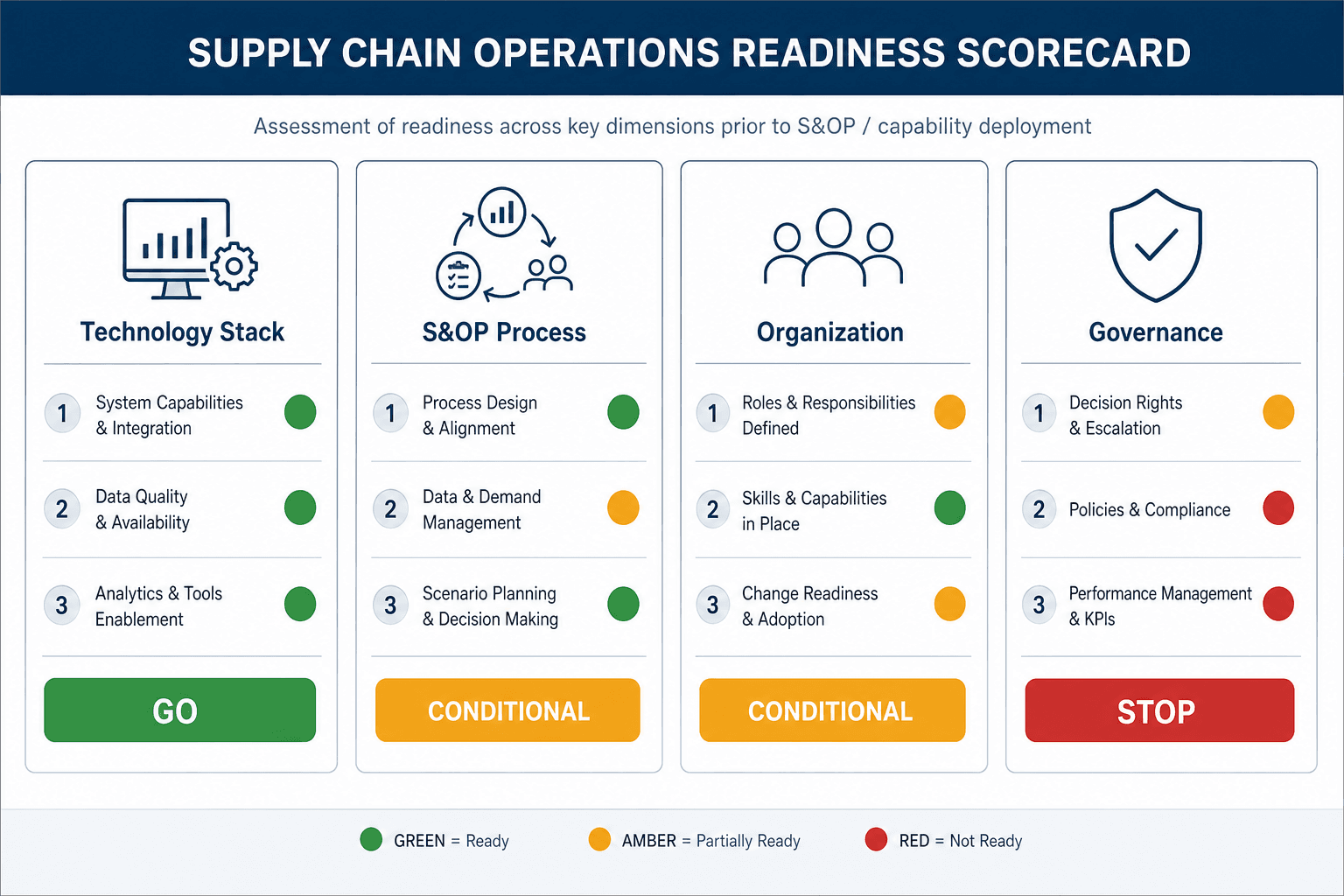
At the end of each dimension, your pattern of green, amber, and red responses maps to one of three verdicts: Go, Conditional Go, or Stop. The scoring methodology and verdict criteria are explained in full in the Scoring section below.
The four dimensions covered here are:
- Technology Stack and ERP Integration Readiness
- S&OP and Planning Process Maturity
- Organizational and Change Management Readiness
- Cross-Functional Governance and Stakeholder Alignment
Dimension 1: Technology Stack and ERP Integration Readiness
An AI demand forecasting layer sits on top of your existing technology infrastructure. If that infrastructure is unstable, inconsistently adopted, or architecturally incompatible with the integration model your AI platform requires, the implementation will encounter blockers that no amount of model tuning will resolve.
This dimension is not about data quality inside your ERP. It is about whether the ERP itself — and the surrounding technology stack — is stable, current, and architecturally ready to support an AI forecasting layer. Antuit's organizational readiness framework identifies a stable, well-adopted ERP as a foundational prerequisite — not a nice-to-have — for any AI-infused planning system. ThroughPut's implementation guidance frames ERP and system integration as a hard prerequisite, noting that integration challenges create data silos that directly reduce supply chain responsiveness.
| Assessment Item | What to Verify | Status |
|---|---|---|
| ERP version currency | ERP is on a supported version with vendor-maintained API capabilities. Customizations are documented and will not block integration. | Green / Amber / Red |
| ERP adoption depth | ERP is actively used as the system of record across all relevant business units. Shadow systems or spreadsheet workarounds are not the primary planning data source. | Green / Amber / Red |
| API availability | ERP exposes stable APIs or data connectors compatible with your shortlisted AI platforms. Batch export is available as a fallback if real-time API is not. | Green / Amber / Red |
| Data extraction infrastructure | A documented, tested data pipeline exists or can be built to move transactional and master data from ERP to the AI platform without manual intervention. | Green / Amber / Red |
| APS or planning tool compatibility | Existing Advanced Planning System (APS) or planning tool is either compatible with AI platform integration or has a defined replacement/coexistence strategy. | Green / Amber / Red |
| Cloud vs. on-premise constraints | Organizational IT policy on cloud deployment is documented. Security, data residency, and procurement approval requirements for SaaS AI platforms are understood. | Green / Amber / Red |
| IT resource availability for integration | Internal IT or a contracted integration partner has confirmed capacity to support the integration build within the planned deployment window. | Green / Amber / Red |
Dimension 2: S&OP and Planning Process Maturity
AI-generated demand forecasts do not deliver value in isolation. They deliver value when planners act on them through a disciplined review and decision process. If your S&OP process is informal, inconsistently followed, or lacks clear ownership of forecast decisions, AI forecasts will sit in a dashboard and influence nothing.
S&OP process maturity is the most commonly underestimated readiness dimension. Organizations invest heavily in AI model selection while leaving the review and actioning process unchanged — and then attribute poor outcomes to the model rather than to the process that failed to use it.
S&OP processes are important because they outline how leadership reviews and implements changes to demand and sales projections. A well-established process ensures your business is reaping the full benefit of advances in data science.
The IBF Journal of Business Forecasting identifies S&OP process maturity as one of three named pillars underpinning successful AI planning transformation, alongside data and technology readiness. The IBF framing is consistent with what practitioners encounter operationally: organizations that skip S&OP process assessment before deploying AI forecasting find that their review cadence cannot absorb the volume or frequency of AI-generated exceptions.
| Assessment Item | What to Verify | Status |
|---|---|---|
| S&OP process documentation | A written S&OP process exists, is current, and is followed in practice — not just in policy. | Green / Amber / Red |
| Cadence regularity | S&OP review meetings occur on a documented, predictable cadence (monthly at minimum). Meetings are not routinely cancelled or deferred. | Green / Amber / Red |
| Forecast review workflow | A defined workflow exists for reviewing statistical or AI-generated forecasts before they are used for planning decisions. Roles in that workflow are assigned. | Green / Amber / Red |
| Exception management process | A process exists for identifying, escalating, and resolving forecast exceptions. Exception volume is manageable within current review capacity. | Green / Amber / Red |
| Cross-functional input frequency | Sales, marketing, finance, and operations contribute demand inputs on a defined schedule. Ad hoc overrides are tracked and attributed. | Green / Amber / Red |
| Forecast actioning process | A clear path exists from approved forecast to inventory, procurement, and production decisions. AI-generated forecasts will feed into this path, not sit outside it. | Green / Amber / Red |
| Forecast accuracy measurement | Current baseline forecast accuracy is measured and tracked. A performance benchmark exists against which AI improvement can be evaluated. | Green / Amber / Red |
Dimension 3: Organizational and Change Management Readiness
Of the four dimensions in this checklist, organizational and change management readiness is the one most consistently skipped during pre-implementation planning — and the one most often cited when implementations fail to reach production.
StockIQ's analysis of AI demand planning adoption is direct on this point: successful AI adoption depends on how your people adopt it, not just on the tool selected. Planners who feel bypassed by AI recommendations, managers who distrust model outputs they cannot explain, and executives who champion the initiative without funding the change management effort — these are the patterns that stall deployments after a successful pilot.
Gartner's supply chain AI foundation guidance recommends upskilling both leaders and frontline teams on AI foundations, value, and governance — and building multidisciplinary teams that can bridge the gap between model outputs and planning decisions. This is not a one-time training event; it is an ongoing organizational capability.
| Assessment Item | What to Verify | Status |
|---|---|---|
| Executive sponsor identification | A named executive sponsor has committed to the AI forecasting initiative and has authority to resolve cross-functional blockers during implementation. | Green / Amber / Red |
| Planner AI literacy baseline | Demand planners have a working understanding of how AI/ML forecasting differs from statistical forecasting. Training gaps are identified and a plan exists to close them. | Green / Amber / Red |
| Resistance risk assessment | Key planner and manager resistance points have been identified. Influential individuals are engaged in the design process, not informed after decisions are made. | Green / Amber / Red |
| Training capacity | Dedicated time for planner training is allocated in the project plan. Training is not assumed to happen alongside full workloads without schedule relief. | Green / Amber / Red |
| Change management resource availability | A named change management lead or function is assigned to the implementation. Change management is a line item in the project budget, not an afterthought. | Green / Amber / Red |
| Human-in-the-loop design intent | The implementation plan explicitly defines where planners retain override authority, what triggers escalation, and how AI recommendations are presented for review — not just accepted. | Green / Amber / Red |
| Internal communication plan | A plan exists to communicate the purpose, scope, and planner role in the AI implementation across affected teams before go-live. | Green / Amber / Red |
Dimension 4: Cross-Functional Governance and Stakeholder Alignment
AI demand forecasting does not stay inside the demand planning function. Forecast outputs inform inventory positioning, procurement commitments, production scheduling, and financial planning. When those downstream functions have not been aligned before go-live — on ownership, input processes, and decision authority — the result is exactly what the GEP/UVA Darden study identified: fragmented approval processes and inconsistent workflows between business units.
Cross-functional alignment must be established before vendor engagement. Attempting to resolve governance questions during implementation — while vendor timelines are running and budgets are committed — consistently produces compromised outcomes. Governance that is designed under time pressure defaults to whoever has the most organizational leverage at that moment, not whoever has the most appropriate accountability.
Gartner recommends a hybrid governance model — centralized policy-setting with decentralized management — and treating data as a P&L-level asset with named ownership. In demand forecasting terms, this means central standards for how AI models are governed, monitored, and overridden, with operational management distributed to the functions that use the outputs.
| Assessment Item | What to Verify | Status |
|---|---|---|
| IT ownership model | IT's role in the AI platform — hosting, integration maintenance, model environment management — is defined and agreed before vendor selection begins. | Green / Amber / Red |
| Finance alignment | Finance understands how AI-generated forecasts will relate to financial planning inputs. Reconciliation between demand forecast and financial forecast is a documented process. | Green / Amber / Red |
| Commercial and sales input process | A defined process exists for sales and commercial teams to submit market intelligence and promotional plans into the forecasting process. Ad hoc overrides are governed, not freeform. | Green / Amber / Red |
| Procurement integration | Procurement understands how AI demand signals will affect purchase order timing and supplier commitments. Lead time assumptions used by the AI model are validated with procurement. | Green / Amber / Red |
| Post-go-live model governance ownership | A named owner is identified for model performance monitoring, retraining triggers, and override policy after go-live. This is not assumed to be the AI vendor's responsibility. | Green / Amber / Red |
| Escalation and exception ownership | When AI-generated forecasts trigger exceptions that cross functional boundaries, the escalation path and decision authority are defined before go-live. | Green / Amber / Red |
| Audit trail requirements | Requirements for logging AI-generated recommendations, planner overrides, and actioning decisions are documented and technically feasible within the chosen platform. | Green / Amber / Red |
Scoring Your Readiness: Go, Conditional Go, or Stop
After completing all four dimensions, review your pattern of green, amber, and red responses. The scoring logic operates at two levels: within each dimension, and across dimensions.
Within a single dimension, the concentration and severity of red responses determines the dimension-level verdict. Across dimensions, the number of dimensions with Stop verdicts determines the overall posture.
| Dimension Verdict | Response Pattern | Implication |
|---|---|---|
| Go | All or nearly all items Green; any Amber items have documented remediation paths with owners and timelines. | Proceed to vendor engagement for this dimension. No blocking conditions. |
| Conditional Go | Majority Green with one or more Amber items; no Red items, or a single Red item with a clear and near-term remediation path. | Proceed to vendor engagement with active remediation underway. Flag Amber items as implementation risks to be tracked. |
| Stop | One or more Red items with no remediation path, or two or more Red items regardless of remediation status, or a majority of items Amber. | Do not proceed to vendor engagement for this dimension. Remediate before committing implementation budget. |
Apply the dimension-level verdict to each of the four dimensions, then use the summary below to determine your overall readiness posture:
| Overall Posture | Dimension Verdict Pattern | Recommended Action |
|---|---|---|
| Go | All four dimensions: Go or Conditional Go, with no more than one Conditional Go. | Proceed to vendor engagement. Document Conditional Go items as implementation risk register entries. |
| Conditional Go | Two or three dimensions: Go or Conditional Go; one or two dimensions: Conditional Go with active remediation underway. | Begin vendor evaluation in parallel with remediation. Do not sign contracts until Stop-level conditions are resolved. |
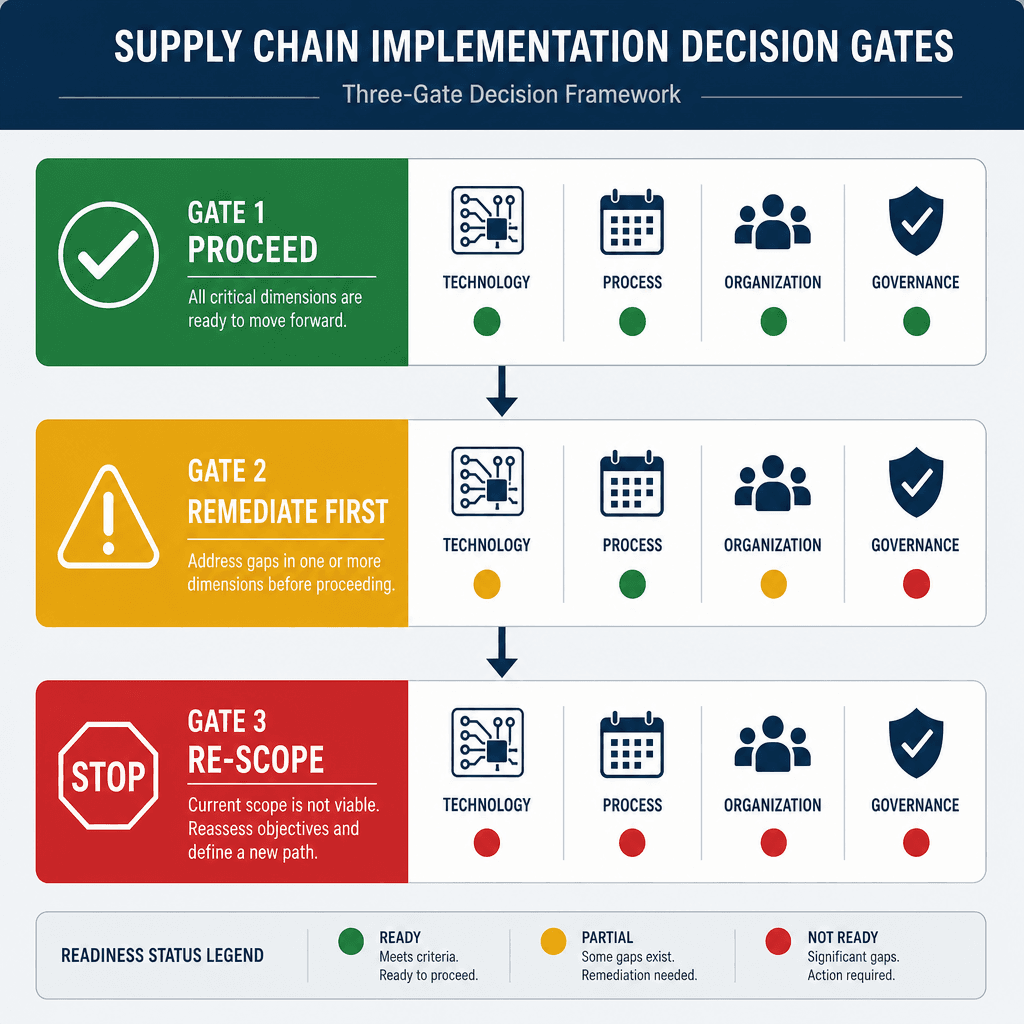
| Stop — Remediate First | One dimension: Stop verdict, with the other three at Go or Conditional Go. | Pause vendor engagement. Remediate the Stop dimension first. Re-assess that dimension in 60–90 days. |
| Stop — Re-scope | Two or more dimensions: Stop verdict. | Do not proceed. Re-scope the implementation timeline and budget. Address foundational blockers before any vendor engagement. |
Remediation Priority Sequencing and Next Steps
When multiple dimensions return amber or red responses, remediation sequencing matters. Fixing the wrong thing first wastes time and can create the appearance of readiness while foundational blockers remain.
The recommended sequence is:
- Technology blockers first. ERP instability, missing API availability, or unresolved cloud/on-premise constraints are hard blockers. No vendor engagement is productive until these are resolved, because integration scoping cannot be completed accurately against an undefined technology baseline.
- S&OP process gaps second. Process remediation — documenting the S&OP cadence, defining the forecast review workflow, establishing exception management — can begin in parallel with technology remediation but must be substantially complete before go-live. A partially documented process will not survive the exception volume that AI forecasting generates.
- Organizational readiness in parallel with process. Executive sponsor identification, planner literacy assessment, and change management planning should begin early — these take longer than most demand planning leads expect, and starting late compresses the time available for training and stakeholder engagement before go-live.
- Governance established before vendor contract. Cross-functional governance alignment — IT ownership, finance alignment, post-go-live model ownership — must be resolved before signing with a vendor. Governance gaps discovered during implementation are significantly more expensive to resolve than those addressed in the pre-engagement phase.
When to Proceed, When to Remediate, When to Re-scope
Proceed to vendor engagement when all four dimensions are at Go or Conditional Go, and active remediation plans are in place for any Conditional Go items. At this stage, vendor demonstrations and integration scoping can be conducted with an accurate picture of your constraints.
Remediate first when one dimension is at Stop. Identify the specific red items in that dimension, assign owners, and set a 60–90 day remediation target. Re-assess the dimension at that point before committing to vendor timelines.
Re-scope the implementation when two or more dimensions are at Stop. This is not a failure — it is a finding. An organization with two Stop-level dimensions that proceeds anyway is likely to become part of the 90% that never scale beyond pilot. Re-scoping to address foundational conditions first is the decision that separates the 10% that successfully deploy from those that do not.
Comments
Join the discussion with an anonymous comment.