
Network Design vs. Supply Chain Planning: Why the Distinction Determines Tool Selection
The most consequential mistake in AI-assisted logistics projects is applying a planning tool to a design problem, or vice versa. These are structurally different tasks with different inputs, different outputs, and different software categories. Conflating them leads to deploying the wrong tool and then attributing the failure to AI rather than to tool selection.
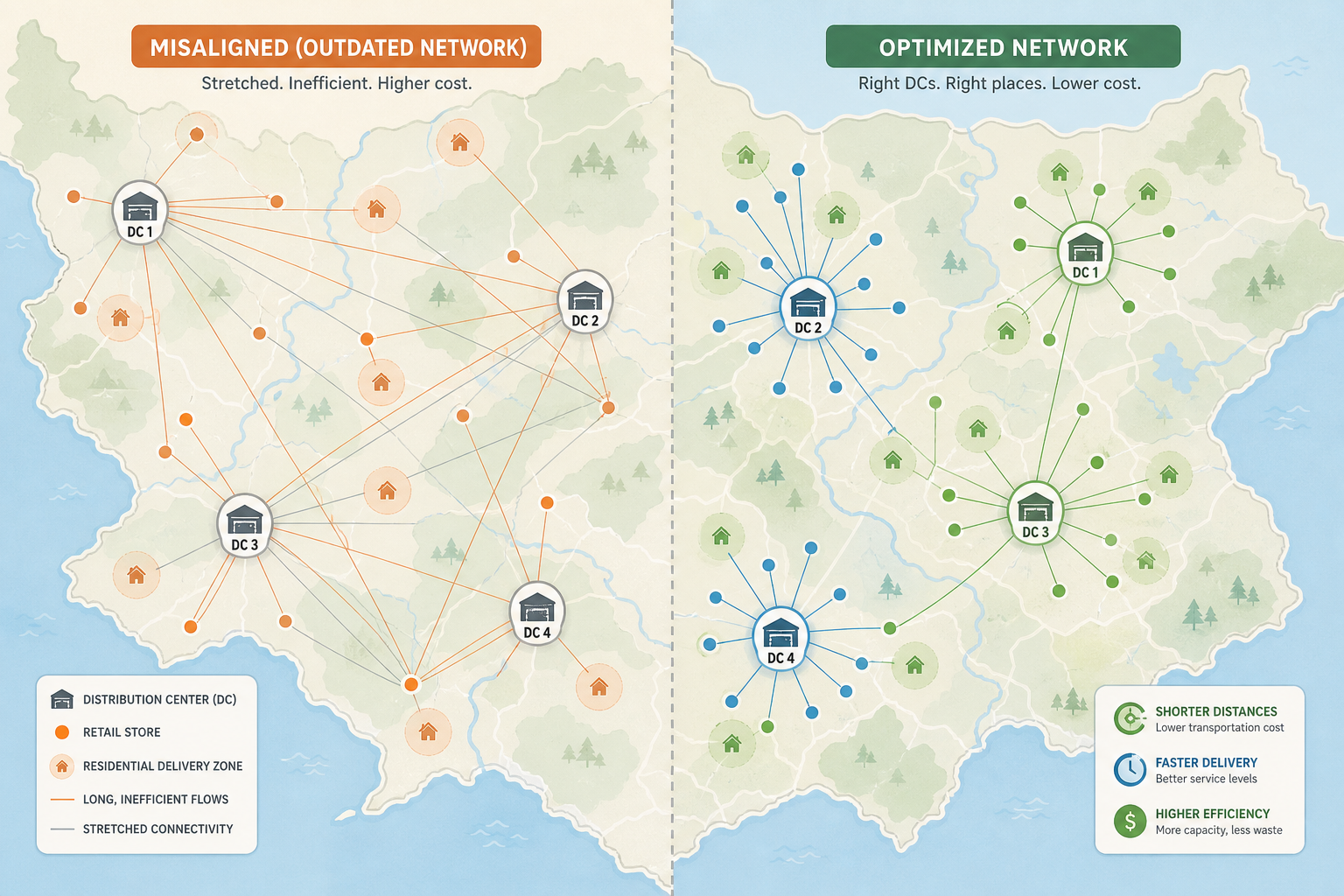
The distinction is precise: planning optimizes what you have; design determines what you should have. A demand planning system, a TMS, and a WMS all assume the network is fixed — they optimize execution within that structure. Network design tools ask a different question: given current and projected demand patterns, cost structures, and service requirements, where should facilities be located, how many are needed, and how should flow be assigned across them?
| Dimension | Supply Chain Planning | Network Design |
|---|---|---|
| Primary question | How do we execute optimally within the current network? | What should the network structure be? |
| Time horizon | Days to months (operational / tactical) | 1–5 years (strategic) |
| Network structure | Fixed input | Decision variable |
| Output | Orders, routes, replenishment signals, schedules | Facility locations, node count, flow assignments, DC roles |
| Typical tools | TMS, WMS, demand planning, S&OP | MILP solvers, stochastic optimization platforms, digital twin |
| Re-run frequency | Continuous or periodic (weekly/monthly) | Triggered by structural change (channel mix shift, new markets, M&A) |
For a VP Operations at a multi-DC retailer, this distinction has a direct implication for software evaluation: if your network structure is the problem — DC locations are wrong for current demand geography, channel mix has shifted, last-mile costs are rising despite volume growth — then optimizing routes or replenishment within that structure will not fix it. You need a network design engagement, not a planning tool upgrade.
Why Multi-DC Retail Is a Structurally Distinct Optimization Problem
Generic network optimization assumes a relatively stable, homogeneous demand signal and a single fulfillment mode. Multi-DC retail violates both assumptions simultaneously. Four structural characteristics make retail network design harder than the generic case — and each one has a direct implication for how the optimization must be set up.
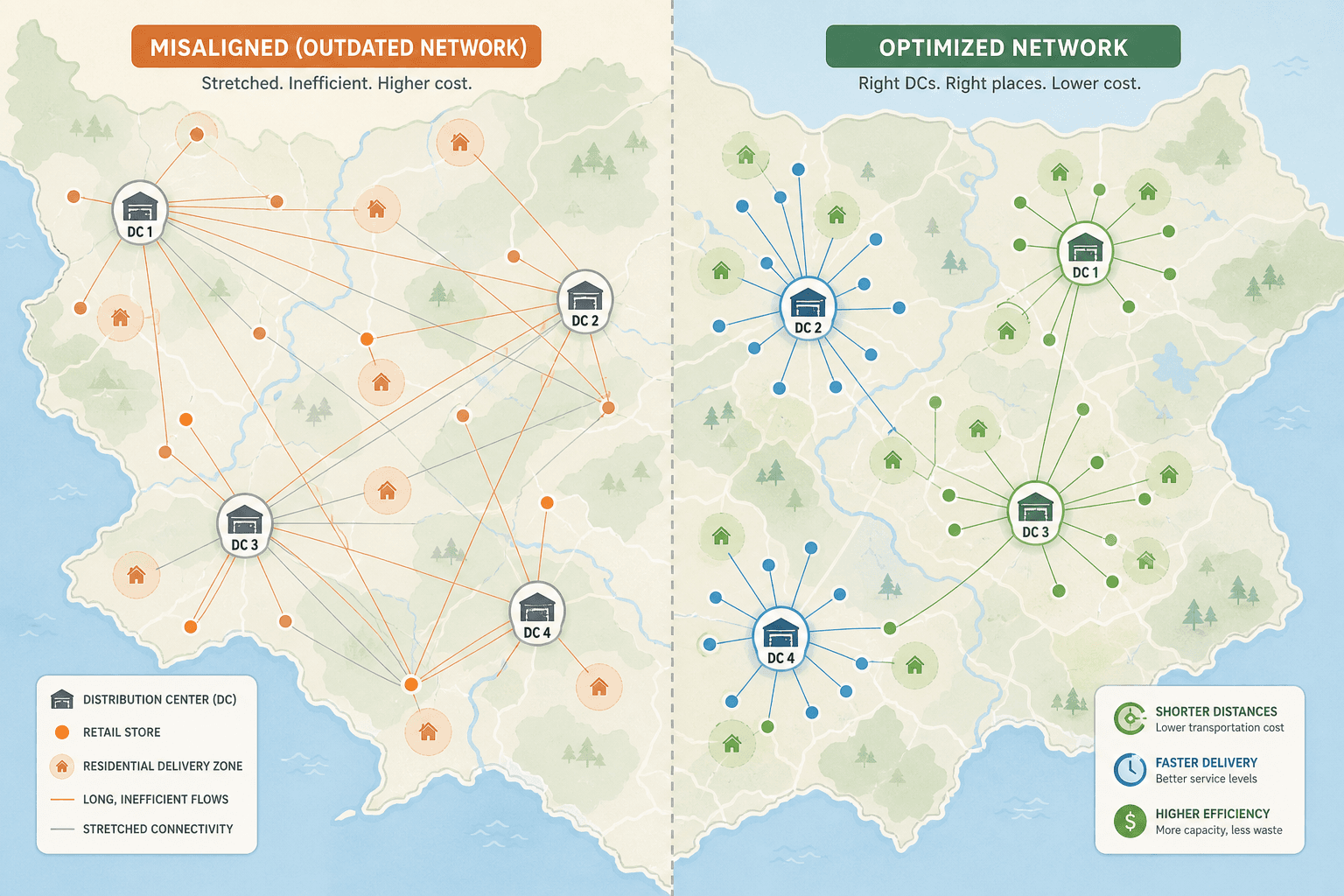
- Channel-split demand. The same SKU does not have the same velocity in-store and online, and that split varies by region. A product with strong brick-and-mortar demand in the Southeast and strong ecommerce demand in the Pacific Northwest requires a different DC placement than a product with uniform channel distribution. Tools that aggregate store and ecommerce demand before optimization produce DC placement recommendations that are wrong for at least one channel — often both.
- Omnichannel physics. Store replenishment operates at pallet level, follows predictable weekly rhythms, and delivers to a fixed location. Ecommerce fulfillment operates at unit level, is geographically diffuse across thousands of delivery addresses, and has substantially higher per-unit last-mile cost. These two fulfillment modes have different optimal node locations. A network designed primarily around store replenishment will systematically underserve ecommerce density clusters, and vice versa.
- Promotional demand spikes. Retail demand is not normally distributed around a mean. Promotional events routinely drive 3–5x baseline volume, and these spikes are predictable in timing but not always in magnitude or geographic concentration. A deterministic network model built on average demand will understate the capacity fragility that emerges at peak — and a network that appears adequate under average conditions may structurally fail under promotion.
- Reverse logistics volume. Ecommerce return rates in fashion and electronics run 20–30%. That volume has to move somewhere, and the optimal location for receiving, processing, and re-integrating returned inventory is not necessarily the same as the optimal location for outbound fulfillment. Retailers that design their forward network without accounting for return flows build a structurally incomplete model — and in high-return categories, this omission can change the optimal DC location by a margin large enough to invalidate the forward-only optimization.
The Three AI Technique Layers and What Each Addresses
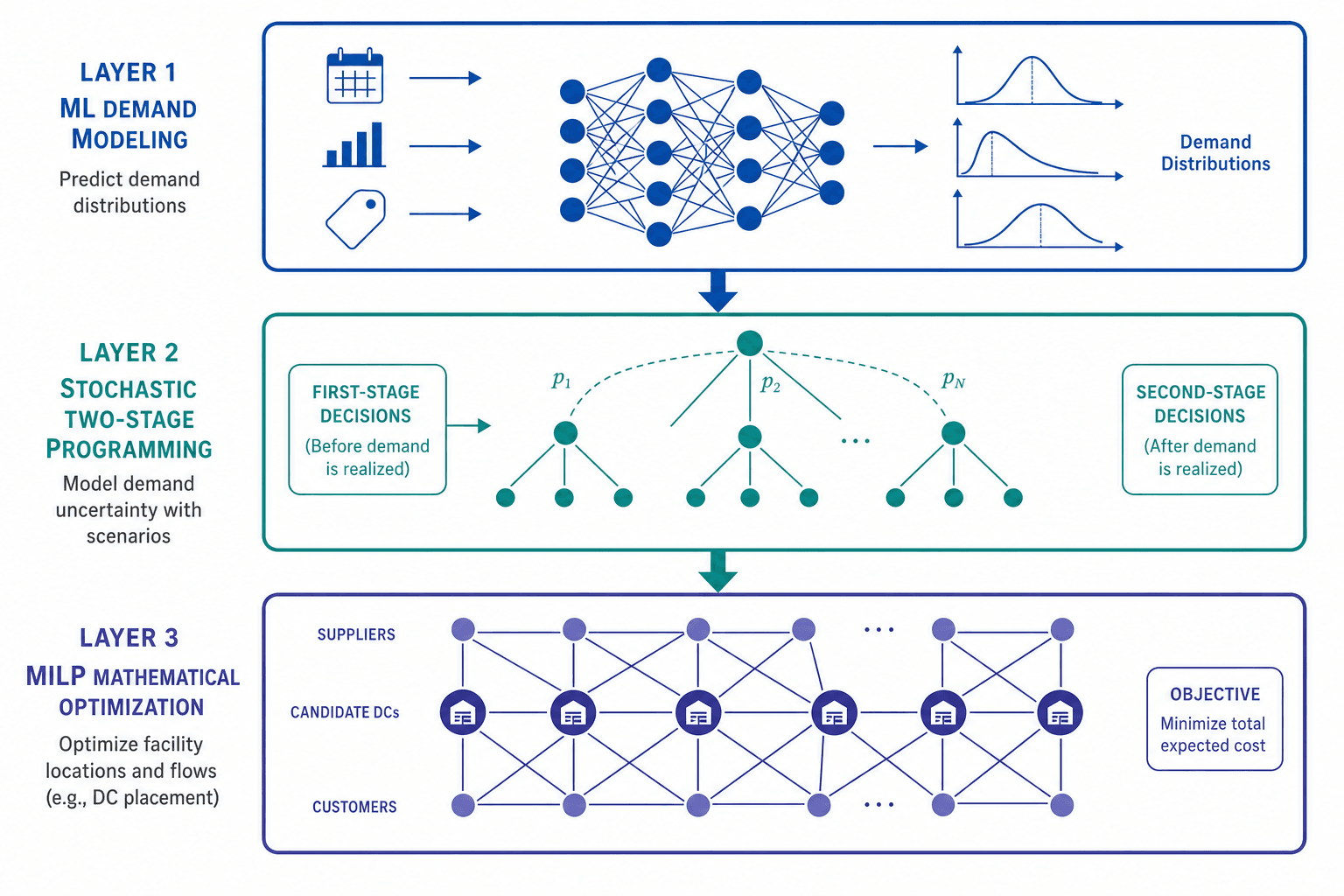
AI-assisted network design is not a single technique. It is a stack of three distinct layers, each addressing a different sub-problem. Selecting the wrong layer for a sub-problem is not a configuration error — it is a structural failure mode that produces outputs that appear rigorous but answer the wrong question.
Layer 1: MILP for Facility Location Decisions
Mixed-integer linear programming is the mathematical foundation of facility location optimization. Given a set of candidate DC locations, demand points, cost parameters, and capacity constraints, MILP finds the combination that minimizes total cost subject to service level requirements. It produces a single deterministic recommendation: open these facilities, close these facilities, assign these demand zones to these nodes.
The limitation is structural: MILP is deterministic. It optimizes against a single demand scenario — typically an average or a representative year. For a retail network with predictable but high-magnitude demand variability (seasonal peaks, promotional events), a MILP solution optimized against the mean will be structurally fragile at the tails. The model will not tell you this — it will simply return the optimal answer for the demand scenario it was given.
Layer 2: Stochastic Two-Stage Programming for Demand Uncertainty
Two-stage stochastic programming is the appropriate framework when demand uncertainty is material and the network must perform across a range of scenarios, not just the expected case. The first stage optimizes network structure (facility locations, assignments) across all scenarios simultaneously. The second stage optimizes operational flows for each specific scenario after demand is realized.
For seasonal retail, this is not optional. A network designed only against average demand will understate its own fragility during the promotional peaks that drive a disproportionate share of annual revenue. Stochastic programming forces the model to account for that fragility explicitly — the first-stage network structure must be robust across the full scenario set, including the 3–5x demand spikes that MILP treats as edge cases.
Layer 3: ML-Based Demand Modeling as the Input Layer
Machine learning demand modeling is not a network optimizer. It is the prerequisite data preparation layer that makes stochastic optimization possible. ML models — gradient boosting, time-series ensembles, probabilistic forecasting — process historical demand data to produce the demand distributions and scenario sets that feed into stochastic programming.
Without this layer, stochastic programming must rely on manually constructed scenarios, which are typically too few, too coarse, and biased toward conditions the modeler has already experienced. ML demand modeling expands the scenario space, surfaces demand patterns that are not obvious in aggregate data, and reduces the human bias in scenario construction.
| Technique | Sub-problem addressed | Output type | Retail limitation |
|---|---|---|---|
| MILP | Facility location and flow assignment | Single deterministic recommendation | Structurally fragile under demand variability; optimizes against one scenario |
| Stochastic two-stage programming | Network robustness under demand uncertainty | Scenario-robust network structure + per-scenario operational flows | Requires well-constructed scenario sets as input; computationally intensive at SKU level |
| ML demand modeling | Demand distribution and scenario generation | Probabilistic demand inputs for stochastic optimization | Not an optimizer; produces inputs, not network recommendations |
| Reinforcement learning | Sequential DC placement decisions | Policy for sequential decisions | Unproven at retail enterprise scale as of 2026; not recommended for production use |
Data Prerequisites by Technique: Gating Conditions, Not Nice-to-Haves
Data quality is consistently identified as the primary barrier to effective AI deployment in supply chain contexts. According to the Impinj Supply Chain Integrity Outlook 2025, data accuracy is the top AI implementation challenge cited by 43% of supply chain managers, ahead of data availability (39%) and real-time data access (36%). The same study found that while 91% of supply chain managers believe they have adequate visibility, only 33% consistently obtain accurate real-time inventory data.
For network design specifically, the data problem is not just about AI performance — it is about whether the model encodes the right network structure at all. A model built on incomplete or incorrectly aggregated data will produce a recommendation that is internally consistent but structurally wrong. The optimization will have worked correctly on the wrong inputs.
Supply chain managers report spending up to 60% of their analytics time identifying and correcting data quality issues rather than generating insights.
Source: Trax Technologies, citing Impinj Supply Chain Integrity Outlook 2025. This figure reflects the structural nature of the data quality problem — it is not resolved by deploying better AI on top of the same data.
The following data conditions are gating requirements for each technique layer. Projects that proceed without them produce models that cannot be defended in a capital allocation decision.
| Data condition | Required for | What happens without it |
|---|---|---|
| Channel-split demand by region (store vs. ecommerce, by geography) | All multi-DC retail models | DC placement is optimized for a blended demand signal that does not exist in reality; recommendation is wrong for at least one channel |
| Node-level cost-to-serve (inbound, outbound, last-mile, handling) | Cost optimization in MILP and stochastic models | Model minimizes a cost function that does not reflect actual economics; low-cost recommendations may be high-cost in practice |
| Returns flow volumes by origin region and product category | Forward network design in high-return categories | Forward network is optimized without accounting for reverse flow; in fashion and electronics, this can change the optimal DC location materially |
| Promotional demand distributions (not just peak averages) | Stochastic programming for seasonal retailers | Scenario set underrepresents the actual demand range; network appears robust but fails at promotional peaks |
| Minimum 2–3 years of clean transactional history by channel and region | ML demand modeling as input layer | Demand distributions are too narrow or biased; scenario sets do not represent the actual demand space the network must serve |
Readiness Signals: Quantifiable Triggers for a Network Redesign
A network redesign is a capital-intensive, organizationally disruptive undertaking. It is warranted when the current network structure is misaligned with the demand it serves — not when planning tools are underperforming. The following triggers are measurable indicators that the network structure itself, not execution within it, is the problem.
- Ecommerce channel mix has shifted 20+ percentage points since the last network review. A network designed when ecommerce was 10% of revenue and now operating at 35% ecommerce is serving a structurally different demand pattern from the one it was built for. The DC locations, node count, and flow assignments reflect the old channel mix, not the current one. This is not a planning problem — it is a design problem.
- Last-mile cost per order is rising despite volume growth. Scale should reduce per-unit last-mile cost as density increases. If cost per order is rising with volume, the network is not capturing density benefits — typically because DCs are not co-located with demand concentration. This is a node placement problem, not a carrier or routing problem.
- Promotional peaks are managed by borrowing from store replenishment capacity. When promotional surges are absorbed by deprioritizing store replenishment, the network has no structural capacity buffer for peak demand. This indicates the current node configuration cannot serve both channels simultaneously at peak — a structural capacity and location problem.
- Persistent regional service level variance with no demand-side explanation. If some regions consistently underperform service targets while others consistently exceed them, and demand patterns do not explain the gap, the network structure is likely the cause. DC proximity, flow assignments, and node capacity are misaligned with regional demand geography.
- DC utilization is chronically imbalanced across nodes. Persistent over-utilization at some DCs and chronic under-utilization at others — not explained by seasonal patterns — indicates that demand assignment to nodes does not reflect actual demand geography. This is a structural flow assignment problem.
Failure Modes: What Actually Goes Wrong in Retail Network Design Deployments
Network design failures in retail are rarely caused by optimization solver errors or software bugs. They are caused by structural decisions made before the optimization runs — demand aggregation choices, scope decisions about which costs to include, and governance structures that do not match the autonomy of the AI system being deployed. The following failure modes are documented patterns, not theoretical risks.
Failure Mode 1: Aggregating Store and Ecommerce Demand Before Optimization
When store and ecommerce demand are combined into a single demand signal before the optimization runs, the model optimizes against a blended average that does not correspond to either fulfillment mode. The resulting DC placement will be geometrically intermediate between the two optimal positions — wrong for store replenishment, wrong for ecommerce last-mile, and a reasonable compromise for neither.
This is the most common structural error in retail network design and is often invisible in the model outputs. The optimization will converge, the outputs will look defensible, and the recommendation will be presented with confidence. The error only becomes apparent when the deployed network underperforms for one or both channels.
Failure Mode 2: Treating the DC Network as Fixed When Channel Mix Has Shifted
Planning tools optimize within the current network. If the network itself is structurally misaligned — because channel mix has shifted materially since the last design review — then optimizing execution within it will not resolve the structural problem. Retailers that respond to rising last-mile costs or regional service failures with better routing algorithms or carrier management are treating a design problem as a planning problem. The underlying network misalignment remains.
Failure Mode 3: Ignoring Reverse Logistics in Forward Network Design
In fashion and electronics, ecommerce return rates of 20–30% create a substantial reverse flow that must be received, inspected, processed, and re-integrated into inventory. The optimal location for receiving and processing returns is influenced by where returns originate geographically — which is determined by where ecommerce demand is concentrated, not necessarily where forward fulfillment is optimal.
Forward-only network design ignores this constraint entirely. In high-return categories, the omission is large enough to change the optimal DC location — meaning the forward-optimized network is also suboptimal for returns, and the combined cost of forward fulfillment plus returns handling is higher than a jointly optimized network would produce.
Failure Mode 4: Governance Gaps in Agentic AI Deployments
Agentic AI systems — platforms that can autonomously trigger scenario re-runs, update network recommendations, or propose structural changes without human initiation — introduce a governance problem that is distinct from the modeling problems above. The issue is not whether the AI produces correct outputs. It is whether the organization has established clear boundaries around what decisions the AI is authorized to make, who reviews its recommendations before they affect capital planning, and how accountability is assigned when recommendations prove incorrect.
40% of current agentic AI projects are expected to be scrapped by 2027, not because the technology doesn't work, but because of integration drag, governance failures, and unclear business value attribution. The failure mode is predictable: organizations deploy agents before establishing clear boundaries around decision authority.
Source: Log-hub's citation of Deloitte's 2026 agentic supply chain report. Note: this figure is attributed to Deloitte's 2026 report as cited in Log-hub's editorial analysis; it has not been independently verified from the primary Deloitte source.
For network design specifically, governance failures take a predictable form: agentic systems produce network restructuring recommendations that are technically valid but organizationally unreviewed, leading to either paralysis (recommendations are ignored because no one has authority to act on them) or overreach (recommendations are implemented without adequate review of assumptions). Neither outcome serves the organization.
Vendor Capability Map: Retail-Specific Requirements vs. Platform Gaps
The network design software market has bifurcated. Legacy platforms built around manual model construction and desktop solvers coexist with AI-forward platforms that automate scenario generation and embed optimization within cloud-native environments. Neither generation fully covers all retail-specific requirements as of 2026. The following assessment maps named platforms against the requirements established in earlier sections.
| Vendor / Platform | Positioning | Retail-relevant capabilities | Documented gaps or limitations |
|---|---|---|---|
| Coupa / LLamasoft | Legacy market leader; desktop-based model construction | Established solver infrastructure; widely deployed in enterprise environments | Desktop-only architecture; solvers do not scale to SKU-level modeling — networks must be built at highly aggregated levels, limiting decision accuracy for retail channel-split analysis; no agentic AI capability reported |
| AIMMS | Modeling platform requiring expert configuration | Flexible mathematical modeling environment; supports custom optimization formulations | Requires PhD-level modeling expertise to configure effectively; creates key-person dependency risk when modelers leave; not a configured retail solution out of the box |
| Sophus | AI-forward challenger; retail-focused marketing | AI-assisted scenario generation; retail-specific framing in product documentation | Characterized by independent sources as not proven at SKU-level enterprise scale for complex networks; better suited to initial design explorations than ongoing enterprise decision-making; governance controls for agentic features not yet mature |
| Optilogic Cosmic Frog | Cloud-native platform combining agentic AI, mathematical optimization, and digital twin simulation | Vendor claims: integrated resilience scoring, scenario comparison, agentic AI features, cloud-native architecture enabling larger model scale; vendor cites 25% cost reduction for Fortune 500 deployments | All capability claims are vendor-authored; independent at-scale retail deployments have not been verified through this research; agentic governance controls should be assessed against the criteria in the failure modes section above |
| ICRON | Included as Representative Vendor in Gartner Market Guide for Supply Chain Network Design Tools (February 2026) | Repeatable scenario comparison; multi-objective trade-off analysis; multi-echelon inventory alignment within an integrated planning framework | Gartner inclusion confirmed via ICRON announcement; detailed capability depth for retail-specific channel-split modeling and stochastic seasonal simulation not independently assessed |
The critical gap that applies across the entire market: no platform in 2026 fully covers channel-split demand modeling, stochastic seasonal simulation, and returns flow integration simultaneously for retail in a single configured solution. Practitioners evaluating these platforms should assess each against the specific retail requirements their network presents — channel mix complexity, return rate exposure, promotional peak magnitude — rather than selecting based on general AI capability claims.
Vendor selection in this category should follow the same sequence as the technique selection logic above: define the sub-problems your network actually presents, identify which technique layers are required to address them, and then evaluate platforms on whether they support those technique layers at the scale and data granularity your operation requires. Platforms that cannot differentiate channel economics or that require heavy aggregation before optimization will produce flawed network recommendations regardless of their AI marketing positioning.
Comments
Join the discussion with an anonymous comment.