
Why Enterprise Playbooks Don't Translate to Mid-Market
Most AI supplier risk scoring implementation guides are written for organizations that already have dedicated data science teams, three or more years of clean structured transaction history, and the IT bandwidth to run a full ERP integration project alongside a new platform deployment. Mid-market procurement teams — here defined as organizations with roughly 200M–2B USD in annual revenue and 500–5,000 employees — have none of those conditions by default, and most will not have them at the time they begin evaluating AI supplier risk tools.
That structural gap matters because the wrong starting assumptions produce the wrong implementation decisions. An enterprise playbook will tell you to clean your supplier master data before you start, build a data pipeline from your ERP, and configure a scoring model against your internal transaction history. A mid-market team that follows that sequence will spend six months on data preparation before generating a single score — and often never gets past it.
This guide offers a different sequence: start with the data you have, select tools that compensate for what you lack, run a tightly scoped pilot against your most spend-critical suppliers, and integrate scores into sourcing decisions before attempting full-base coverage. Readers who need foundational context on what AI supplier risk scoring does and how it differs from manual scorecards should start with the AI Supplier Risk Scoring in Procurement Automation practitioner's guide before returning here.
Pre-Implementation Readiness: A Mid-Market Checklist
The goal of a pre-implementation readiness check is not to achieve perfect data before you start. It is to know specifically which gaps exist so you can select tools that compensate for them — rather than discovering those gaps mid-pilot when they become blockers.
Three areas matter most for mid-market teams:
- Supplier master data cleanliness. Can you identify your top 200 suppliers by spend without manual reconciliation? Are there significant duplicate records, missing tax IDs, or gaps in basic firmographic fields (country of operation, industry classification, parent company)? You do not need a fully deduplicated global supplier master before starting — but you need to know the extent of the problem so you can prioritize enrichment accordingly.
- ERP minimum viable state. Can you extract purchase order history, invoice data, and on-time delivery records for your top suppliers in a structured format? It does not need to be clean or complete — but if your ERP data requires significant manual extraction or transformation before it can be ingested by a third-party tool, that is a project in itself that needs to be scoped separately from the scoring deployment.
- Baseline spend visibility. Can your team identify the top 20% of suppliers by spend concentration without running a multi-week analysis? If spend visibility is itself unclear, that needs to be resolved before pilot supplier selection — because spend concentration determines where scoring errors are most costly.
| Readiness Area | Minimum Viable State for Pilot | Gap Implication |
|---|---|---|
| Supplier master data | Top 200 suppliers identifiable by spend; basic firmographic fields present for most | Missing firmographics → prioritize tools with external enrichment |
| ERP transaction data | PO history and invoice data extractable for top suppliers, even if imperfect | No extraction path → scope ERP work as a separate pre-pilot task |
| Spend visibility | Top 20% of suppliers by spend concentration identifiable | Unclear spend → resolve before pilot supplier selection |
Choosing the Right Risk Dimensions When Internal Data Is Thin
Mid-market teams often default to the risk dimensions their ERP already supports — payment history, on-time delivery rates, and invoice accuracy. These are useful, but they are trailing indicators. They tell you what happened, not what is likely to happen next.
The more consequential gap is in financial health assessment. Payment history and credit checks are not the same as financial health. A supplier can maintain a clean payment record right up until the point it cannot — meaning the moment a payment problem becomes visible in your transaction data, the underlying financial stress has often been building for months.
For mid-market teams with limited internal transaction history, the five risk dimensions where external data can compensate most effectively are:
- Financial health signals. Balance sheet indicators, operating margins, leverage ratios, and cash flow trends — not just payment history. This requires external financial data sources, since mid-market suppliers rarely provide this proactively.
- Delivery performance. On-time delivery and lead time variability, drawn from your ERP where available and supplemented by third-party logistics data for suppliers where your internal records are sparse.
- Geographic and geopolitical exposure. Country-of-operation risk, single-country concentration, and exposure to active trade policy changes or sanctions regimes. This dimension is almost entirely dependent on external data and is increasingly important given current tariff volatility.
- ESG flags. Labor practices, environmental compliance, and governance indicators — particularly relevant for suppliers in regions with weaker regulatory enforcement. External ESG databases cover this where internal audit data does not exist.
- News monitoring signals. Adverse media, litigation, regulatory enforcement actions, and reputational events. This dimension requires continuous monitoring rather than point-in-time assessment, and is best handled by tools with built-in news monitoring rather than manual tracking.
Tool Selection Criteria for Mid-Market Teams
The most common mid-market tool selection mistake is evaluating platforms primarily on model sophistication — the complexity of their ML algorithms, the number of scoring dimensions, or the depth of their AI capabilities. Model sophistication is largely irrelevant if the model has insufficient internal data to work with. At the mid-market scale, bundled external data enrichment is the primary selection criterion, ahead of everything else.
The practical argument: a tool that brings its own continuously updated external supplier data — firmographics, financial signals, ESG indicators, news monitoring, geographic risk — can generate reliable scores from day one against a supplier base with thin internal transaction history. A more sophisticated model that requires the team to supply clean, structured, multi-year data cannot generate reliable scores until that data exists. For most mid-market teams, that wait is measured in years.
API-based external supplier data enrichment providers have matured enough that this is no longer a differentiating capability reserved for enterprise platforms. Providers covering tens of millions of companies across dozens of data points — including certifications, locations, ESG policies, and financial risk indicators — are available to teams without in-house data science, through standard API connections or pre-built integrations.
| Selection Criterion | Mid-Market Priority | What to Assess |
|---|---|---|
| Bundled external data enrichment | Primary — evaluate first | Coverage of your supplier base geography; data freshness; which dimensions are covered (financial, ESG, news, geo) |
| Integration complexity | High — evaluate second | Does score generation require a completed ERP integration, or can it start with a supplier list and be enriched incrementally? |
| Per-supplier cost structure | High for smaller bases | Per-supplier pricing models favor mid-market teams; per-seat or flat enterprise pricing often over-charges for smaller supplier bases |
| Configurability without data science | Medium | Can risk dimension weights be adjusted by a procurement analyst, or does reconfiguration require vendor professional services? |
| Model sophistication | Lower priority at this scale | Relevant only after data sufficiency is confirmed; do not trade enrichment coverage for algorithmic complexity |
Designing a Focused Pilot: 20–50 Suppliers, Not the Full Base
The instinct to run a broad initial pilot — scoring the full supplier base or a large representative sample — is understandable but counterproductive at the mid-market scale. A broad pilot produces a large volume of scores before anyone has validated whether those scores are meaningful, and it consumes the team's limited bandwidth on data preparation rather than on learning what works.
A focused pilot of 20–50 suppliers in the highest spend-concentration category produces more actionable validation for three reasons: scoring errors are most costly in this segment, category managers already have institutional knowledge to validate scores against, and a successful outcome in this segment is a credible internal proof point for securing scaling budget.
Supplier Segment Selection Logic
Select the pilot segment based on spend concentration, not supplier count. The top 20–30 suppliers by spend typically represent 60–80% of total procurement spend for a mid-market organization. A scoring error that leads to a wrong sourcing decision in this segment carries materially higher consequence than an equivalent error in the tail.
Within that spend-concentrated segment, prioritize suppliers where your internal data is thinnest — because those are the cases where external enrichment will add the most incremental value and where the tool's data coverage is most directly testable.
Scoring Validation Approach
Validation is not about confirming that the AI agrees with what you already know — it is about understanding where and why it diverges from institutional knowledge. For each pilot supplier, ask category managers to rate their perceived risk level before seeing the AI-generated score. Then compare.
- Where AI scores align with category manager judgment: confirm which data signals are driving the score and whether those signals reflect the right risk dimensions for your category.
- Where AI scores are higher than expected: investigate whether the tool is detecting a genuine risk the team has not tracked, or whether it is flagging a false positive driven by data quality issues.
- Where AI scores are lower than expected: identify whether the tool lacks access to the signals that category managers are using (e.g., relationship-based intelligence, operational history not captured in structured data).
Stakeholder Alignment Before Broader Rollout
The pilot validation step is also the point at which category managers need to be involved in defining how scores will be used — not just informed after the fact. Specifically: which score thresholds will trigger which actions, what the escalation path looks like, and how scores will interact with existing sourcing decision criteria. Category managers who help define these rules are substantially more likely to act on scores than those who receive a completed scoring system as a fait accompli.
Embedding Scores in Sourcing Workflows
A supplier risk score that lives only in a dashboard has no operational value. The score's value is entirely determined by whether it triggers a specific sourcing action at the right point in the procurement process. This is the section of the implementation that most mid-market teams underinvest in — and it is the primary reason deployments produce scores that nobody uses.
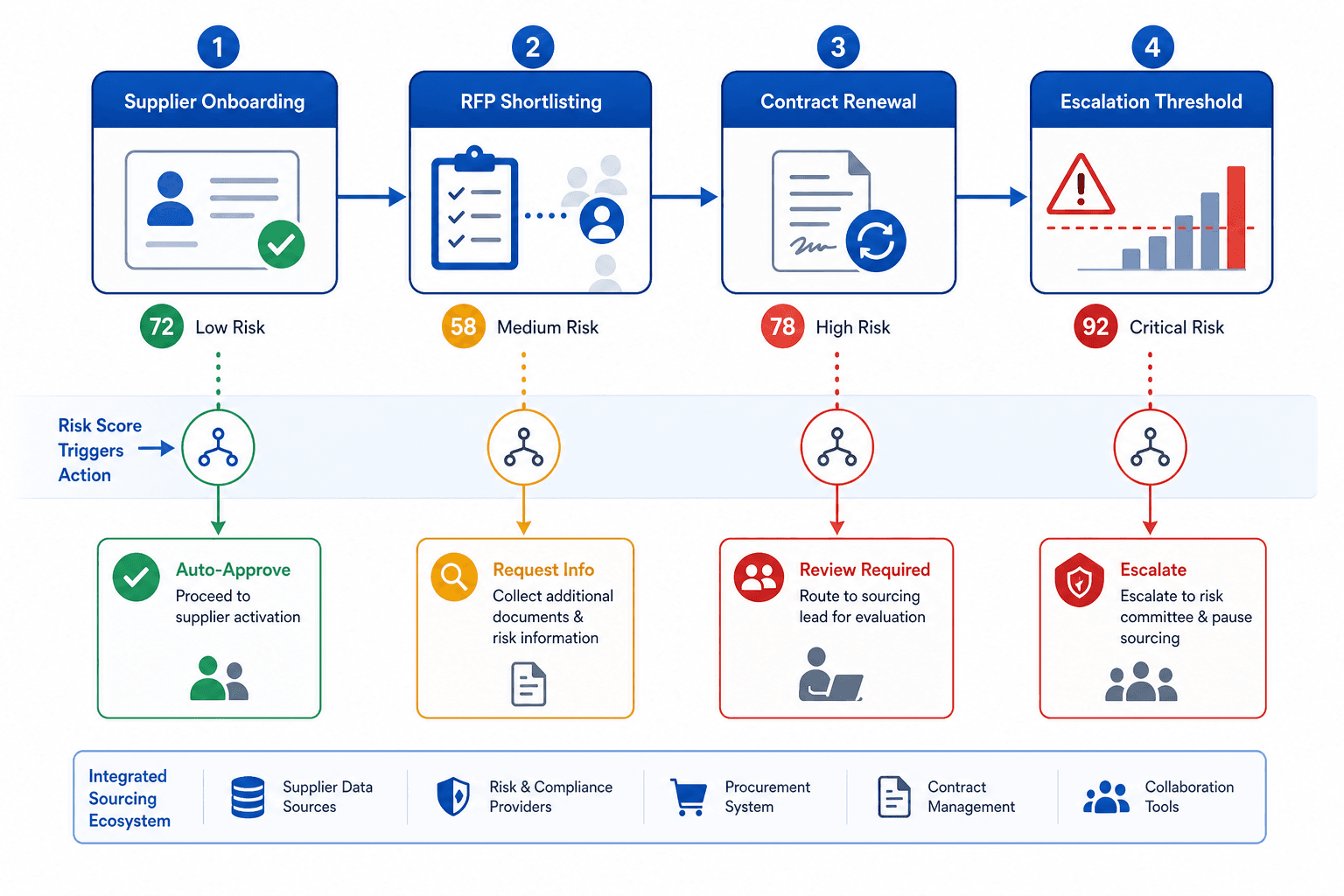
There are four workflow integration points that cover the majority of sourcing decisions where risk scores are most actionable:
1. New Supplier Onboarding Gates
Define a minimum score threshold that a supplier must meet before being added to the approved vendor list. This is the simplest integration point to implement and the one with the clearest ROI: it prevents high-risk suppliers from entering the base before a relationship creates switching costs.
The threshold should be category-specific rather than universal. A supplier threshold for a single-source critical component category should be more stringent than for a commodity category with multiple available alternatives. This differentiation requires category managers to define acceptable risk levels per category before the onboarding gate goes live.
2. RFP Shortlisting
Use scores to filter or flag suppliers before shortlisting, not just after award. Evaluating a supplier through a full RFP process only to discover a high-risk score at the award stage wastes sourcing team time and creates pressure to proceed anyway because of sunk cost.
The practical implementation: add a risk score check as a mandatory step in the RFP supplier identification phase. Suppliers below a defined threshold require either additional due diligence before inclusion or explicit sign-off from the sourcing lead. This does not prevent high-risk suppliers from being shortlisted — it ensures the decision to include them is deliberate rather than uninformed.
3. Contract Renewal Triggers
Configure automated alerts for suppliers whose scores cross a defined threshold during an active contract period. The alert should not automatically trigger a contract action — it should trigger a review. The review then determines whether the score change reflects a genuine deterioration requiring renegotiation, an early renewal conversation, or contingency sourcing, versus a data artifact requiring investigation.
For mid-market teams, this integration typically requires connecting the scoring platform's alert output to whatever system the procurement team uses for contract management — which may be as simple as a shared inbox or a Slack channel in the near term, before a formal CLM integration is in place.
4. Escalation Thresholds
Pre-defined escalation procedures are what convert supplier risk scoring from a monitoring activity into a decision system. Without them, score alerts accumulate without resolution — which is operationally equivalent to not monitoring at all.
Define escalation thresholds before the scoring system goes live, not after. The minimum viable escalation framework answers four questions: what score change magnitude or absolute threshold triggers escalation; who is the named decision owner (not a committee — a person); what information is required before a decision can be made; and what is the maximum time a decision can remain open.
| Workflow Integration Point | What It Requires | Common Gap |
|---|---|---|
| New supplier onboarding gate | Category-specific score thresholds defined before go-live | Universal threshold applied regardless of category criticality |
| RFP shortlisting | Score check step added to supplier identification phase | Score checked only at award stage, after RFP investment is sunk |
| Contract renewal trigger | Alert configuration connected to contract management workflow | Alerts generated but not routed to a responsible owner |
| Escalation threshold | Named decision owner, evidence standard, and time limit defined | Escalation triggered but no defined resolution path or deadline |
Scaling from Pilot to Full Supplier Base
The most common reason mid-market AI supplier risk scoring deployments stall after a successful pilot is that the team attempts to scale score generation and workflow operationalization simultaneously. Both require different investments, and conflating them produces neither.
A two-phase structure reduces this risk:
- Phase 1 — Score generation and validation. Expand coverage from the pilot supplier set to the full spend-concentrated tier (typically the top 100–200 suppliers). Validate scores against category manager knowledge. Identify and resolve systematic data gaps. Confirm that the tool's external enrichment is covering your supplier base geography adequately. Do not attempt to connect scores to sourcing workflows at scale until this validation is complete.
- Phase 2 — Workflow operationalization. Embed the four workflow integration points described above. Train category managers on how to interpret and act on scores. Establish the escalation framework. Expand coverage to the broader supplier base only after the workflow integration is functioning reliably for the spend-concentrated tier.
Data Infrastructure Investments That Pay Off at Scale
Not all data infrastructure investments are worth making before Phase 2. Prioritize the ones that directly improve score reliability for your highest-spend suppliers:
- Supplier master data governance. Deduplication, parent-child hierarchy mapping, and basic firmographic completeness for the top 200 suppliers. This pays off immediately in score accuracy and scales directly as coverage expands.
- ERP data extraction automation. Automating the extraction of PO history and delivery performance data removes a recurring manual step that becomes a bottleneck as coverage expands. Worth investing in before Phase 2 if the current state is manual export.
- External enrichment API connection. If your selected tool supports direct API-based enrichment, establishing a stable connection and refresh cadence before Phase 2 ensures that score accuracy does not degrade as the supplier base grows.
Mid-Market-Specific Failure Modes and How to Avoid Them
The failure modes that end mid-market AI supplier risk scoring deployments are different from the general catalogue. They are not primarily about data quality or model performance — they are about organizational and commercial decisions made before the first score is generated.
Over-Specified Tools Chosen for Enterprise Use Cases
Platforms designed for Fortune 500 procurement organizations typically assume large supplier bases (10,000+), dedicated implementation resources, complex multi-tier ERP integrations, and pricing structures that reflect that scale. Mid-market teams that select these platforms often find that the implementation prerequisites exceed their available bandwidth, the per-supplier cost economics do not work for a 500-supplier base, and the configuration complexity requires vendor professional services for every adjustment.
Avoidance: During vendor evaluation, ask specifically about the minimum viable implementation path — what is required before a score can be generated for a single supplier. If the answer involves a multi-month ERP integration project, the tool is likely scoped for a different customer profile.
Pilot-Only Budget Approvals with No Scaling Path
Securing budget for a pilot without securing a conditional commitment for Phase 2 creates a structural problem: a successful pilot produces validation evidence but no approved path to use it. The team then needs to run a second budget approval process while the pilot momentum dissipates and the vendor relationship goes cold.
Avoidance: Frame the initial budget request as a two-phase investment with Phase 2 contingent on defined pilot success criteria. Specify what a successful pilot looks like — score coverage for the top 50 suppliers, validation agreement rate above a defined threshold, at least one sourcing decision influenced by a score — so the Phase 2 approval is a decision about results, not a new budget conversation from scratch.
Unused Dashboards
Scores that are generated but not connected to any sourcing decision workflow produce no operational value. This failure mode is more common than it appears: the platform is deployed, scores are generated, the dashboard is reviewed in monthly procurement reviews, and the scores have no effect on any actual sourcing decision. The team has built monitoring infrastructure, not a decision system.
Avoidance: Define the workflow integration points — specifically which sourcing decisions will be influenced by scores and how — before the platform goes live, not after. If the team cannot answer "what sourcing action will a score of X trigger?" before deployment, the deployment will produce a dashboard rather than a decision system.
Category Manager Change Management Failures
This is the most underestimated failure variable in mid-market deployments. Category managers who were not involved in defining the scoring logic, the risk dimension weights, or the escalation thresholds have no stake in the system's conclusions. When a score conflicts with their judgment — which it will, especially early in deployment — they override it. After enough overrides, the scoring system becomes advisory in name only, and the workflow integration collapses.
Avoidance: Involve category managers in three specific decisions before go-live: which risk dimensions are weighted most heavily in their categories, what score thresholds should trigger which actions, and how divergences between scores and their judgment will be documented and reviewed. This is not a consensus process — the procurement lead makes final calls — but it converts category managers from passive recipients of a scoring system into active participants in its design.
Comments
Join the discussion with an anonymous comment.