
Vendor Snapshot: What Coupa Is and Is Not
Coupa is a spend management platform. That classification matters before anything else in this profile, because the most common evaluation error practitioners make is approaching Coupa as a supply chain-native planning vendor. It is not. Coupa's primary product is source-to-pay automation — procurement workflows, spend visibility, contract management, and supplier network intelligence at enterprise scale. Supply chain design and planning is a serious embedded business within Coupa, but it sits inside a spend management suite, not the other way around.
Coupa has been privately held under Thoma Bravo ownership since February 2023. The company does not publish financial disclosures, so all scale figures cited here are vendor-stated. As of Q2 2026, Coupa reports more than 3,500 enterprise customers, a buyer-supplier network exceeding 10 million participants, and a community spend dataset the company describes as representing $10 trillion in transactions. That dataset figure appeared as $8 trillion in late 2025 communications and has grown in Coupa's own materials since; the methodology for measuring or auditing community data contributions is not publicly disclosed.
| Attribute | Detail | Source Type |
|---|---|---|
| Ownership | Thoma Bravo (private since Feb 2023) | Public record |
| Enterprise customers | 3,500+ (vendor-stated) | Vendor-stated |
| Buyer/supplier network | 10M+ participants (vendor-stated) | Vendor-stated |
| Community spend dataset | $10 trillion (vendor-stated; was $8T in Q4 2025) | Vendor-stated, methodology undisclosed |
| Primary classification | Spend management platform with embedded SC design business | Independent review (Lokad) |
| SC design lineage | LLamasoft, acquired 2020 (~$1.5B) | Public record |
The Dual-Track Architecture: Why Procurement AI and SC Design Must Be Evaluated Separately
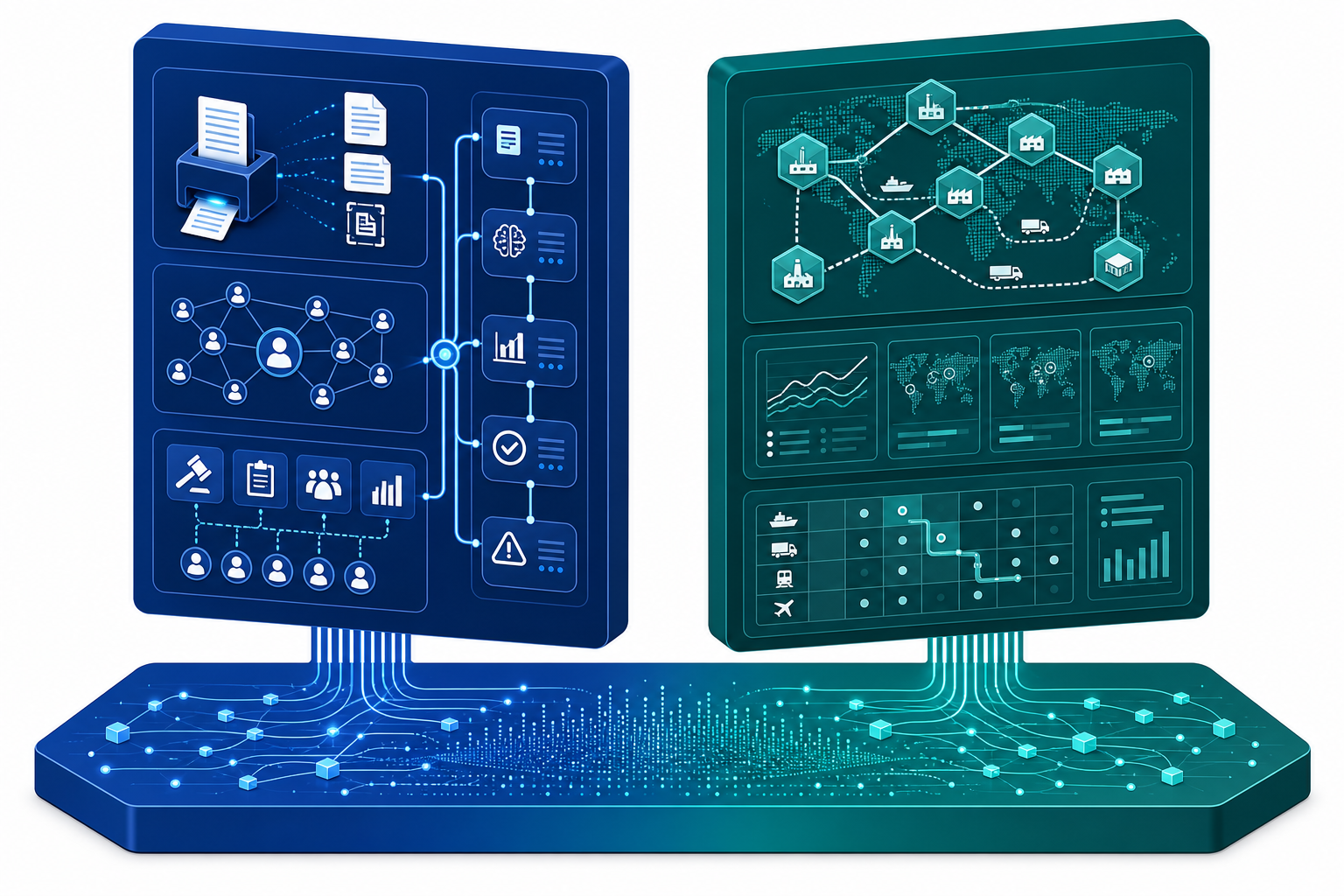
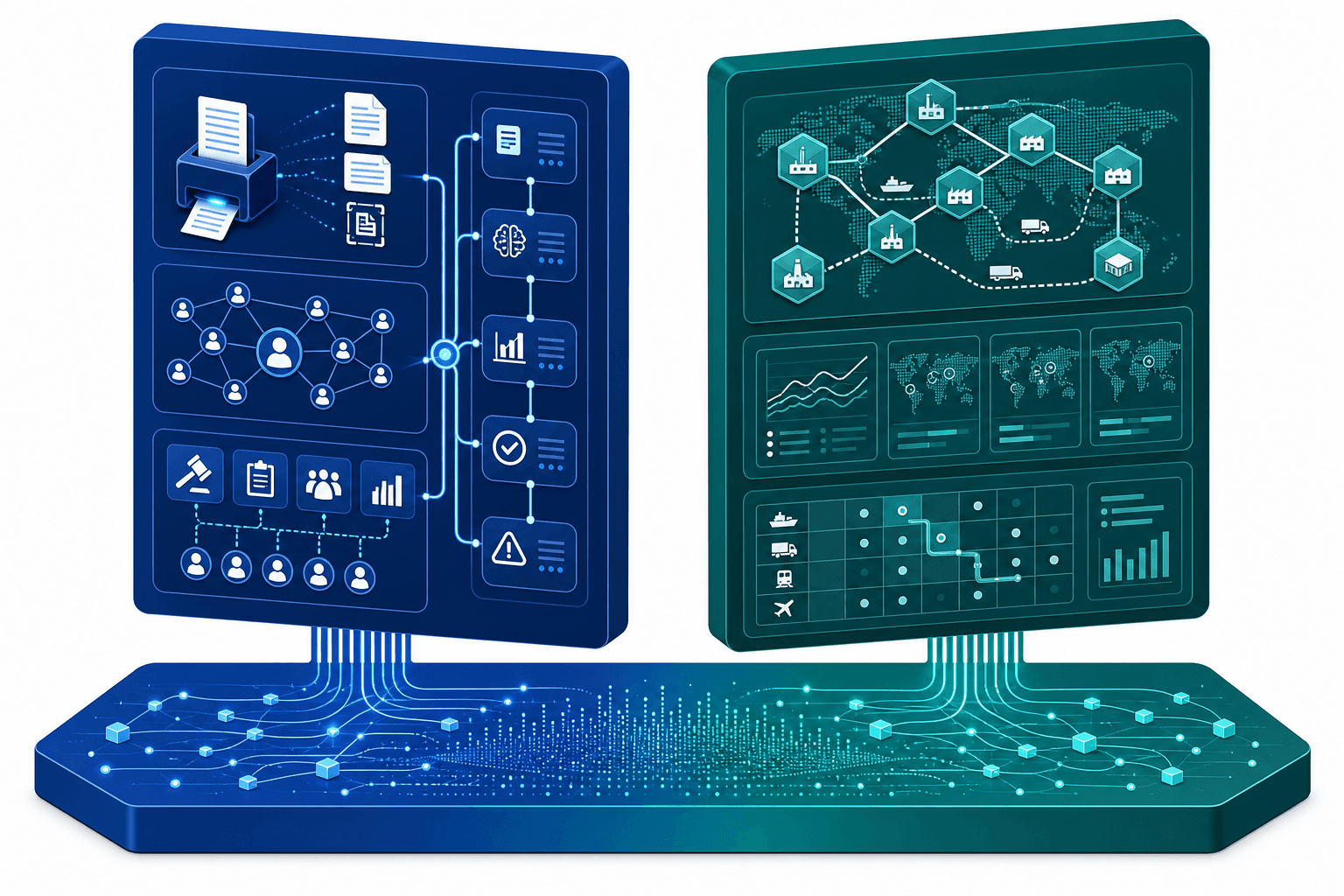
Coupa's AI capabilities in 2026 divide into two structurally distinct tracks. Understanding this split is the prerequisite for any useful evaluation of the platform.
Track 1 is the procurement-side agentic AI stack: Navi agents, Coupa Compose, Catalyst, and the recently acquired Rossum and Tonkean capabilities. This track is SaaS cloud-native, has accelerated rapidly since 2024, and is grounded in the community spend dataset. Its AI claims are described primarily in outcome language — the underlying model architecture is less technically transparent than the optimization substrate in Track 2.
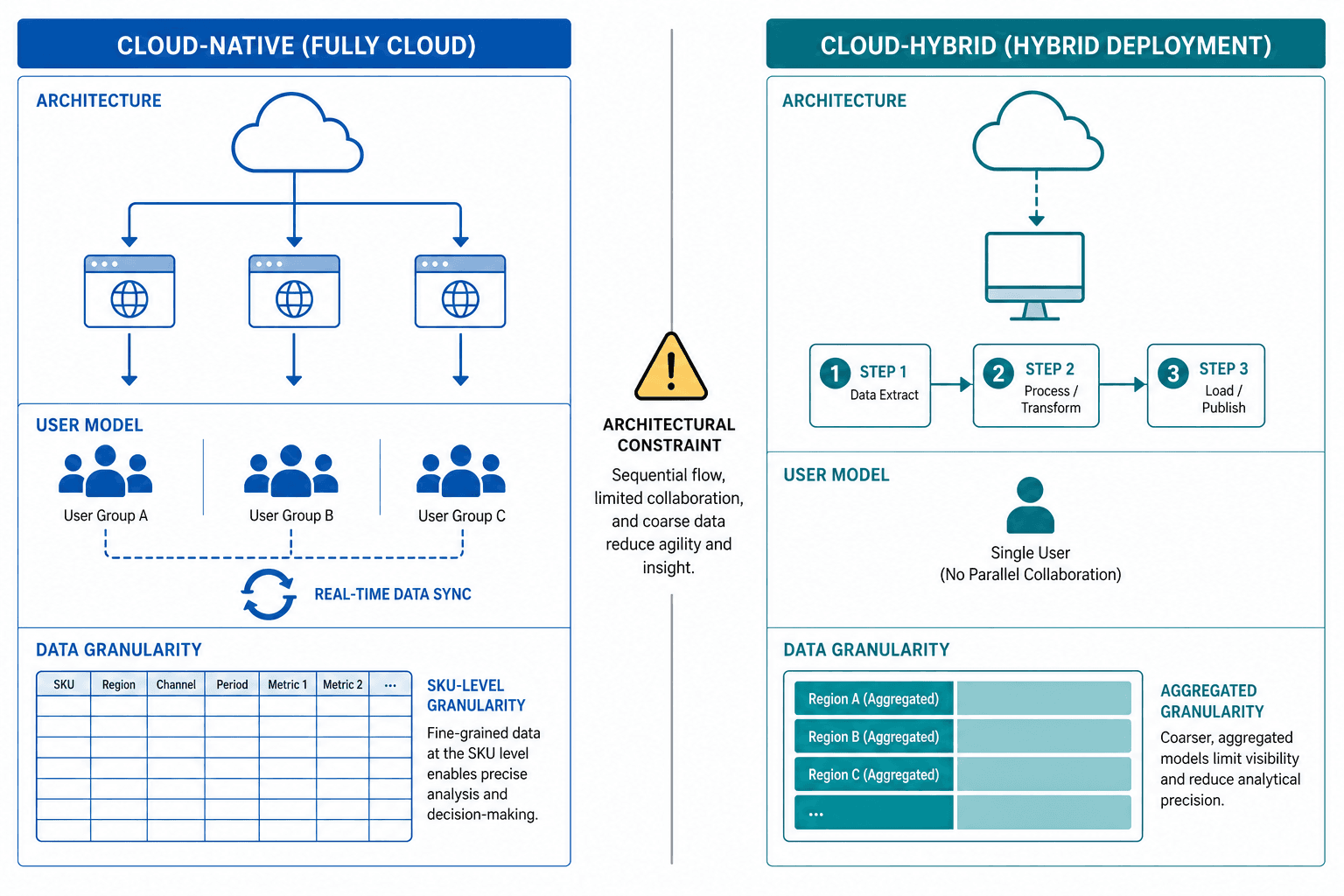
Track 2 is the supply chain design and planning layer, inherited from LLamasoft. This track has genuine technical depth — real network optimization, scenario modeling, and solver-based planning — but it operates under architectural constraints that the procurement track does not share. It is cloud-hybrid in practice, not cloud-native, and its solver architecture limits granularity to aggregated models rather than SKU-level detail.
| Dimension | Procurement AI Track | SC Design & Planning Track |
|---|---|---|
| Technical lineage | Coupa-native + acquisitions (Cirtuo, Scoutbee, Rossum, Tonkean) | LLamasoft (acquired 2020) |
| Deployment model | SaaS cloud-native | Cloud-hybrid; desktop installation required for model construction |
| AI transparency | Outcome-described; model architecture less exposed | Solver-based optimization; technically documented lineage |
| Data foundation | $10T community spend dataset (vendor-stated) | Internal operational data + $9.5T spend data for demand modeling |
| Maturity trajectory | Rapid acceleration since 2024; four acquisitions in ~12 months | Stable capability base; innovation focus shifted toward procurement side |
| Primary buyer | CPO, procurement leads, AP teams | Supply chain directors, network design analysts |
Conflating these tracks leads to predictable evaluation errors. A procurement team evaluating Coupa for source-to-pay automation will find a genuinely mature and expanding agentic platform. A supply chain team evaluating Coupa as a replacement for a cloud-native network design tool will encounter architectural constraints that the procurement-side marketing does not surface. The rest of this profile covers each track in sequence.
Procurement AI Layer: Navi Agents, Coupa Compose, and Catalyst
The procurement AI layer is where Coupa has invested most aggressively since 2024. As of May 2026, the platform includes more than 20 deployed persona-based agents, a three-component orchestration environment called Coupa Compose, and a forward-deployed AI services offering called Catalyst.
The Navi Agent Catalog
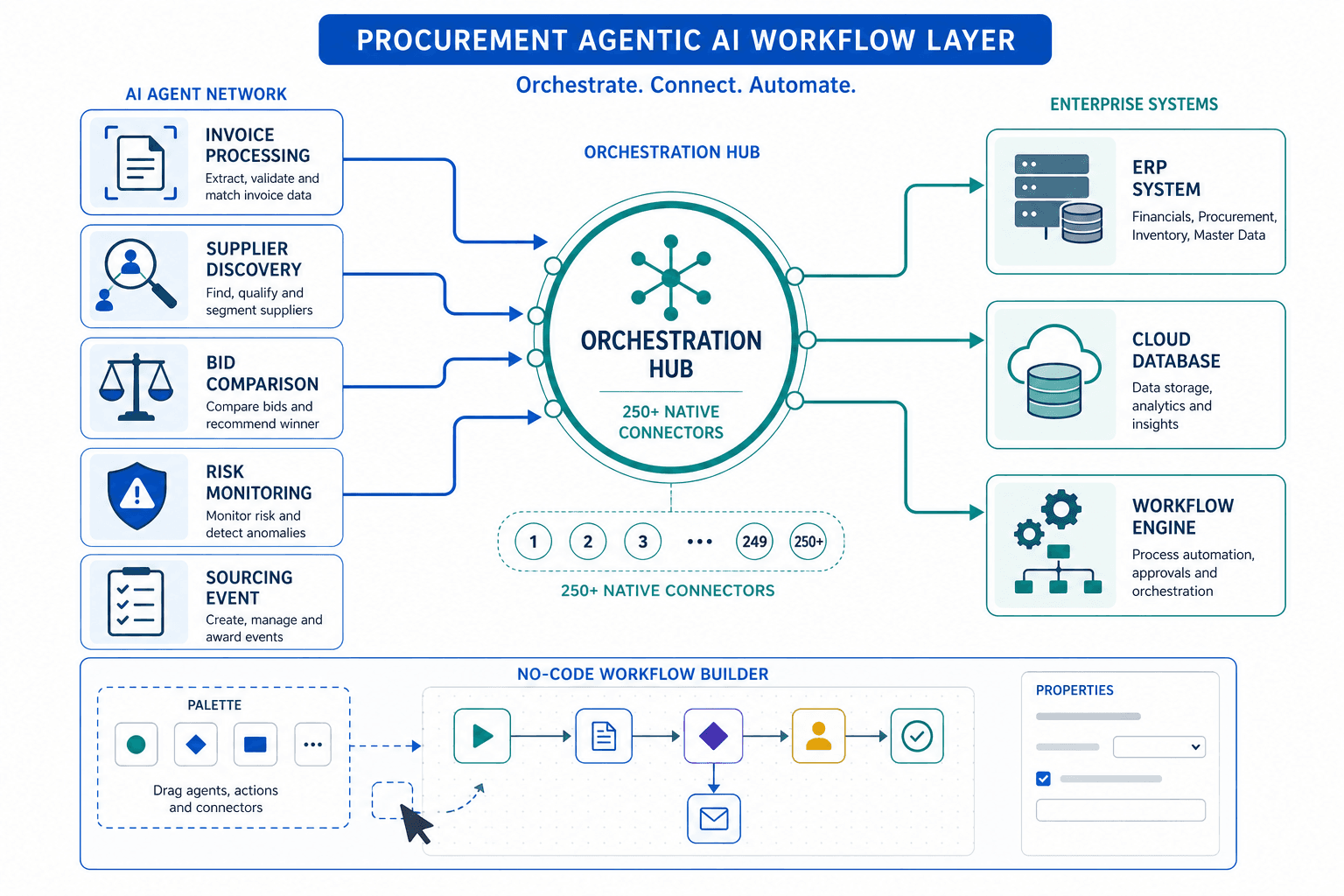
The Navi agent catalog covers the full source-to-pay process. Agents announced or generally available as of May 2026 include:
- Sourcing event creation — automated event structuring from category strategy inputs
- Bid comparison — structured evaluation of supplier responses against defined criteria
- Supplier discovery — natural language queries against the 10M+ buyer/supplier network; vendor claims up to 100% faster identification of best-fit suppliers
- Risk sentinel — ongoing supplier risk monitoring across the supply base
- Sanctions risk — automated screening against sanctions lists
- Autonomous opportunity analysis — spend pattern analysis to surface sourcing opportunities
- Scenario ranking — comparative evaluation of sourcing award scenarios
- Cost formula assistance — plain language to cost/scoring formula translation; vendor claims up to 75% faster formula creation and reduced errors
- SOW request creation — structured statement of work generation with file upload support; vendor claims up to 50% reduction in manual entry time
- Supplier assistance — self-service interface for suppliers to navigate procurement processes
Coupa Compose: Three-Component Orchestration Environment
Coupa Compose is the orchestration layer that connects agents to intake processes and enterprise systems. It comprises three components:
- Navi Agent Studio — a no-code interface for building and configuring custom agents using natural language. Became generally available in May 2026. Practitioners can create organization-specific agents without developer resources.
- Smart Intake and Orchestration — the entry point for all procurement intake requests. Preserves business context across process steps and triggers the appropriate agents at each stage, reducing the context loss that typically occurs when requests move between systems.
- Navi Connect — the agent-to-agent (A2A) integration layer enabling real-time ERP updates and cross-system communication. This is the component that Tonkean's 250+ native connectors will extend once that integration is complete.
Catalyst: Forward-Deployed AI Transformation Services
Catalyst is Coupa's professional services offering specifically designed to close the gap between product capability and operational value delivery. It deploys engineers and business solution architects directly into customer environments. For organizations that have purchased the procurement AI stack but lack the internal resources to configure agents, build intake workflows, or integrate with complex ERP landscapes, Catalyst is the primary implementation pathway Coupa offers. It is not a product feature — it is a billable services engagement.
Recent Acquisitions: Capability Additions and Integration Status
Coupa has completed four AI acquisitions since May 2025, each targeting a specific gap in the procurement AI stack. The integration status of each acquisition varies significantly, and practitioners should distinguish between announced capability and generally available capability.
| Acquisition | Closed | Core Capability | Integration Status (Q2 2026) |
|---|---|---|---|
| Cirtuo | May 13, 2025 | AI-guided category strategy creation, supplier strategy development, initiative tracking with value monitoring | Generally integrated; category strategy connects to sourcing event execution within Coupa |
| Scoutbee | October 6, 2025 | AI supplier discovery platform; natural language supplier search across global supplier base | Network enrichment integrated; buyer/supplier matching within Coupa network operational |
| Rossum | May 12, 2026 | Transactional LLM (T-LLM) trained on tens of millions of documents; intelligent document processing beyond legacy OCR | Deployed in AP/invoicing workflows; platform-wide extension across full source-to-pay is stated as planned, not yet complete |
| Tonkean | May 21, 2026 | 100% no-code intake and process orchestration; 250+ native connectors; A2A multi-agent coordination | Integration in early rollout stage; platform-wide deployment not yet complete as of article publication |
Rossum: T-LLM for Intelligent Document Processing
Rossum's core contribution is a purpose-built transactional large language model trained on tens of millions of documents. Unlike legacy OCR-based invoice processing, the T-LLM learns from each customer's specific document set, improving extraction accuracy over time. The acquisition builds on a partnership that began in 2024 for AP invoice automation. The stated integration roadmap extends IDP capabilities across the full source-to-pay process — purchase orders, contracts, goods receipts, and supplier communications — but that extension is not yet generally available across all Coupa modules.
Tonkean: No-Code Orchestration and A2A Coordination
Tonkean addresses a structural limitation in enterprise procurement automation: the difficulty of connecting AI-driven workflows to existing systems without requiring rip-and-replace architecture changes. Its 250+ native connectors wrap around existing ERP, WMS, and workflow systems without requiring replacement. The natural language process builder is designed to increase adoption among non-technical users. Vendor-stated outcomes from Tonkean's existing customer base include a 2.2x increase in user adoption and 50% cycle time reduction — these figures predate the Coupa integration and reflect Tonkean's standalone deployment history, not Coupa-specific results.
Cirtuo: Closing the Category Strategy Gap
Cirtuo was the first of the four acquisitions and is the most integrated as of Q2 2026. It provides an AI-guided, interview-style workflow for category strategy creation — a capability that previously required significant consultant time. The integration translates approved category plans directly into sourcing events within Coupa, creating a closed loop from strategic planning to tactical execution. Cirtuo customers prior to acquisition included Walmart, Johnson & Johnson, Novartis, Molson Coors, and Boeing. Vendor claims category savings realization up to 30% faster through this integration.
Supply Chain Design and Planning Layer: Capabilities and Architecture
The supply chain design and planning product is the direct descendant of LLamasoft, which Coupa acquired in 2020. It is a technically substantive offering — genuine network optimization, scenario modeling, and solver-based planning — and it serves some of the world's largest supply chains. Coupa claims 75% of top supply chains use the product, though this figure is vendor-stated and the methodology is not disclosed.
The product covers six primary capability areas:
- Network Optimization — Rapid Network Explorer for fast scenario analysis (vendor claims up to 50x faster results); Data Flow for network data management
- Transportation Optimization — AI-assisted route, carrier, and equipment selection with Scope 1, 2, and 3 emissions tracking
- Inventory Optimization — SKU-level stocking policies and safety stock calculation, supported by Navi SC agents (Knowledge Management Agent and Network Modeling Agent)
- Demand Modeling — AI-powered demand forecasts drawing on $9.5 trillion in community spend data (vendor-stated)
- Tariff Impact Planning — AI-assisted modeling of tariff, tax, and duty impacts across product categories and sourcing geographies
- App Studio — low-code environment with pre-built templates for scenario communication and visual reporting
The product is packaged in three tiers: Essentials, Advanced, and Orchestrator, with unlimited user licensing across all tiers. The Navi Supply Chain Agents — Knowledge Management Agent and Network Modeling Agent — are positioned as AI assistants that allow analysts to query models and surface insights through natural language.
Deployment Model and Integration Requirements
The deployment reality for Coupa's two tracks differs substantially, and this is where evaluation errors are most consequential.
Procurement Suite: SaaS Cloud-Native
The procurement platform — source-to-pay, Navi agents, Coupa Compose, and the newly acquired Rossum and Tonkean capabilities — deploys as SaaS. No local installation is required for the core procurement workflows. ERP integration is handled through APIs, Navi Connect, and (post-Tonkean) the 250+ native connector library.
SC Design & Planning: Cloud-Hybrid in Practice
Coupa's own product page describes the SC Design & Planning product as cloud-native. Independent sources — including analysis from Supply Chain Xchange (August 2025) cited in the Optilogic review, and the Lokad independent assessment — document a different deployment reality: model construction and data integration through Data Guru still require desktop installation.
The practical consequences of the desktop-hybrid architecture are significant:
- Scenarios must run sequentially, not in parallel — analysts must choose which questions to pursue rather than running simultaneous scenario sets
- No real-time cross-functional collaboration — multiple analysts cannot work on the same model simultaneously
- Solver operates at aggregated data levels — models cannot be built at SKU-level granularity for network optimization purposes
- Desktop installation creates IT governance overhead — particularly relevant in organizations with strict endpoint management policies
ERP Integration Complexity
ERP integration is a consistent source of implementation friction across both tracks. Coupa itself has acknowledged that SAP ECC and S4HANA integration is non-trivial. Verified user reviews across G2, Capterra, and TrustRadius describe implementation as complex and time-consuming, particularly in global enterprise environments. Oracle and Microsoft D365 integration playbooks exist but carry similar complexity.
Rolling out Coupa across global or large enterprises can be complex and time-consuming. Coupa is highly configurable but not easily customizable beyond its standard framework.
The quote above is drawn from verified user reviews aggregated by Stampli, a Coupa competitor in the AP automation market. The framing reflects Stampli's editorial bias, but the quoted user text references verifiable third-party platforms. The SAP integration acknowledgment appears in Coupa's own materials.
| Integration Target | Status | Known Friction Points |
|---|---|---|
| SAP ECC / S4HANA | Supported; acknowledged as non-trivial by Coupa | Configuration complexity; no plug-and-play path |
| Oracle ERP Cloud | Supported via integration playbook | Similar configuration overhead to SAP |
| Microsoft D365 | Supported via integration playbook | Playbook exists; complexity varies by org configuration |
| Other ERPs | Via Navi Connect / Tonkean connectors (250+ post-integration) | Tonkean integration not yet fully complete as of Q2 2026 |
Data Prerequisites
The procurement AI layer's community-grounded capabilities — benchmarking, supplier discovery, spend analysis — require that the customer contribute transaction data to Coupa's community dataset. Organizations with strict data governance policies should evaluate the contribution model before assuming community AI features are available on day one.
The SC design layer requires clean master data — facility data, cost structures, transportation lanes, and demand history — before meaningful network modeling is possible. The Data Guru integration tool handles data preparation but requires the desktop installation described above.
Documented Gaps and Limitations
The following limitations are drawn from independent reviews, verified practitioner accounts, and Coupa's own disclosed documentation. They are presented as first-class evaluation criteria, not as caveats.
SC Design Layer Constraints
- Desktop dependency for model construction — Model construction and Data Guru data integration require local installation despite cloud solver additions. This is corroborated by Lokad's independent review and Supply Chain Xchange (August 2025).
- Sequential solving ceiling — Scenarios must run one at a time. Cloud-native competitors offer parallel scenario execution that Coupa's architecture does not currently match.
- Solver aggregation constraints — Network optimization solvers cannot scale to SKU-level data. Models must be built at aggregated levels, limiting fidelity for B2C use cases, same-day delivery modeling, and high-SKU-count distribution networks.
- Limited probabilistic modeling depth in the public record — Coupa's SC design documentation does not prominently describe probabilistic forecasting capabilities. Practitioners requiring deep probabilistic demand modeling should verify this capability directly before relying on it.
- Aging algorithm architecture — The LLamasoft-derived solver architecture is functional but documented as difficult to configure for complex rule modeling. Innovation in this layer appears to have slowed relative to the procurement side.
Procurement AI Layer Constraints
- Rossum and Tonkean not yet fully integrated — Both acquisitions closed in May 2026. Platform-wide rollout is in early stages. Capabilities described in acquisition press releases should not be assumed to be generally available across all Coupa modules.
- Lower technical transparency of AI claims — The Navi agent and Community.ai capabilities are described in outcome language. The underlying model architecture is not as technically documented as the LLamasoft optimization substrate. Practitioners who need to audit AI model behavior will find less to work with on the procurement side.
- Implementation complexity and support quality — Verified user reviews across G2, Capterra, and TrustRadius consistently cite complex implementation, poor UI in some modules, and slow support response times. One reviewed user noted support answers were 'really vague, not really addressing the issue or question submitted.'
- Community dataset contribution requirements — Community-grounded AI features depend on data contribution. Organizations with restrictive data governance may not have access to the full community intelligence layer.
Strategic Risk
Verified Customer Outcomes: Conditions and Scope
The following outcomes are drawn from attributed practitioner accounts and named-source reporting. Each is presented with the specific product, conditions, and source that generated the result.
| Organization | Product Used | Outcome | Source |
|---|---|---|---|
| Jabil | Coupa Advanced Sourcing Optimization (CSO) | Logistics sourcing cycle time reduced from weeks to hours; approximately $25 million in savings and cost avoidance | FreightWaves, Jabil spokesperson |
| M. Dias Branco | Coupa SC Design & Planning (network optimization) | 14% cost-to-serve reduction for cookies; 24% cost-to-serve reduction for pasta | FreightWaves |
| Grupo Bimbo | Coupa SC Design & Planning | Network complexity management across ~200 manufacturing sites, 100+ co-manufacturers, and ~157,000 delivery routes serving 3 million points of sale | FreightWaves |
The Jabil result is particularly relevant for practitioners evaluating Coupa CSO for transportation sourcing. The FreightWaves reporting quotes the Jabil spokesperson directly on the shift from weeks to hours for analysis, and the $25 million figure is attributed to a Jabil spokesperson, not a Coupa marketing claim.
Fit Assessment: When Coupa Is and Is Not the Right Choice
The following criteria are structured around the two tracks. A practitioner who clearly identifies which track addresses their primary problem will arrive at a more accurate fit assessment than one who evaluates Coupa as a single unified platform.
Strong Fit Conditions
- The primary problem is source-to-pay automation at enterprise scale — procurement workflows, supplier management, contract lifecycle, and spend visibility are the core requirements
- The organization needs category strategy management connected to sourcing execution, and Cirtuo's closed-loop approach aligns with the procurement operating model
- Supplier discovery and risk intelligence across a large, global supply base are priorities — Coupa's 10M+ buyer/supplier network and Scoutbee integration provide genuine scale here
- The existing ERP environment is SAP or Oracle and the organization has the implementation resources (internal or via Catalyst) to manage integration complexity
- The supply chain design use case is strategic network modeling and scenario analysis at aggregated levels — Grupo Bimbo-scale complexity with facility and route network optimization, not real-time SKU-level planning
- The organization values a unified spend management network with procurement, sourcing, and supply chain design in a single platform and is willing to accept the architectural constraints of the SC design layer
Weaker Fit Conditions
- The primary need is real-time collaborative supply chain network design with multiple analysts working simultaneously on the same model — the desktop-hybrid architecture does not support this
- SKU-level network optimization granularity is required — the solver architecture operates at aggregated levels for network design, and this is a documented constraint, not a configuration choice
- B2C fulfillment modeling, same-day delivery network design, or high-velocity e-commerce distribution planning is the core use case — the solver aggregation ceiling limits fidelity for these scenarios
- Probabilistic demand planning as a standalone capability is the primary requirement — Coupa's demand modeling draws on spend data but does not have the probabilistic depth of specialist demand planning vendors
- The organization needs fully integrated intelligent document processing across the full source-to-pay process today — Rossum's platform-wide extension is planned, not yet complete
- The implementation team is lean and the organization cannot absorb complex ERP integration work — verified practitioner reviews consistently flag this as a resource-intensive process
Comments
Join the discussion with an anonymous comment.