


Why Quarterly Re-Slotting Fails in High-Velocity Conventional DCs
Most high-velocity distribution centers re-slot on a quarterly or annual cycle. The operational logic is straightforward: gather order data, reclassify SKUs by velocity tier, move product to better locations. The problem is that SKU velocity profiles in a high-velocity DC do not wait for the next scheduled review. Seasonal shifts, promotional lifts, product launches, and assortment changes continuously alter which items are moving fastest—and every pick cycle between re-slotting events runs against an increasingly misaligned slot assignment.
That misalignment compounds. A fast-moving item slotted in a secondary zone forces pickers to travel further on every order that includes it. Across thousands of picks per shift, the aggregate travel penalty is substantial. And because the slot assignment stays wrong until the next re-slotting event, the loss accumulates for weeks or months.
Labor is the primary cost lever this affects. Industry data from Speed Commerce confirms that labor accounts for approximately 45–55% of total warehouse operating costs. Picker travel efficiency is one of the most controllable components of that spend. When slot assignments lag demand, labor efficiency degrades in a way that is both measurable and preventable.
AI slotting optimization addresses the lag problem by replacing the periodic re-slotting cycle with a continuous scoring process. The technology sits above existing RF and voice-directed operations—it does not require changes to pick execution hardware or WMS pick logic. What it changes is how slot assignments are generated and how frequently they are updated.
What AI Slotting Actually Does Differently from WMS-Native Rules
Most WMS platforms include some form of slotting capability. Before evaluating a standalone AI slotting engine, operations directors need to understand what WMS-native slotting actually does—and where its ceiling is.
WMS-native slotting applies location rules defined by the warehouse manager: product class, velocity tier (ABC), physical dimensions, storage type. When a product arrives or a periodic review triggers, the WMS classifies the product and assigns it to a location that matches the manager's predefined criteria. The rules are static until a manager changes them. The system does not re-evaluate assignments based on observed demand shifts between review cycles.
AI slotting engines operate differently. Rather than applying manager-defined static rules, they continuously score and re-rank slot assignments using velocity patterns, demand signals, and pick path impact modeling. The scoring updates as order data accumulates, which means the system can identify when a SKU's velocity profile has shifted enough to warrant a slot move—without waiting for a scheduled review.
| Dimension | WMS-Native Rule-Based Slotting | AI Slotting Engine (Standalone) |
|---|---|---|
| Assignment logic | Static rules defined by warehouse manager | Continuous algorithmic scoring using demand patterns |
| Re-evaluation trigger | Periodic review or manual override | Ongoing; triggered by velocity threshold changes |
| Pick path impact modeling | Typically not included | Combinatorial optimization factoring travel time |
| Seasonal/promotional handling | Requires manual reclassification | ML-based demand pattern classification |
| Digital twin simulation | Not available in most platforms | Available in platforms like FORTNA OptiSlot DC |
| Integration requirement | Embedded in WMS | API or flat-file integration with WMS required |
FORTNA OptiSlot DC is the most documented standalone AI slotting platform for conventional DC environments. It uses advanced algorithms and digital twin simulation to generate slot recommendations and allows operators to preview proposed changes against real order data before executing physical moves—reducing the risk of large-scale re-slotting disruptions.
AI Technique Mechanics in Conventional Pick Environments
Three algorithmic approaches underpin most AI slotting implementations in conventional pick environments. Understanding what each does helps operations teams evaluate vendor claims and anticipate where data quality will constrain output.
- Velocity-weighted zone scoring: The system assigns each SKU a velocity score based on order frequency, pick quantity, and recency weighting. Scores are used to rank SKUs for placement in golden zones—locations closest to pack stations, at optimal ergonomic height, with the shortest average travel from the pick start point. The scoring updates continuously as new order data flows in, rather than waiting for an ABC reclassification cycle.
- Combinatorial optimization for pick path impact: Slot assignment decisions are not independent. Moving a high-velocity SKU to a golden zone only improves outcomes if the SKUs co-located in that zone complement each other in terms of order co-occurrence. Combinatorial optimization models the aggregate pick path impact of proposed slot assignments across the actual order mix—not just individual SKU velocity. This is where AI slotting diverges most clearly from simple ABC-based zone assignment.
- ML-based demand pattern classification for re-slot triggering: Rather than re-evaluating all slot assignments on a fixed schedule, ML classification identifies which SKUs have experienced statistically significant velocity changes and flags them for re-slot consideration. This reduces the volume of slot moves to those with meaningful ROI potential and avoids unnecessary disruption to stable assignments.
Picker travel time reduction is a downstream benefit of better slot assignments, not a direct output of the slotting engine itself. The slotting engine determines where SKUs live; the pick path algorithm determines the sequence in which a picker visits those locations. These are related but distinct optimization problems. For the routing dimension, see the companion article on AI pick path optimization in high-velocity distribution centers.
Data Prerequisites and Minimum Quality Thresholds
AI slotting engines are only as reliable as the data they consume. The most common implementation failure in conventional DC deployments is not a technology problem—it is a data problem that was not identified before vendor engagement. This section defines the minimum data conditions required to generate reliable slot recommendations.
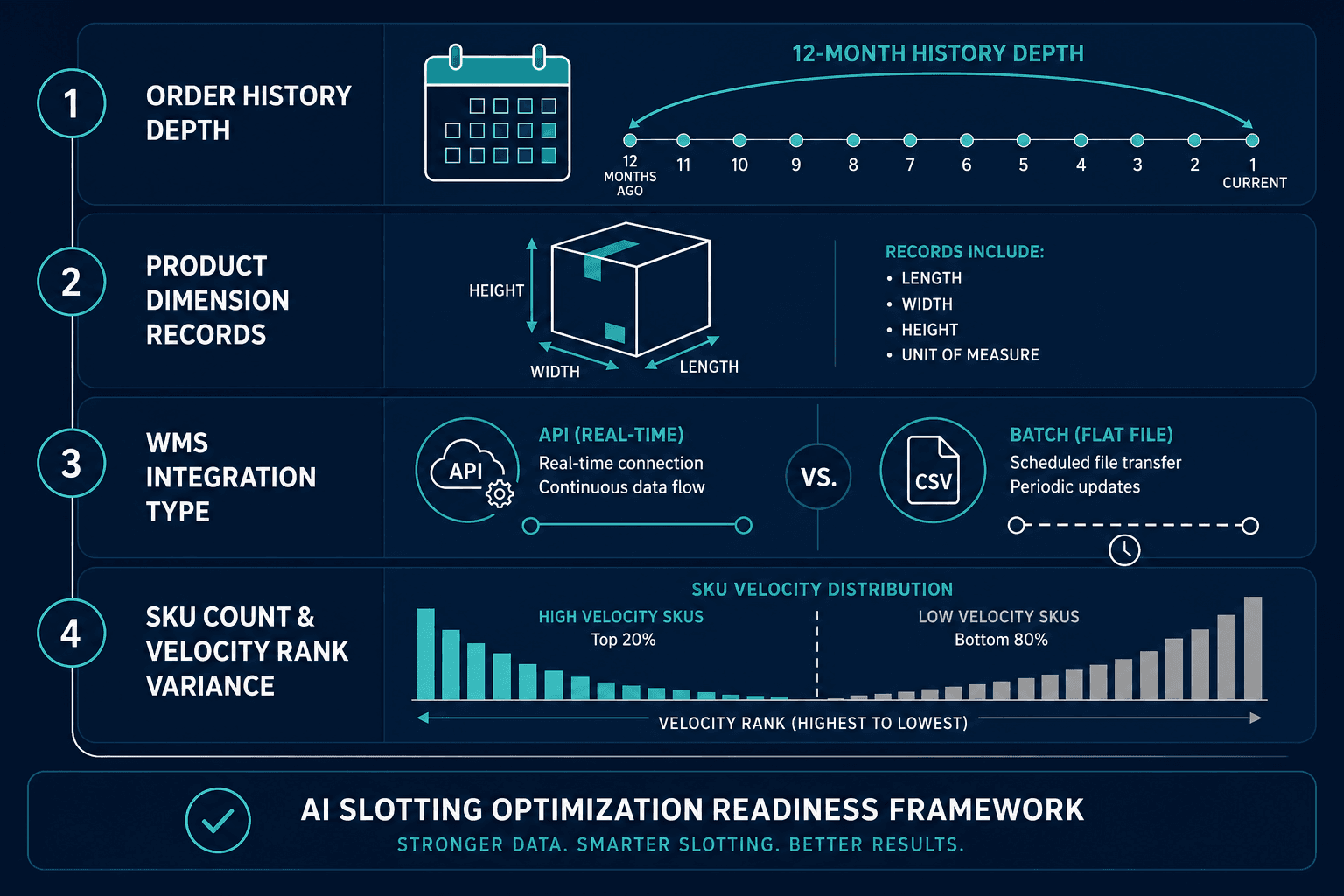
- Order history depth with location-level pick data: A practitioner guideline of 12 months of order history is a reasonable starting threshold, with data captured at the location level—meaning the system knows which specific slot a pick was fulfilled from, not just which SKU was picked. Aggregate SKU-level order history without location attribution limits the engine's ability to model actual pick path impact. Seasonal businesses should verify they have at least one full demand cycle represented.
- Product dimension and weight accuracy: Slot assignment recommendations depend on matching product physical characteristics to location constraints. Missing or inaccurate dimension records cause the engine to recommend placements that are physically incompatible with the assigned location—a failure that is only discovered during physical execution. Dimension data accuracy should be validated before implementation begins, not during.
- Location master completeness: The location master in the WMS must accurately reflect the physical layout of the DC, including aisle, bay, level, and slot capacity attributes. Gaps or errors in the location master propagate directly into slot recommendations. A common issue is locations that exist in the WMS but have been physically blocked, repurposed, or are otherwise unavailable—these must be reconciled before the AI engine is run.
- Slot utilization tracking currency: The WMS must accurately reflect what is physically in each slot at the time of recommendation generation. In DCs with informal slot assignment practices—where pickers or putaway staff place product in available locations without updating the WMS—the system's location data diverges from physical reality. Feeding this diverged data to an AI engine produces recommendations based on a warehouse that does not exist.
| Data Requirement | Minimum Threshold | Common Gap Condition |
|---|---|---|
| Order history depth | 12 months, location-level pick data | Aggregate SKU history only; no location attribution |
| Product dimensions | Length, width, height, weight for all active SKUs | Missing records for slow-moving or recently added SKUs |
| Location master | Complete aisle/bay/level/capacity attributes | Physically blocked or repurposed locations still active in WMS |
| Slot occupancy currency | WMS reflects actual physical slot contents | Informal putaway practices create divergence from WMS records |
| Velocity history granularity | Daily or weekly order frequency per SKU | Only monthly or period-end snapshots available |
WMS Integration Readiness: API vs. Flat-File Exchange
The integration architecture between the AI slotting engine and the WMS has a direct and often underestimated impact on optimization value. This is not a technical implementation detail—it determines how frequently the system can act on its recommendations and how much of the theoretical benefit is captured in practice.
Real-time API integration enables closed-loop slot execution. When the slotting engine identifies a slot move, it can push the updated assignment directly to the WMS, which then directs putaway or replenishment staff to execute the move as part of normal workflow. The system can also receive live inventory and order data, keeping its scoring model current without manual data exports.
Batch or flat-file exchange introduces latency at both ends of the data flow. The engine receives order and inventory data on a scheduled export cycle—daily or weekly in many legacy WMS configurations—and slot recommendations must be manually imported back into the WMS. This latency degrades the benefit of more frequent re-slotting cycles. If the data feeding the engine is already 24 hours old and slot move execution takes another 24–48 hours to coordinate, the effective re-slotting frequency is constrained regardless of how sophisticated the algorithm is.
| Integration Type | Data Latency | Slot Move Execution | Effective Re-Slotting Frequency | Optimization Value Captured |
|---|---|---|---|---|
| Real-time API | Near-zero | System-directed, embedded in putaway workflow | Continuous or near-continuous | High |
| Daily batch / flat-file | 24 hours | Manual import, separate coordination required | Weekly at best | Moderate |
| Weekly or periodic batch | 7+ days | Manual planning event required | Monthly or less frequent | Low—comparable to manual re-slotting |
For RF-directed environments, slot move execution also requires that the WMS can direct putaway or replenishment staff to the correct source and destination locations via the RF terminal. This means the slot assignment update must be reflected in the WMS before the move is directed—not after. Confirming this workflow with the WMS vendor before implementation prevents a common operational gap where slot moves are recommended but cannot be systematically executed through existing RF workflows.
Applicability Conditions: Is Your DC a Good Candidate?
Not every conventional DC will achieve meaningful ROI from AI slotting optimization. The technology delivers the fastest payback in environments where several specific conditions are present. This framework is designed for self-assessment before vendor engagement—not as a definitive qualification gate.
- SKU count above 5,000 active items: Below this threshold, the combinatorial complexity that AI optimization addresses is manageable through manual or rule-based approaches. Above it, the number of possible slot configurations exceeds what periodic manual review can optimize effectively.
- High velocity rank variance across seasons or product categories: If your top 20% of SKUs by velocity are largely stable year-round, the benefit of continuous re-scoring is limited. The strongest candidates are DCs where seasonal demand, promotional cycles, or new product introductions regularly shift which items are moving fastest—creating persistent gaps between current slot assignments and optimal placement.
- Current re-slotting cycle longer than 90 days: The longer the gap between re-slotting events, the more misalignment accumulates. DCs re-slotting quarterly or annually are the primary beneficiaries of moving to a continuous or near-continuous optimization model.
- Labor cost as a primary operational concern: AI slotting's ROI case is strongest when picker travel time is a material cost driver. DCs with very short pick aisles, low order complexity, or already-optimized zone layouts will see smaller travel time reductions.
- No AMR or goods-to-person infrastructure: In AMR-augmented environments, slot assignments interact with robot navigation and dispatch logic in ways that require a different optimization approach. The applicability conditions in this article are specific to conventional pick operations.
A documented real-world example of conventional DC AI slotting is the Tandy Brands belt accessories distribution center in Dallas—a 185,000+ square foot conventional pick operation that used FORTNA OptiSlot DC to optimize velocity-based slotting. The project required resolving data accuracy issues before generating a slotting blueprint, and the team evaluated tradeoffs between pure velocity-based slot assignments and retail customer grouping requirements. After implementation, the DC achieved its target of replenishing no more than twice per week for 92% of items—a meaningful operational result in a non-automated environment.
Documented Failure Modes in Conventional DC Deployments
AI slotting implementations in conventional DCs fail in predictable patterns. Understanding these failure modes before deployment is more valuable than discovering them during or after rollout.
- WMS location data that does not reflect physical slot occupancy: This is the primary failure mode. In DCs where informal putaway practices allow staff to place product in available locations without updating the WMS, the system's location records diverge from physical reality over time. When an AI slotting engine consumes this data, it generates recommendations based on a warehouse configuration that does not exist. Slot moves are directed to locations that are already occupied, blocked, or physically inaccessible. The fix requires a data reconciliation process—physical location audits cross-referenced against WMS records—before the optimization engine is run. The Tandy Brands case explicitly documented data collection and correction as a two-week precondition before generating a slotting blueprint.
- Organizational change management gaps: Experienced pickers in conventional DCs develop spatial memory of SKU locations. When AI slotting generates a large batch of slot moves, it disrupts that memory, temporarily increasing pick errors and travel time until pickers re-learn the new layout. Operations teams that do not prepare pickers for this transition period—and do not have a process for communicating slot changes through the RF system—often see short-term productivity drops that undermine confidence in the technology. Phased implementation with clear communication protocols mitigates this.
- Over-optimization for peak demand that degrades base-demand performance: AI slotting engines that are tuned primarily on peak-season order data will generate slot assignments optimized for that demand profile. When demand returns to base levels, the slot configuration may no longer reflect the actual velocity distribution, and the system may not re-optimize quickly enough if re-slotting cycles are long or if the velocity shift is gradual. This failure mode is particularly relevant for seasonal DCs. Mitigation requires configuring the engine to weight demand patterns across the full demand cycle, not just the most recent or most intense period.
ROI Benchmarks and What to Measure
Published ROI figures for AI slotting in conventional DC environments come primarily from vendor-published case studies and product documentation. They should be treated as directional benchmarks, not independently verified industry averages. The following figures are sourced from FORTNA's OptiSlot DC product documentation and customer case study summaries.
| Metric | Directional Benchmark | Source / Attribution |
|---|---|---|
| Productivity gain | ~10% | FORTNA OptiSlot DC product page (vendor-published) |
| Damage reduction | ~40% | FORTNA OptiSlot DC product page (vendor-published) |
| Replenishment frequency reduction | ~12% | FORTNA OptiSlot DC product page (vendor-published) |
| Picker travel time reduction | 10–20% range | Directional range from non-automated environment deployments |
| Replenishment target achievement | 92% of items at ≤2x/week | Tandy Brands case study (Inbound Logistics, 2010) |
Boston Scientific is documented as a FORTNA OptiSlot DC customer that achieved reductions in replenishment frequency, reduced order picking travel time, and improved capacity utilization within their distribution center. Specific figures are not publicly disclosed beyond these directional outcomes.
For internal measurement, the most actionable metrics in a conventional DC context are:
- Picker travel time per order line (baseline vs. post-slotting): the most direct measure of slot assignment quality
- Replenishment frequency per SKU: a proxy for slot size appropriateness and velocity alignment
- Labor cost per order: the aggregate efficiency measure that incorporates both travel and replenishment labor
- Slot move execution rate: the percentage of AI-recommended slot moves that are actually executed, which reveals organizational adoption gaps
Implementation Sequencing for Conventional Pick Operations
Successful AI slotting deployments in conventional DCs follow a sequenced approach that validates data quality before generating recommendations and limits initial scope to a manageable pilot zone before expanding. The following sequence reflects the pattern documented in conventional DC deployments and the broader warehouse AI implementation literature.
- Establish baseline measurements: Before any system configuration, document current picker travel time per order line, replenishment frequency per SKU category, and labor cost per order. These baselines are the only credible basis for measuring post-implementation improvement. Without them, ROI claims cannot be validated and organizational confidence in the technology is difficult to build.
- Conduct data reconciliation: Audit physical slot occupancy against WMS location records for the pilot zone. Correct dimension data gaps for all active SKUs in scope. Confirm that the location master accurately reflects physical layout constraints. The Tandy Brands case completed this step in approximately two weeks before generating a slotting blueprint—treat this as a realistic minimum for a bounded pilot zone.
- Select a bounded pilot zone: Choose a zone with sufficient SKU count and velocity variance to generate meaningful optimization signal, but small enough that slot move execution can be coordinated without disrupting the full operation. A single pick module or aisle cluster is a reasonable starting scope.
- Run digital twin simulation before physical execution: Platforms like FORTNA OptiSlot DC allow operators to preview proposed slot changes against real order data before any physical moves are made. Use this capability to validate recommendations, identify conflicts with operational constraints (customer grouping requirements, hazmat adjacency rules, ergonomic policies), and build internal confidence before committing to execution.
- Execute slot moves with picker communication protocol: Coordinate slot move execution with shift supervisors. Ensure that RF terminals reflect updated slot assignments before pickers begin shifts in the affected zone. Brief pickers on the changes and establish a feedback mechanism for reporting location errors discovered during picks.
- Measure against baseline and apply phase-gate criteria before expansion: After a defined measurement period (typically 4–8 weeks in a conventional pick environment), compare pilot zone metrics against baseline. Apply predefined phase-gate criteria before expanding to additional zones. For detailed phase-gate sequencing criteria applicable to warehouse AI implementations, see the pilot-to-production phase-gate framework for warehouse AI.
Comments
Join the discussion with an anonymous comment.