

Vendor Snapshot
Blue Yonder is a supply chain software company headquartered in Scottsdale, Arizona, operating as a wholly owned subsidiary of Panasonic Holdings Corporation following Panasonic's $8.5 billion acquisition in September 2021. The company traces its commercial roots to i2 Technologies, which merged with JDA Software to form the JDA entity that rebranded as Blue Yonder in 2020. That lineage is operationally significant: the 19 consecutive years of Gartner TMS Magic Quadrant Leadership the company claims encompasses the full i2/JDA/Blue Yonder history, not just the post-rebrand period.
Since the Panasonic acquisition, Blue Yonder has executed three material acquisitions that have broadened its functional perimeter: Doddle (October 2023, adding e-commerce returns capability), flexis (April 2024, adding manufacturing planning), and One Network Enterprises ($839 million, closed August 2024, adding a multi-enterprise trading partner network). Each acquisition expanded what the platform can address. Each also added integration complexity to a product estate that was already assembled from legacy foundations.
Blue Yonder reports serving more than 3,000 customers across 81 countries and 13 named industries. Because the company operates as a Panasonic subsidiary and does not publish standalone financial results, these scale figures are vendor-stated and cannot be independently verified from public filings. The company also reports that 19 companies in the Gartner Supply Chain Top 25 are among its customer base — a figure cited by LedgerSupply's 2026 independent review.
Platform Architecture
Blue Yonder's platform is built on what the company calls the Luminate Platform — a cloud-native, Azure-hosted microservices architecture that serves as the shared data and AI foundation across all functional modules. The defining architectural choice is the use of Snowflake Data Cloud as a unified data layer: rather than each module maintaining its own data store, agents and modules share a single cloud data foundation. In principle, this means the Warehouse Decisioning Agent can access the same demand signal data that the Transportation Precision Agent is acting on, without requiring custom API bridges between them.
The platform is designed as composable — modules can be deployed independently and phased in over time rather than requiring a full-suite implementation at once. This composability is a genuine architectural advantage for large enterprises that want to start with one or two modules and expand. It is also the basis for the company's argument that new agentic AI capabilities can be added to existing deployments without replacing underlying systems.
Module-by-Module Functional Breakdown
Blue Yonder's functional perimeter spans seven distinct areas. The depth and architectural maturity varies by module — the original JDA planning and WMS capabilities are the most battle-tested, while newer additions from acquisitions are still being integrated into the common platform.
| Module | Core Capabilities | Maturity Signal |
|---|---|---|
| Supply Chain Planning | Demand sensing, inventory optimization, replenishment, network design | Original core strength; 12 consecutive Gartner SCP MQ Leader years |
| WMS | Robotics Hub, Yard Management, Advanced Slotting, Labor Management, multi-client warehouse support | 25+ years of functionality; Gartner Level 3–4 use case depth; 14 consecutive WMS MQ Leader years |
| TMS | Multimodal freight planning, freight audit and settlement, transportation modeling, sustainability emissions tracking | 19 consecutive TMS MQ Leader years; strongest in strategic freight, not last-mile dispatch |
| Order Management | Omnichannel fulfillment, fulfillment agent, customer service agent | Native AI agents added in 2025–2026 product cycle |
| Retail Planning | Merchandise Financial Planning, Assortment Planning, Micro Space Planning, Lifecycle Pricing, Allocation and Replenishment | Retail-specific depth; enhanced AI agents announced January 2026 |
| Workforce Management | Labor scheduling, task management for warehouse and store operations | Integrated with WMS labor optimization layer |
| One Network | Multi-enterprise trading partner collaboration, 172,000+ global partners | Acquired August 2024; integration maturity with legacy modules still maturing |
Supply Chain Planning
Supply chain planning is where Blue Yonder's deepest technical investment is concentrated. The module covers demand sensing, multi-echelon inventory optimization, replenishment, and network design. It is the capability that has driven 12 consecutive years of Gartner Magic Quadrant Leadership in supply chain planning, with Blue Yonder positioned furthest right for Completeness of Vision in the April 2025 report. Evaluators considering Blue Yonder primarily for planning-layer capabilities should also review the AI Demand Planning Software comparison covering Blue Yonder, o9 Solutions, Kinaxis, and Anaplan for a multi-vendor planning-layer assessment.
Warehouse Management System
Blue Yonder's WMS carries more than 25 years of accumulated warehouse execution functionality. The May 2025 Gartner Critical Capabilities report ranked it second highest for Level 3 and Level 4 warehouse operations use cases and among the top five for Level 5 — a meaningful signal for enterprises running complex, high-throughput distribution networks. The module includes a Robotics Hub for integrating automated material handling equipment, Yard Management, Advanced Slotting, and Labor Management. For a side-by-side WMS comparison against Körber and Manhattan Associates, see the AI WMS Vendor Comparison: Körber, Manhattan Associates, Blue Yonder.
Transportation Management System
Blue Yonder's TMS is positioned as a strategic freight and global network orchestration platform, not a last-mile dispatch tool. Its strengths are in comprehensive multimodal planning, advanced network modeling, multileg optimization, freight audit and settlement, and sustainability emissions tracking — CO₂ visibility across modes, lanes, and carriers. The platform also includes transportation modeling and scenario analysis capabilities, which Wegmans used to achieve a 4.75% cost reduction per Blue Yonder's 2026 TMS Magic Quadrant blog. The Logistics Ops Agent, introduced in the 2025–2026 product cycle, surfaces alerts for unrouteable loads and backhaul opportunities within the TMS workflow.
AI Capability Layer: Predictive, Generative, and Agentic
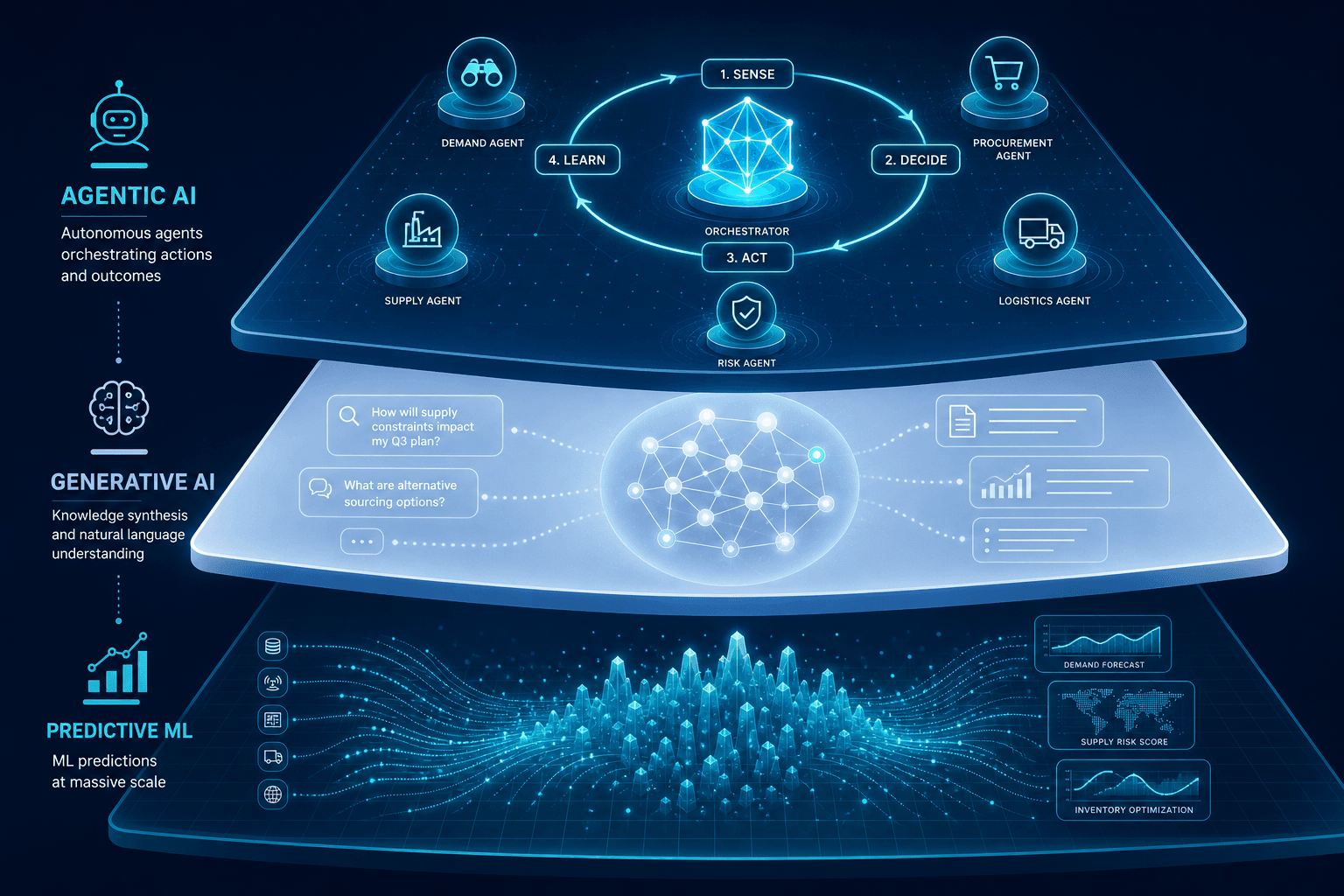
Blue Yonder organizes its AI capabilities into three distinct layers. Understanding the distinction matters for evaluators, because the evidence base for each layer differs significantly in terms of independent verifiability.
Layer One: Predictive ML via Cyclic Boosting
Cyclic Boosting is Blue Yonder's core predictive machine learning method — an open-source, explainable, gradient-boosting-based approach that is publicly documented on GitHub and arXiv. It is not a deep learning architecture. The platform uses it to generate approximately 25 billion AI/ML predictions daily across demand, inventory, and replenishment applications. Because the method is open-source and publicly documented, it is the most independently verifiable AI claim in the Blue Yonder product portfolio. For methodology depth on how Cyclic Boosting operates in demand planning contexts, see the Blue Yonder Demand Planning AI Vendor Profile — that profile covers the ML methodology, data prerequisites, and planning-layer limitations in detail.
Layer Two: Generative AI via Cognitive Solutions
The generative AI layer, branded Cognitive Solutions, enables natural language querying of supply chain data and a supply chain knowledge graph built on RelationalAI running on Snowflake. This layer allows planners to ask questions in plain language — querying demand anomalies, inventory positions, or network constraints — and receive synthesized responses grounded in the platform's unified data foundation. The knowledge graph component is intended to capture supply chain relationships (supplier-to-SKU, DC-to-store, lead time dependencies) in a way that supports more contextually aware responses than simple retrieval.
Layer Three: Agentic AI via SADA Loop and Domain Agents
The agentic AI layer is the most recent and most heavily marketed capability. Blue Yonder describes five purpose-built domain agents — Warehouse Decisioning, Collaborate and Respond (multi-enterprise demand and supply planning), Transportation Precision, Space Planning at Scale, and Inventory/Shelf Ops — each running a continuous SADA loop: See, Analyze, Decide, Act. A sixth component, the Blue Yonder Orchestrator, provides memory, governance logic, and cross-agent coordination across the five domain agents.
According to Blue Yonder's product page, agents execute governed and reversible actions directly against WMS, TMS, and OMS systems of record without middleware dependencies, and are described as deployable within 6–12 weeks without requiring a rip-and-replace of existing systems. In the first 10 months of 2025, Blue Yonder reported optimizing over 23 million human tasks in warehouses through these agentic capabilities.
| Agent | Primary Function | Systems It Acts Against |
|---|---|---|
| Warehouse Decisioning | Real-time warehouse task optimization and resource allocation | WMS |
| Collaborate and Respond | Multi-enterprise demand and supply planning coordination | Planning platform, One Network |
| Transportation Precision | Freight routing, unrouteable load alerts, backhaul identification | TMS |
| Space Planning at Scale | Planogram optimization and product substitution at shelf | Retail planning |
| Inventory / Shelf Ops | Inventory positioning, multi-sourcing adjustments via natural language | OMS, inventory layer |
| Blue Yonder Orchestrator | Memory, governance, and cross-agent coordination | All agents and modules |
Gartner Analyst Recognition
Blue Yonder holds simultaneous Gartner Magic Quadrant Leadership positions across three distinct supply chain software categories — a distinction it shares with only one other vendor as of the most recent reports.
| Magic Quadrant | Consecutive Years as Leader | Most Recent Report Date | Notable Position |
|---|---|---|---|
| Supply Chain Planning | 12th consecutive year | April 14, 2025 | Furthest right for Completeness of Vision |
| Warehouse Management Systems | 14th consecutive year | May 1, 2025 | Ranked 2nd highest for Level 3 and Level 4 use cases in Critical Capabilities |
| Transportation Management Systems | 19th consecutive year | March 30, 2026 | Comprehensive global transportation planning recognition |
The 2026 TMS Magic Quadrant report (dated March 30, 2026, authored by Brock Johns, Oscar Sanchez Duran, and Manav Jain) specifically cited Blue Yonder's strengths in comprehensive global transportation planning, advanced network modeling, multileg optimization, and robust integration capabilities.
Target Customer Profile
Blue Yonder's investment case is strongest for a specific buyer profile. The platform's cost structure, implementation complexity, and multi-module ROI logic are calibrated for large enterprises — not for mid-market buyers or single-module deployments.
Strong Fit
- Global retailers, CPG manufacturers, and 3PLs deploying three or more modules on the common Snowflake data cloud — this is where the unified data architecture delivers compounding value.
- Large enterprises with complex multi-modal freight environments, high SKU-volume replenishment operations, or multi-DC warehouse networks where WMS and TMS integration depth matters.
- Organizations running SAP or Oracle ERP seeking a best-of-breed supply chain AI overlay rather than a native ERP-embedded planning tool.
- Enterprises in apparel, automotive, consumer goods, grocery, high tech, industrial manufacturing, life sciences, logistics services, postal/parcel, specialty retail, and wholesale — the 13 named industries Blue Yonder cites as its primary verticals.
- Organizations with $500M+ in annual revenue and the budget, IT resources, and transformation capacity to support a 12–24 month implementation runway.
Weak Fit
- Mid-market buyers — the implementation cost structure and professional services requirements are designed for enterprise scale; mid-market organizations will pay enterprise prices for capabilities they may not fully utilize.
- Single-module deployments — the multi-module ROI argument depends on shared data infrastructure; a standalone WMS or TMS deployment does not leverage the platform's architectural differentiation.
- Teams requiring fast deployment — the MOCA configuration language, data migration requirements, and integration complexity make rapid go-live scenarios unlikely for complex environments.
- Operations requiring deep last-mile execution — Blue Yonder's TMS is positioned for strategic freight and global network orchestration; purpose-built last-mile platforms offer more granular dispatch and carrier management depth.
- Organizations without dedicated IT and supply chain transformation resources — LedgerSupply's 2026 review explicitly identifies this as a disqualifying condition.
Documented Customer Outcomes
The following outcomes are drawn from named customer statements at the ICON 2026 conference and from Blue Yonder's own published materials. Each entry carries its source and scope. None should be treated as a platform-wide benchmark or a guarantee of results in other deployment contexts.
"Availability is becoming a strategic driver. Reliability is becoming a primary competitive edge, not just an operational measure."
Sainsbury's CEO Simon Roberts made this statement at the ICON 2026 keynote, describing how the company drove product availability to approximately 98% across its network using Blue Yonder AI. Source: Gaven Simon, Logistics Viewpoints, June 4, 2026. This is a keynote-reported figure from a specific retailer's deployment — it is not a platform-wide availability benchmark.
Australia Post CEO Paul Graham, also at ICON 2026, described deploying Blue Yonder's transportation management system and AI-driven coordination as creating a "central brain" for real-time decision-making across thousands of facilities. Source: same Logistics Viewpoints report.
Three additional customer statements appeared in Blue Yonder's September 2025 Gartner MQ announcement blog: Micron's Gaurav Tyagi described AI enabling a path toward a "lights-off" supply chain scenario where problems are identified and resolved automatically; Penske Logistics' Ramu Pannala cited reduced errors and strengthened compliance through real-time computer vision replacing manual entries; BevChain's Drew Franklin described improved positioning for Southeast Asia growth through greater operational efficiency.
On the TMS side, Wegmans achieved a 4.75% cost reduction using Blue Yonder Transportation Modeling, per Blue Yonder's 2026 TMS Magic Quadrant blog.
Implementation Reality: Timeline, TCO, and Friction Points
The gap between Blue Yonder's platform narrative and the actual experience of deploying it at enterprise scale is where most evaluation surprises occur. The following picture is drawn from third-party analyst platforms, Gartner Peer Insights review themes, and independent vendor assessments — not from Blue Yonder's own implementation documentation.
Timeline and Professional Services
Multi-module Blue Yonder deployments typically run 12 to 24 months from contract signing to full production. Professional services costs routinely equal or exceed the annual license fee in year one — a pattern driven by the MOCA proprietary configuration language, data migration complexity, and the integration work required to connect Blue Yonder to existing ERP, WMS, and data infrastructure. This is not unique to Blue Yonder among enterprise supply chain platforms, but it is more pronounced here than with lighter-weight SaaS alternatives.
TCO Components
- License fees — not publicly disclosed; estimated at $100K+ annually for WMS alone based on user-reported data from SelectHub (directional, not vendor-confirmed).
- Professional services — often equals or exceeds Year 1 license fees; scope extension beyond original project estimates is a consistent Gartner Peer Insights reviewer complaint, as cited by Locus (March 2026) and LedgerSupply (2026).
- Integration development — connecting Blue Yonder to SAP, Oracle, or legacy WMS/TMS infrastructure requires custom integration work; complexity scales with the number of modules and existing system landscape.
- Ongoing maintenance and upgrade costs — the MOCA proprietary configuration language requires re-testing of customizations during software upgrades, adding a recurring maintenance burden that is easy to underestimate in initial TCO models.
Gartner Peer Insights Review Themes
Blue Yonder's overall Gartner Peer Insights rating is 4.6 out of 5 across 275 reviews — a strong overall score. However, ease of deployment and support quality score lower than overall functionality, per Locus's March 2026 analysis citing Gartner Peer Insights data. Recurring reviewer themes include: implementation costs running higher than projected, professional services scope extending beyond the original contract, UI described as cluttered and not intuitive (particularly in the TMS module), and support escalation slowness. LedgerSupply's 2026 review adds that Blue Yonder's SaaS support model has "not fully matured, with support teams sometimes lacking access to client-specific implementation documentation" — a meaningful operational risk for complex enterprise deployments.
Known Limitations and Failure Modes
The following limitations are documented in independent reviews and should be explicitly addressed in any evaluation process.
- Architectural heterogeneity: Lokad's April 2026 independent review (overall score: 5.8/10; product and architecture integrity: 5.6/10) describes the suite as structurally heterogeneous — "broader than it is architecturally elegant" — with legacy JDA foundations, Panasonic ownership dynamics, and four acquisitions since 2021 all contributing to a product estate where integration depth between modules varies. Evaluators should map their specific module combinations against current integration maturity, not the unified platform narrative.
- UI quality gaps: The TMS and WMS interfaces are consistently cited in Gartner Peer Insights reviews as cluttered, outdated, and not intuitive. This is a practical issue for planner adoption and training — not a theoretical concern.
- Mid-market misfit: The platform's implementation complexity and cost structure are calibrated for enterprise scale. Mid-market buyers will encounter enterprise-level professional services requirements without the volume or complexity to justify them.
- Last-mile execution depth: Blue Yonder's TMS is built for strategic freight planning and multimodal network orchestration. Operations requiring granular last-mile dispatch, dynamic routing at the driver level, or carrier performance management at high frequency should evaluate purpose-built last-mile platforms alongside Blue Yonder.
- SaaS support model maturity: LedgerSupply's 2026 review flags that support teams sometimes lack access to client-specific implementation documentation — a structural gap in a SaaS support model that is still maturing relative to the platform's enterprise deployment complexity.
- MOCA configuration overhead: The proprietary MOCA scripting language used for WMS configuration adds an ongoing maintenance burden. Every software upgrade requires re-testing of customizations — a cost that compounds over a multi-year deployment lifecycle.
Competitive Positioning
The following is an orienting summary of how Blue Yonder differentiates from its primary enterprise alternatives. Each competitor receives a brief framing — not a detailed evaluation. Dedicated comparison analyses are linked for evaluators who need deeper differentiation.
| Competitor | Blue Yonder's Differentiation | Competitor's Advantage |
|---|---|---|
| Kinaxis | Broader functional suite spanning WMS, TMS, retail, and workforce alongside planning; triple MQ leadership | Stronger in manufacturer-centric concurrent planning and scenario modeling; cleaner architecture for planning-only deployments |
| o9 Solutions | Greater execution depth in WMS and TMS; more established enterprise install base; One Network multi-enterprise layer | Graph-based IBP with strong unified UX; faster deployment for planning-layer use cases |
| SAP IBP | Best-of-breed AI depth across planning, WMS, and TMS; triple MQ leadership outside the SAP stack | Native SAP ecosystem integration; lower total integration cost for all-SAP environments |
| Manhattan Associates | Broader multi-module suite including TMS and retail planning; stronger transportation network modeling depth | Deep WMS and OMS execution capability; modern UI; strong last-mile and store fulfillment features |
For planning-layer comparisons against Kinaxis and o9, see the Kinaxis vs. o9 vs. Blue Yonder: AI Demand Planning, IBP, and S&OP Compared analysis. For the full agentic AI and architecture comparison against Manhattan Associates and Oracle, see Blue Yonder vs. Manhattan Active Supply Chain vs. Oracle Fusion Cloud SCM: Enterprise Comparison, 2026. For Kinaxis's standalone profile, see the Kinaxis RapidResponse Vendor Profile. For o9's profile, see the o9 Solutions Vendor Profile: AI Supply Chain Planning Platform.
Buyer Decision Framework
The following framework is designed to help evaluators reach a shortlist decision or structured disqualification conclusion efficiently — not to replace a full RFP process.
Proceed to Demo and Shortlist If:
- You are deploying three or more modules (planning + WMS + TMS is the highest-ROI combination) on a shared data infrastructure.
- Your organization is $500M+ in revenue with dedicated supply chain transformation and IT resources available for a 12–24 month implementation.
- You operate a complex multi-modal freight environment, a multi-DC warehouse network, or a high-SKU replenishment operation where execution depth matters.
- You are running SAP or Oracle ERP and need a best-of-breed supply chain AI overlay rather than a native ERP planning module.
- You are in retail, CPG, 3PL, automotive, high tech, or life sciences — the industries where Blue Yonder's reference customer depth is strongest.
- You are willing to invest in multi-year professional services and can absorb Year 1 professional services costs that may equal or exceed the license fee.
Consider Alternatives If:
- You are mid-market (under $500M revenue) — the cost structure and implementation complexity are not calibrated for your scale.
- You need a single-module deployment — the platform's architectural differentiation does not materialize without multi-module data sharing.
- You require a fast deployment (under 6 months to production) — consider lighter-weight SaaS alternatives or purpose-built point solutions.
- You need deep last-mile execution — evaluate purpose-built last-mile platforms alongside or instead of Blue Yonder's TMS.
- You are primarily a manufacturer seeking concurrent planning and rapid scenario modeling — Kinaxis may offer a stronger fit for that specific use case.
- You want a unified planning and IBP platform with modern UX and faster time-to-value — o9 Solutions is a credible alternative to evaluate.
Key Due Diligence Questions to Ask Blue Yonder Before Contracting
- What is the total estimated implementation cost including professional services, integration development, and Year 1 and Year 2 maintenance — not just the annual license fee?
- For the specific module combination we are evaluating, what is the current integration maturity between those modules on the Snowflake Data Cloud — and are any of those modules still on legacy JDA infrastructure?
- What are the MOCA upgrade implications for any customizations we plan to build — and what is the typical re-testing effort per major platform release?
- For agentic AI features: which agents are in production at reference customers, what governance model governs agent actions, and can you connect us with a customer who has deployed agents in our specific functional area?
- What is your support model for our deployment specifically — dedicated support team, shared support pool, or partner-managed — and what SLAs apply to production incidents?
- How does the One Network acquisition integrate with the planning and TMS modules we are evaluating — and what is the current product roadmap for that integration?
Blue Yonder's triple Magic Quadrant leadership is a genuine market signal — the platform has sustained analyst recognition across three distinct supply chain software categories for longer than most competitors have existed in their current form. But that recognition reflects breadth and vision, not guaranteed deployment outcomes. The evaluators who get the most from this platform are those who match the buyer profile precisely, staff the implementation with dedicated resources, and engage Blue Yonder's professional services with clear contractual scope from day one.
Comments
Join the discussion with an anonymous comment.