


Vendor Snapshot
Kinaxis Inc. (TSX: KXS) is a publicly traded enterprise software company headquartered in Ottawa, Canada. Founded in 1984 and listed on the Toronto Stock Exchange in 2014, it is one of the few pure-play supply chain planning vendors with a multi-decade operating history and a verifiable enterprise customer base.
| Attribute | Detail |
|---|---|
| Legal name | Kinaxis Inc. |
| Stock ticker | TSX: KXS |
| Headquarters | Ottawa, Canada |
| Founded | 1984 |
| Listed | 2014 (Toronto Stock Exchange) |
| Enterprise customers | 400+ globally |
| Inventory orchestrated | $200B+ annually |
| Planning scenarios generated | 250,000+ per month |
| Current platform brand | Kinaxis Maestro |
These figures are relevant context for enterprise evaluators because they establish Kinaxis as a durable market actor — not a venture-backed startup with unproven scale — before any product capability claims are assessed.
Platform Evolution: From RapidResponse to Maestro
Kinaxis built its market position on RapidResponse, a supply chain planning platform that became synonymous with concurrent planning and scenario simulation for global manufacturers. The Maestro brand was introduced as the current product umbrella, repositioning the platform as an AI-powered orchestration suite that extends beyond the original RapidResponse planning core.
This profile covers Kinaxis under its current Maestro branding and supersedes earlier coverage of the RapidResponse era. Readers familiar with the prior RapidResponse positioning can reference ChainSignal's earlier RapidResponse vendor profile for historical context; the present article reflects the Maestro-era product, AI capabilities, and 2026 analyst positioning.
Concurrent Planning: The Core Architectural Differentiator
Concurrent planning is the technical foundation that distinguishes Kinaxis Maestro from conventional advanced planning and scheduling (APS) systems. In a traditional batch-sequential APS, demand planning, supply planning, inventory optimization, and financial reconciliation run in separate processing cycles — changes in one domain propagate to others only at the next scheduled batch run, which may be daily, weekly, or longer.
Maestro's concurrent planning engine maintains a single shared model in which demand signals, supply constraints, inventory positions, and financial parameters are continuously synchronized. When a demand signal changes — a customer order revision, a forecast update, a disruption alert — the impact propagates immediately across supply, inventory, and financial views without waiting for a batch cycle. Planners can evaluate trade-offs and run scenario comparisons against live data rather than snapshots.
This matters most at scale: organizations running dozens of ERP instances across multiple regions, with interdependent production sites and complex supplier networks, cannot afford the latency of batch-sequential planning when responding to supply disruptions, demand spikes, or component shortages. The ability to generate and compare hundreds of thousands of planning scenarios monthly — a figure Kinaxis publicly reports — reflects the architectural throughput that concurrent planning enables.
"We chose Kinaxis because it let us plan finished goods, components, and materials in one place. We needed the visibility and speed that comes with concurrent planning." — Material Planning Lead, BAT (British American Tobacco), as cited on the Kinaxis Gartner MQ landing page
"Concurrency gives us the visibility and speed we need to manage disruptions." — Global S&OP Manager, Castrol, as cited on the Kinaxis Gartner MQ landing page
Both quotes reflect the same operational value proposition: concurrent planning reduces the time between a disruption event and an actionable, cross-functional response. For evaluators assessing whether Kinaxis's architectural claims are substantiated, these practitioner references — from a global CPG company and a multinational energy company — are among the most credible public evidence available.
Functional Coverage Map
Maestro covers the full breadth of supply chain planning functions, from demand signal capture through production scheduling and execution-adjacent orchestration. The platform's scope expanded with the 2022 acquisition of MPO, which added execution-adjacent capabilities including order management and multi-party orchestration.
| Function | Coverage in Maestro | Notes |
|---|---|---|
| Demand Planning | Core capability | Statistical forecasting, ML-based demand sensing, consensus demand management |
| Supply Planning | Core capability | Multi-echelon supply network planning, constraint-based supply balancing |
| Inventory Optimization | Core capability | Safety stock optimization, inventory positioning across network nodes |
| S&OP / IBP | Core capability | Integrated business planning with financial reconciliation and scenario simulation |
| Production Planning & Scheduling | Core capability | Capacity planning, production scheduling, changeover optimization |
| Control Tower / Orchestration | Core capability | Real-time exception management, disruption sensing, cross-functional visibility |
| Order Management | Available (via MPO) | Multi-party order orchestration, execution-adjacent capabilities from 2022 MPO acquisition |
| Network Design | Via partner ecosystem | Not a native Maestro module; typically addressed through SI-delivered solutions or partner tools |
For evaluators focused specifically on demand planning methodology and how Maestro compares to alternatives in that function, the AI demand planning software vendor landscape provides cross-vendor context. This profile covers Maestro's demand planning capabilities as one component of a broader planning suite, not as a standalone demand planning platform comparison.
AI Layer Architecture: Predictive, Generative, and Agentic Tiers
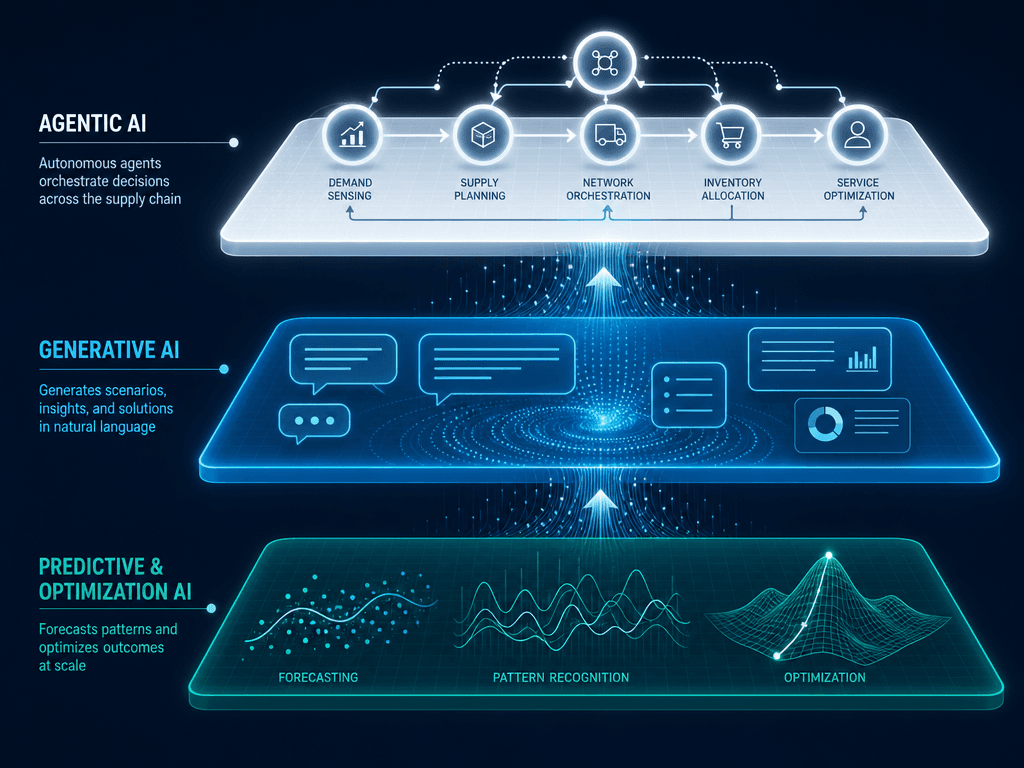
Kinaxis describes Maestro's AI architecture as a composable framework spanning eight layers: multimodal data, semantic intelligence, decisioning (heuristics, optimization, simulation, ML), democratized experience (no-code/low-code/pro-code interfaces), AI runtime, security and governance, orchestration, and learning. For evaluators, the most practically relevant distinction is across three AI tiers, which carry different levels of evidential weight.
| AI Tier | Product / Feature | Status | Evidence Weight |
|---|---|---|---|
| Predictive ML & Optimization | Forecasting models, optimization engine, scenario simulation | Generally available — established capability | Strong: well-documented, decade of analyst recognition, practitioner quotes |
| Generative AI | LLM-powered interfaces, Agent Studio (GPT / Gemini) | Generally available (Agent Studio GA: Feb 2026) | Moderate: real product launch, documented LLM integrations, thinner technical depth than optimization core |
| Agentic AI | Maestro Agents (Oct 2025 GA), Agent Studio agent composition (Feb 2026 GA) | Generally available with documented early-adopter outcomes | Moderate: real product launches with named outcomes; public technical documentation thinner than concurrent planning core |
| Agentic AI — Roadmap | Orchestrator agents, external agent connections, expanded shared data context | Planned for later 2026 — not GA | Not yet evidenced; roadmap items only |
Maestro Agents (October 2025)
Maestro Agents launched on October 17, 2025, as context-aware AI co-workers embedded natively within the live Maestro planning environment. The design philosophy is explicit: agents operate inside the planning system with access to live data, not as bolted-on assistants calling an external API. Human-in-the-loop guardrails and explainable reasoning are built into the agent framework, which Kinaxis positions as a prerequisite for enterprise adoption in regulated industries.
Two early-adopter outcome metrics were publicly disclosed at launch. A top-10 global pharmaceutical company reported up to 10× improvement in planner productivity, reducing inventory risk identification from 40 clicks to 4. A large electronics manufacturer reported saving more than 30 hours per month in manual reporting. Both figures are vendor-reported from named-but-not-disclosed customer deployments; they should be treated as directional indicators rather than independently verified benchmarks.
Maestro Agent Studio (February 2026)
Maestro Agent Studio became generally available on February 5, 2026. It provides a no-code interface for supply chain teams to compose custom AI agents using OpenAI GPT and Google Gemini LLMs, grounded in Maestro's existing data, workflows, and governance framework. Agents built in Agent Studio can evaluate trade-offs, recommend actions, and apply human-in-the-loop approval gates — all within Maestro's concurrent supply chain environment.
NVIDIA cuOpt GPU Acceleration (March 2026)
In March 2026, Kinaxis announced the integration of NVIDIA cuOpt GPU acceleration into Maestro. Testing on a large-scale semiconductor planning model — nearly 50 million decision variables, covering 40,000+ SKUs across a six-quarter daily planning horizon — produced the following results:
- Planning cycle reduced from more than 3 hours to approximately 17 minutes (12× faster end-to-end)
- Core optimization solve time improved 23×, from hours to minutes, while maintaining comparable solution quality
- Test model: ~50 million decision variables, 40,000+ SKUs, six-quarter daily planning horizon
These benchmarks apply to a semiconductor planning use case at extreme scale. Evaluators in other verticals or with smaller planning models should not assume identical performance improvements. The practical implication is that organizations with very large optimization models — previously constrained to overnight batch runs — can now iterate intraday, enabling more frequent scenario comparisons and faster disruption response.
Target Customer Profile and Organizational Fit
Kinaxis Maestro is designed for large, complex global manufacturers. The platform's architectural strengths — concurrent multi-ERP synchronization, large-scale scenario simulation, and cross-functional planning integration — deliver the most value in organizations where those capabilities address genuine operational pain points, not theoretical ones.
| Fit Dimension | Ideal Profile |
|---|---|
| Revenue threshold | $3B+ annual revenue |
| Operations footprint | Global, multi-region, multi-site |
| ERP environment | Multi-ERP (SAP, Oracle, or mixed), often 5–50+ instances |
| Supply chain complexity | High: long lead times, multi-tier supply networks, regulated materials or products |
| Primary verticals | Pharma / life sciences, electronics / high-tech, automotive, CPG, aerospace / defense, chemicals, industrial |
| Planning team maturity | Established S&OP or IBP process with dedicated planning function |
| Data engineering readiness | Sufficient to support enterprise data integration across ERP instances |
Third-party buyer analysis (Horizon Solutions) offers three diagnostic questions that supply chain leaders can use to self-qualify before investing in a Kinaxis evaluation:
- Does your scale genuinely require concurrent planning capability — or would a well-implemented batch-sequential APS address your current pain points adequately?
- How mature is your data engineering? Maestro's concurrent synchronization requires clean, reliable data feeds from multiple ERP instances. Immature data infrastructure extends implementation timelines and increases program risk.
- How time-bounded is your executive sponsorship? A 12–18 month implementation program requires sustained C-suite commitment. Organizations where executive sponsorship is likely to rotate or where budget cycles make multi-year commitments difficult face higher program failure risk.
Deployment Model and Implementation Realities
Kinaxis Maestro is delivered as a cloud-first SaaS platform. There is no on-premise deployment option for the current Maestro platform. Cloud delivery is supported on AWS and Microsoft Azure, with a Google Cloud partnership in place for infrastructure and AI workloads.
Full multi-module implementations typically run 12–18 months. This reflects the integration complexity of connecting Maestro to multiple ERP instances, migrating planning data, configuring concurrent planning models, and training planning teams on a fundamentally different planning paradigm. Kinaxis offers two implementation frameworks — Planning One and RapidStart — that are designed to accelerate time-to-value for specific deployment scenarios, but these frameworks compress the timeline for scoped initial deployments, not for full enterprise rollouts.
Large Maestro deployments are system integrator-dependent. Kinaxis works with a partner ecosystem of global SIs (including Accenture, Deloitte, and Infosys, among others) for implementation delivery. Organizations that lack an existing SI relationship or are evaluating Kinaxis on a compressed timeline should factor SI selection and onboarding into their program plan.
Key Integrations and Technology Partnerships
Integration capability is a primary evaluation criterion for enterprise buyers operating multi-ERP environments. Kinaxis delivers integration through a single layer that supports batch, message-based, and real-time data transfer methods across dozens of ERP instances, with a visual drag-and-drop integration workflow designer.
| Integration / Partnership | Type | Notes |
|---|---|---|
| SAP ERP (all major versions) | Pre-built templates, SAP-certified | Deepest pre-built integration; SAP certification reduces IT evaluation risk |
| Oracle ERP | Standard connector | Available; less pre-built depth than SAP |
| Salesforce | Standard connector | CRM-to-demand signal integration |
| Google Cloud | Infrastructure and AI partnership | Cloud infrastructure and AI workload support |
| NVIDIA cuOpt | GPU acceleration integration | GA March 2026; large-scale optimization solve acceleration |
| OpenAI GPT | Agent Studio LLM | Used for Agent Studio agent composition; grounded in Maestro data and governance |
| Google Gemini | Agent Studio LLM | Available alongside GPT in Agent Studio |
| AWS | Cloud infrastructure | Supported deployment environment |
| Microsoft Azure | Cloud infrastructure | Supported deployment environment |
| Databricks | Strategic data partnership | April 2025; verify current integration scope directly with Kinaxis before specifying |
Customer Evidence and Named References
The following named customer references are confirmed from Kinaxis's public customer case study library and investor relations announcements. Evaluators should use this list to identify peer companies for reference calls.
- Jabil — Maestro Agents early adopter; Senior Director of Advanced Planning publicly cited human-in-the-loop safeguards and faster decision-making with contract manufacturers
- BAT (British American Tobacco) — global supply planning; concurrent planning cited for finished goods, components, and materials visibility
- Castrol — unified supply chain on Maestro for global visibility and disruption response
- Reckitt — improved OEE, reduced changeover times, integrated planning and scheduling
- ExxonMobil — next-generation supply chain management for oil and gas
- Bosch — supply chain digitalization and resilience
- Scania Group — global planning modernization for automotive
- Vizio — concurrent planning for high-tech / electronics
- Syensqo — global planning modernization for chemicals
- Merck — shelf-life planning and write-off reduction for life sciences
Two early-adopter outcome metrics from the Maestro Agents launch (October 2025) are the most specific publicly available performance claims for the agentic AI layer:
- A top-10 global pharmaceutical company reported up to 10× improvement in planner productivity, reducing inventory risk identification from 40 clicks to 4. Source: Kinaxis investor relations press release, October 17, 2025. Scope: vendor-reported, customer name not publicly disclosed.
- A large electronics manufacturer reported saving more than 30 hours per month in manual reporting. Source: Kinaxis investor relations press release, October 17, 2025. Scope: vendor-reported, customer name not publicly disclosed.
Analyst Positioning
Kinaxis is named a Leader in both the 2026 Gartner Magic Quadrant for Supply Chain Planning Solutions for Discrete Industries and for Process Industries. In the Discrete Industries quadrant, Kinaxis is positioned highest on Ability to Execute and furthest on Completeness of Vision among all vendors evaluated. Leadership recognition in Gartner MQ supply chain planning evaluations spans more than a decade across multiple report titles.
The sustained Leader positioning across both discrete and process industry quadrants is meaningful for evaluators: it indicates that Kinaxis's platform has been assessed as competitive across a broad range of manufacturing verticals, not just its historical strongholds in electronics and automotive. The highest Ability to Execute placement in the Discrete Industries quadrant reflects analyst assessment of Kinaxis's customer base scale, implementation success rates, and product viability — factors that are difficult for newer entrants to replicate.
Honest Capability Assessment: Where the Evidence Is Strong and Where It Is Thin
Kinaxis Maestro's capabilities are not uniformly evidenced. Evaluators who treat the concurrent planning core and the agentic AI layer as equally proven will make a category error that could affect their vendor selection decision.
Where the evidence is strong: Concurrent planning, scenario simulation, and multi-ERP integration breadth are the most rigorously evidenced capabilities in Kinaxis's public record. They are supported by a decade of Gartner MQ Leader recognition, practitioner quotes from named enterprise customers (BAT, Castrol), independent technical analysis, and the NVIDIA cuOpt benchmark data (which, while specific to semiconductor planning at extreme scale, demonstrates the optimization engine's architectural capacity). These capabilities are Kinaxis's defensible differentiators and should be the primary basis for evaluation.
Where the evidence is thinner: The agentic AI layer — Maestro Agents and Agent Studio — represents real product launches with documented early-adopter outcomes. These are not vaporware. However, the public technical documentation for the agent layer does not yet match the depth available for the concurrent planning core. Evaluators cannot independently verify the LLM grounding methodology, the agent execution architecture, or the governance enforcement mechanisms from public sources alone.
The practical implication for evaluators: weight Maestro's concurrent planning and scenario simulation capabilities heavily in your scoring — they are well-evidenced and architecturally distinctive. Weight the agentic AI claims at a discount until you can assess them directly through a proof-of-concept or reference calls with Maestro Agents early adopters.
Competitive Fit Guide: When Kinaxis Wins and When Alternatives Make More Sense
This section is a buyer-fit guide, not a feature comparison. For a structured three-way AI architecture comparison across Kinaxis, SAP IBP, and o9, see the Kinaxis Maestro vs SAP IBP vs o9 Digital Brain AI architecture comparison.
When Kinaxis Maestro Is the Right Choice
- Your organization operates at $3B+ revenue with global manufacturing or distribution operations across multiple regions
- You run 5 or more ERP instances and need a planning layer that synchronizes across all of them in real time without batch latency
- Your primary verticals are pharma/life sciences, electronics/high-tech, or automotive — industries where Kinaxis has the deepest customer reference base and most relevant pre-built planning configurations
- Your supply chain complexity is genuinely high: long supplier lead times, regulated materials, multi-tier networks, or high-mix/low-volume production environments
- Your organization has an established S&OP or IBP process and a planning team capable of absorbing a 12–18 month implementation program
- You have executive sponsorship that will sustain a multi-year platform investment and the organizational change management it requires
When Alternatives Make More Sense
| Alternative | When It Fits Better Than Kinaxis |
|---|---|
| SAP IBP | SAP-centric organizations that prioritize native ERP integration, lower integration complexity, and a planning tool that operates within the SAP ecosystem without requiring a separate data synchronization layer |
| o9 Solutions | Organizations prioritizing modern AI architecture, knowledge-graph-based IBP, or a platform with a more flexible data model and faster initial deployment. See the o9 vendor profile for a comparable structured assessment. |
| Blue Yonder | Retail and CPG organizations that need integrated demand planning and warehouse management (WMS) capabilities on a single platform, or where Blue Yonder's retail-native forecasting models are a better vertical fit |
| OMP | Process industries (chemicals, food & beverage, refining) where OMP's process-industry-specific planning models and scheduling capabilities are a closer functional match than Maestro's discrete-industry-optimized core |
| Anaplan | Finance-led planning initiatives where the primary driver is connected financial planning and scenario modeling rather than operational supply chain optimization — Anaplan's connected planning model is better suited to this use case |
Evaluators shortlisting o9 as an alternative can reference the o9 Solutions vendor profile for a comparable structured assessment. Evaluators considering Blue Yonder can reference the Blue Yonder supply chain AI platform vendor profile. For a side-by-side demand planning and S&OP comparison across Kinaxis, o9, and Blue Yonder, see the Kinaxis vs o9 vs Blue Yonder AI demand planning comparison.
Comments
Join the discussion with an anonymous comment.