
What This Article Covers — and What It Doesn't
This article is a functional deep dive into o9 Solutions' demand planning module specifically. It covers the AI/ML forecasting engine, the FVA-based touchless planning pathway, demand sensing signal architecture, collaborative planning workflows, NPI handling, and the data and organizational readiness conditions that determine whether vendor-cited outcomes are achievable in your environment.
It does not cover the full Digital Brain platform, IBP, supply network planning, SRM, or RGM modules. If you need a complete platform overview — architecture, all modules, ERP integration requirements, competitive positioning, and deployment model — the o9 Solutions vendor profile covers that comprehensively. If you are still in early-stage vendor discovery and want to understand where o9 sits relative to the broader field, start with the AI demand planning vendor landscape snapshot for Q2 2026 before returning here.
Module Positioning: Demand Planning Within the o9 Digital Brain
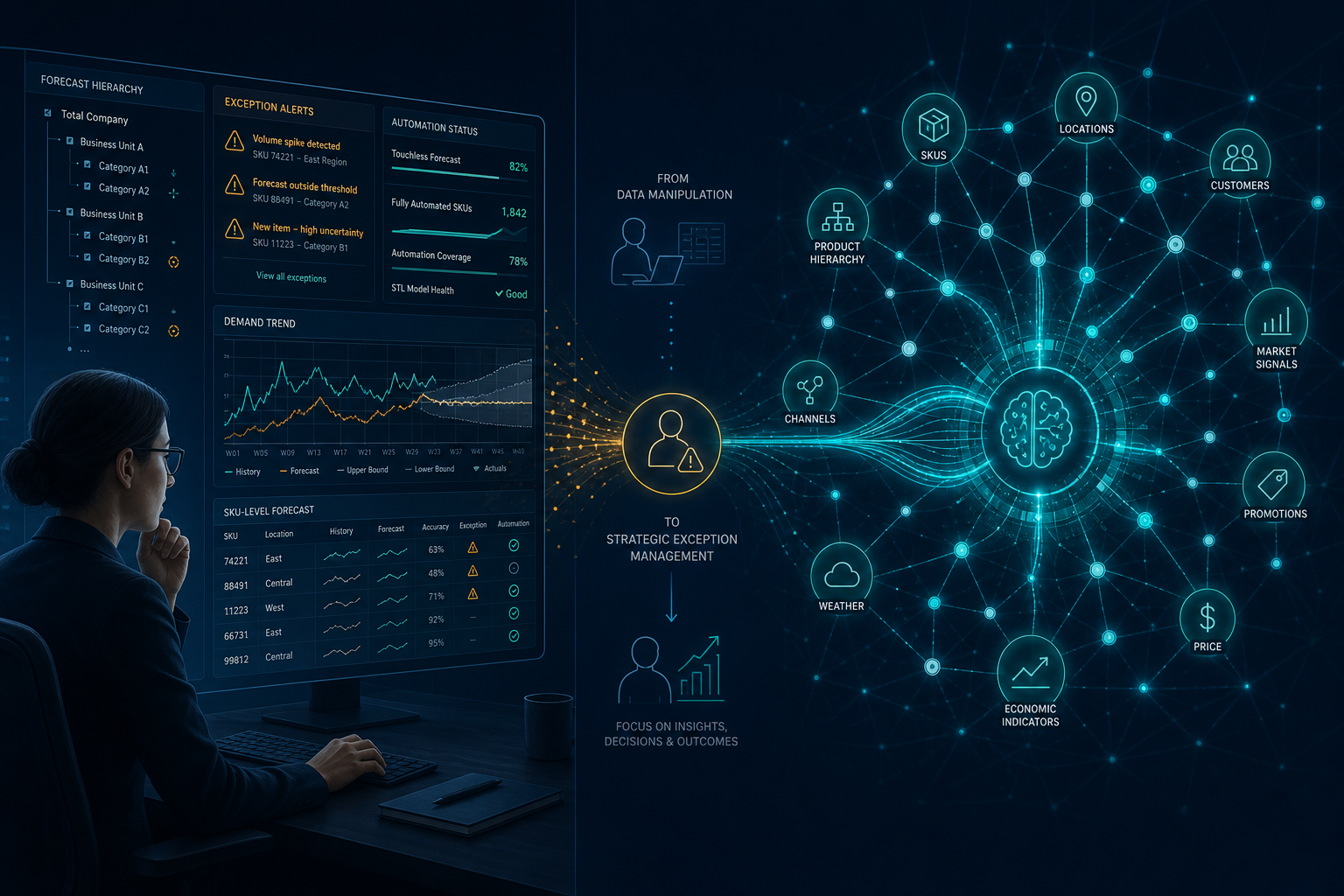
o9's demand planning module is one functional layer within the Digital Brain platform, which uses an Enterprise Knowledge Graph (EKG) to unify data relationships across SKUs, locations, customers, suppliers, and market signals. For demand planning practitioners, the EKG matters primarily for three reasons: it enables multi-level hierarchy management across any planning granularity, it provides the data substrate for external signal ingestion, and it allows demand plans to connect directly to supply and financial planning without manual data handoffs.
The demand planning module itself covers four core use cases: AI/ML-driven demand forecasting, demand sensing, collaborative demand planning, and new product introduction (NPI) planning. Exception-based forecasting and FVA tracking are cross-cutting capabilities that apply across all four.
o9 targets Fortune 500-scale enterprises, typically organizations above $1 billion in annual revenue. The platform is not positioned for mid-market buyers, and the implementation profile reflects that — configuration depth, SI dependency, and time-to-value expectations are calibrated for large, complex operating environments.
- What the demand planning module includes: AI/ML forecasting, demand sensing, collaborative consensus workflows, NPI planning, FVA tracking, exception-based review, multi-level and multi-horizon forecasting.
- What it does not include (covered in separate modules): supply network planning, inventory optimization (MEIO), integrated business planning (IBP), supplier relationship management, revenue growth management.
- Platform dependency: the demand planning module runs on the Digital Brain platform and requires EKG configuration — it is not a standalone SaaS application that can be deployed in isolation from the broader platform architecture.

AI/ML Forecasting Engine: Model Tournaments, Ensemble Methods, and FVA Accountability
The forecasting engine is built around a model tournament architecture. Rather than selecting a single algorithm for all SKUs, the platform continuously evaluates multiple model approaches — statistical baselines, gradient-boosted trees, deep learning models, and meta-learning algorithms — and selects the best-performing blend for each SKU segment and planning horizon.
Meta-learning adds a second layer: models that learn which algorithms perform best at each planning intersection. This means the system is not just running multiple models in parallel — it is building a performance history that informs future model selection at a granular level. Kraft Heinz's implementation used a similar "tournamenting" approach where forecasting models competed directly against one another to determine which delivered the most accurate results for a given SKU-location combination.
Feature engineering is automated for promotions, weather effects, and calendar events. Deep learning components handle the creation of derived features that would require manual specification in traditional statistical packages. This reduces the analytical burden on planners while capturing non-linear demand drivers that simpler models miss.
FVA as the Accountability Mechanism
Forecast Value Add (FVA) analysis is the mechanism that makes the entire touchless planning pathway operationally credible. FVA quantifies whether human overrides are improving or degrading forecast accuracy at each planning intersection. The platform tracks three states: positive FVA (the human adjustment improved the forecast), negative FVA (the adjustment reduced accuracy), and touchless (the machine-generated forecast was accepted without modification).
This creates a feedback loop that is visible to both planners and management. When FVA analysis shows that a planner's overrides are consistently negative — meaning the AI's baseline is more accurate than the human adjustment — there is a data-grounded basis for expanding automation in that segment. When overrides are positive, the system preserves human input and uses that signal to improve model training.
| FVA State | What It Means | Planning Implication |
|---|---|---|
| Positive FVA | Human override improved accuracy vs. the AI baseline | Preserve override; consider incorporating the driver into model features |
| Negative FVA | Human override degraded accuracy vs. the AI baseline | Candidate for touchless automation; planner coaching opportunity |
| Touchless | Machine forecast accepted without modification | Automation is working; monitor for drift at volume |
Touchless Planning: What It Means Technically and How the Adoption Path Works
Touchless planning means machine-generated forecasts are accepted and released into the supply planning process without a planner manually reviewing and overriding them. It is not a binary on/off state — organizations build toward it progressively, segment by segment, as FVA data establishes where the AI is reliably outperforming human judgment.
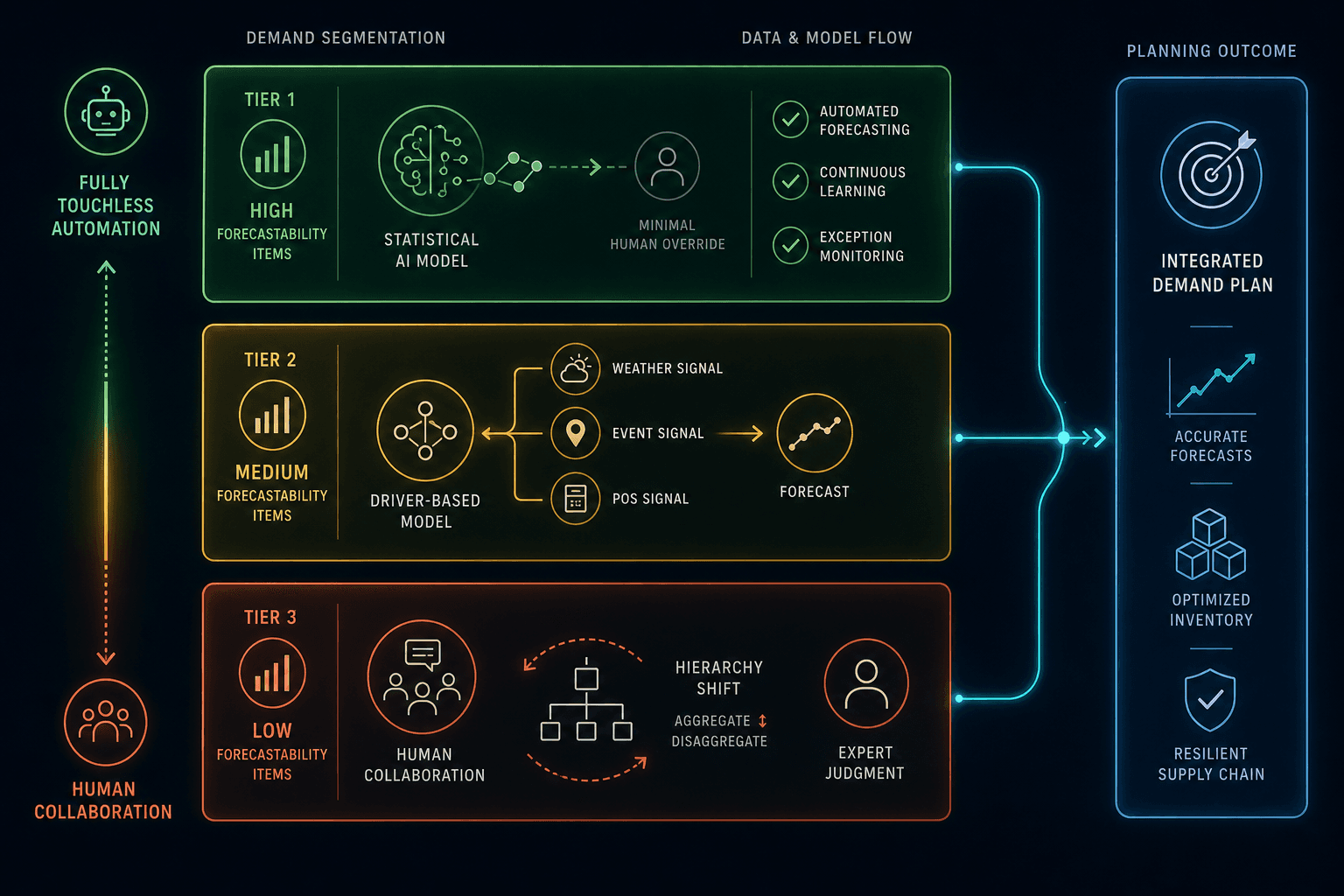
The architectural mechanism that enables this progression is forecastability-based segmentation. The platform classifies SKUs into forecastability tiers and applies differentiated strategies to each:
| Forecastability Tier | Strategy | Planner Role |
|---|---|---|
| High | Reduced override dependency; machine forecast accepted automatically | Exception monitoring only; intervene when signals indicate structural change |
| Medium | Driver-based modeling incorporating external signals (promotions, weather, events) | Review and validate driver inputs; override when causal context is known |
| Low | Collaboration-centered; hierarchy shifting to aggregate levels with more stable signal | Primary owner; AI provides a reference baseline, not an authoritative forecast |
AB InBev's deployment illustrates what this looks like at scale after a sustained transformation program. After nearly five years of deployment across 10 countries covering 75% of global volume, AB InBev reached 85% touchless demand plans in the U.S., with 70–90% touchless adoption across key markets. Forecast accuracy improved by more than 11 percentage points to 87%, inventory levels fell 20%, and U.S. service levels reached 99.5% with out-of-stocks below 0.5%.
Demand Sensing: Signal Architecture, Intraday Resolution, and Sense-and-Shape Capability
Demand sensing addresses the gap between when demand changes in the market and when that change appears in sell-in or shipment data. The o9 demand sensing module ingests leading indicators that move ahead of traditional demand signals, allowing the planning system to recalibrate before the lag data catches up.
The signal ingestion architecture supports a wide range of external data sources:
- Social media and search trend data as early demand proxies
- Weather forecasts tied to product demand models
- Local events via PredictHQ, a commercial event data provider integrated into the platform
- POS and sell-out data from retail partners at store-item-channel granularity
- Mobility indices as demand-context signals in relevant categories
Data ingestion uses streaming infrastructure via Apache NiFi and Kafka, enabling continuous recalculation rather than batch updates. For fresh food and bakery applications, the platform supports hourly or intraday forecasting resolution at the store-item level — a capability that requires both the streaming ingestion layer and granular master data alignment.
Pattern decomposition uses both supervised and unsupervised learning to distinguish genuine demand shifts from noise. This is the technical mechanism that prevents the sensing system from overreacting to short-term signal spikes while still capturing meaningful trend changes early. Causal lag features capture how promotions influence demand days or weeks after the promotional event, and hierarchical ML manages sparse signals by aggregating to more stable levels before disaggregating to store or day granularity.
The sense-and-shape capability extends demand sensing into supply-side response. When sensing identifies demand building toward a constrained supply node, the platform can redirect demand — through promotional or channel adjustments — before the constraint becomes a service failure. This requires integration with supply planning and commercial planning functions, not just the demand sensing module in isolation.
Collaborative Demand Planning, NPI, and Exception-Based Workflows
Beyond the AI forecasting engine, the demand planning module supports structured cross-functional workflows for consensus forecast development. Collaborative demand planning in o9 operates across multiple levels of granularity simultaneously — commercial teams can work at brand or customer-group level while supply planners work at SKU-location level, with the platform reconciling inputs across the hierarchy.
Flexible demand assumptions management allows any team to enter volume assumptions at any level or horizon without requiring a fixed workflow sequence. This matters in organizations where sales, marketing, and finance each hold different views of demand and need a structured process for reconciling them into a consensus number that the supply plan can execute against.
NPI Planning and Sparse History Handling
New product introduction planning is handled through forecastability-based segmentation applied to items with limited or no sales history. The platform uses reference product similarity, attribute-based modeling, and analog forecasting to generate baseline projections for NPI items, with explicit routing to collaborative workflows for products where statistical history is insufficient to support algorithmic forecasting.
Exception-based forecasting directs planner attention to genuine outliers rather than requiring routine review of the full SKU portfolio. As touchless adoption matures — with FVA analysis confirming that the AI baseline is reliable across high-forecastability segments — the exception management workflow becomes the primary mode of planner engagement. Planners shift from reviewing every forecast to reviewing only the forecasts where the system has flagged uncertainty, driver changes, or anomalous patterns.
- Exception triggers include: statistical anomaly detection on demand history, driver-based alerts (e.g., a promotional event with no corresponding demand uplift), supply constraint flags propagated from the supply planning module, and FVA degradation alerts when previously touchless segments start showing accuracy decline.
- Exception routing is configurable by role — commercial planners see demand-side exceptions, supply planners see constraint-driven exceptions, and S&OP facilitators see consensus gaps that require cross-functional resolution.
- Exception volume directly reflects organizational maturity: early in deployment, most SKUs generate exceptions; as FVA analysis matures and touchless adoption expands, exception volume shrinks and planner capacity shifts to higher-value analytical work.
Data Prerequisites and Organizational Readiness: The Gating Conditions
The most consequential insight from documented o9 deployments is not about the platform's capabilities — it is about the conditions that determine whether those capabilities translate into business outcomes. Data readiness and organizational readiness are not post-implementation concerns. They are prerequisites that must be in place before AI forecasting can perform at the levels vendor case studies describe.
"Garbage in, garbage out — we had to ensure the right foundation was in place to get the most from o9."
That framing came from the Amway demand planning team, describing their experience deploying o9 across 65 markets and 28,000+ SKUs. It captures a reality that applies across all three major documented deployments: the platform's AI models are only as reliable as the historical sales data, master data governance, and process discipline that feed them.
What Data Readiness Actually Requires
- Clean granular historical sales data: at minimum 24–36 months of clean sell-out or shipment history at the planning granularity the organization intends to forecast. Gaps, reclassifications, and inconsistent customer hierarchies in historical data degrade model training quality directly.
- Master data alignment: SKU master data, location hierarchies, and customer segmentation must be consistent across source systems before EKG configuration. Misaligned master data creates reconciliation failures that surface as forecast anomalies during deployment.
- Promotion and event history: for driver-based modeling to work, promotional calendars and event records must be available in structured form at the SKU-customer-date level. Promotional history stored in spreadsheets or unstructured formats requires significant preprocessing before it can serve as model input.
- Process governance: data maintenance disciplines — how new SKUs are onboarded, how discontinued items are retired, how promotional changes are recorded — must be operationally active before deployment, not established afterward.
Organizational Readiness Is the Primary Differentiator
An independent analysis by Procurement Insights (November 2025) examined multiple o9 deployments and concluded that the platform's case studies systematically attribute outcomes to AI capabilities while underweighting the organizational work that actually delivered them. The analysis found that process restructuring, behavioral alignment, and change management investment were the primary success drivers across implementations — and that organizations which completed structured readiness assessments before deployment had substantially higher success rates than those that treated readiness as a post-go-live concern.
The Kraft Heinz case study is the clearest illustration of this dynamic. In Phase 2 of their four-phase transformation (2021–2022), adoption stalled because planners reverted to Excel. The technology was deployed and functional. The failure was behavioral — planners did not trust the AI baseline enough to act on it, and the change management infrastructure to build that trust had not been established. Resolving this required deliberate intervention: FVA tracking made override quality visible, management reinforced automation targets, and the organization invested in planner training on how to interpret and act on AI-generated forecasts.
Documented Customer Outcomes: AB InBev, Kraft Heinz, and Amway
Three large-enterprise deployments have produced publicly documented outcome metrics. All three are sourced from vendor-curated case study materials published on o9's website. Independent verification of specific figures is not available; the organizational context that enabled each outcome is summarized alongside the metrics.
| Company | Key Metrics | Program Context | Source Type |
|---|---|---|---|
| AB InBev | 85% touchless demand plans (U.S.); +11pp forecast accuracy to 87%; 99.5% service level; 20% inventory reduction; out-of-stocks below 0.5% | ~5-year program; 10 countries; 75% of global volume; simultaneous deployment of demand planning, supply network planning, MEIO, and reverse logistics; significant workforce upskilling investment | Vendor case study |
| Kraft Heinz | +48.2% autonomous planning adoption; +10.4% weekly forecast accuracy (SKU-location-customer level); +11% production forecast accuracy (2 months out); +7% Case Fill Rate; ~30% planner time savings; $50MM+ working capital released; 45% waste reduction | 4-phase transformation from 2019 to 2025; 5,000+ SKUs; 30+ factories; 100 distribution points; Phase 2 stalled due to planner reversion to Excel before change management intervention | Vendor case study |
| Amway | Adoption tripled since go-live; monthly forecast review time from 5 days to under half a day; 4–5pp improvement in forecast accuracy and bias; 98% fill rate achieved consistently | 65 markets; 400 points of sale; 28,000+ SKUs; replaced homegrown legacy system; data readiness work completed before deployment; FVA described as central to planner trust-building | Vendor case study |
Several patterns are consistent across all three deployments. First, the outcomes were not achieved at go-live — each required sustained investment over multiple years. Second, FVA tracking appears in all three as the mechanism that made automation expansion trustworthy to both planners and leadership. Third, each organization explicitly identifies people and process work as co-equal to technology in explaining their results.
The Amway team's observation is worth noting directly: "We need planners who understand the context, who can ask the right questions, and who know how to use these tools to support better decisions." This is not a disclaimer — it is a description of what the evolved planner role looks like when touchless adoption is working as intended.
Known Limitations and Practitioner-Reported Gaps
An honest evaluation of o9's demand planning module requires acknowledging the documented limitations alongside the capabilities. The following gaps are supported by independent sources or are inherent to the platform's design.
Configuration Complexity and SI Dependency
o9 is a configuration-rich enterprise platform. The Lokad independent review (April 2026) characterizes it directly: "this is a configuration-rich enterprise platform that depends on modeling, rollout methodology, and implementation effort." This is not a criticism of the platform's capability — it is an accurate description of what deployment requires. Organizations should expect to engage a systems integrator with documented o9 demand planning experience, and should not underestimate the modeling and configuration work required before the AI forecasting engine can be trained on their specific data.
Algorithmic Opacity
The Lokad review identifies a meaningful transparency gap: o9's public materials describe configuration surfaces and named components clearly, but provide limited disclosure of the mathematical behavior inside those components. For practitioners in regulated industries or organizations with model governance requirements, this matters. The platform is not a white-box probabilistic modeling environment — it is an enterprise planning suite that exposes configuration levers, not algorithm internals.
If your governance model requires the ability to audit forecasting logic at the algorithm level — not just at the output level — this is a question to put directly to o9 during evaluation, and to validate through reference calls with customers in similar regulatory contexts.
Implementation Timeline and Time-to-Value
The documented customer programs are multi-year. AB InBev's deployment ran nearly five years. Kraft Heinz's transformation covered four structured phases from 2019 to 2025. Amway's deployment started in 2020 and outcomes were reported in subsequent years. Organizations expecting material forecast accuracy improvements within 6–12 months of contract signature are not aligned with the evidence base from these deployments.
APEX Operating Model: Newly Announced, Not Battle-Tested
o9 launched the APEX operating model framework in March 2026, positioning it as an AI-powered operating model for enterprises navigating volatile conditions. APEX combines Agile, Adaptive, and Autonomous Planning and Execution as a conceptual framework connecting the Digital Brain platform to enterprise-wide decision-making. As of Q2 2026, APEX is a newly introduced framework with limited documented commercial deployment evidence. It should be evaluated as a strategic direction, not as a proven enterprise capability with a reference customer base.
- Configuration complexity: expect a multi-month EKG configuration and data onboarding phase before the forecasting engine can be trained on production data.
- SI dependency: o9 implementations typically require a systems integrator with domain-specific o9 experience; this adds cost and introduces a second dependency on SI quality alongside platform quality.
- Algorithmic transparency: limited white-box disclosure of forecasting algorithm internals; configuration surfaces are accessible but mathematical behavior inside components is not publicly documented.
- Organizational readiness as the primary failure mode: the platform will not self-correct for data quality gaps, master data misalignment, or planner resistance; these must be addressed through organizational investment, not configuration.
- APEX: newly launched in March 2026; treat as strategic direction rather than a deployable capability with a track record.
Demand Planning Buyer Fit Checklist: Questions to Ask Before Shortlisting o9
The following questions are structured for practitioners specifically evaluating o9 for demand planning — not for the full Digital Brain platform. They are designed to surface fit and readiness gaps before a demo or RFP, not after.
| Evaluation Area | Question to Answer Before Shortlisting | What a Weak Answer Signals |
|---|---|---|
| Data readiness | Do we have clean, granular historical sales data at the planning level we intend to forecast — at minimum 24 months, ideally 36? | Data cleanup and governance work will extend implementation timelines significantly and delay AI model performance |
| Master data governance | Are our SKU master data, location hierarchies, and customer segmentation consistent across source ERP and data warehouse systems today? | EKG configuration will surface master data conflicts that require resolution before the forecasting engine can be trained |
| Organizational readiness | Is leadership aligned on a multi-year transformation program — with change management, planner upskilling, and process redesign as funded workstreams — rather than a software installation? | Documented deployments show adoption stalls when organizational investment is treated as optional or deferred |
| SI dependency tolerance | Have we budgeted for a systems integrator with documented o9 demand planning experience, and do we have internal resources to own the configuration and data governance work long-term? | SI dependency is structural, not optional; under-resourcing the SI relationship is a documented failure mode |
| FVA baseline | Do we currently measure Forecast Value Add — do we know whether planner overrides are improving or degrading our statistical baseline? | Without a current FVA measurement process, the trust-building feedback loop that enables touchless adoption has no starting point |
| Demand sensing fit | Do we have POS or sell-out data from retail partners at daily or finer granularity, and are we willing to invest in the data partnerships required to sustain that feed? | Intraday and store-level sensing capabilities require data availability that many organizations do not currently have from retail partners |
| Algorithmic transparency requirements | Does our governance model require white-box access to forecasting algorithm logic — not just output-level explainability? | o9 exposes configuration surfaces, not algorithm internals; organizations with strict model auditability requirements should validate this gap directly |
| Implementation timeline expectations | Is leadership aligned that material forecast accuracy improvements will be measured in years, not months? | Documented programs (AB InBev, Kraft Heinz) ran 4–5 years; misaligned timeline expectations are a leading cause of program abandonment before outcomes are realized |
o9's demand planning module is a substantive enterprise-grade platform with documented outcomes at scale. The question for any given organization is not whether the platform is capable — the AB InBev, Kraft Heinz, and Amway deployments establish that it is. The question is whether your organization has the data foundation, organizational alignment, and multi-year commitment that those outcomes required. Answering that question honestly before shortlisting is the most valuable evaluation work you can do.
Comments
Join the discussion with an anonymous comment.