
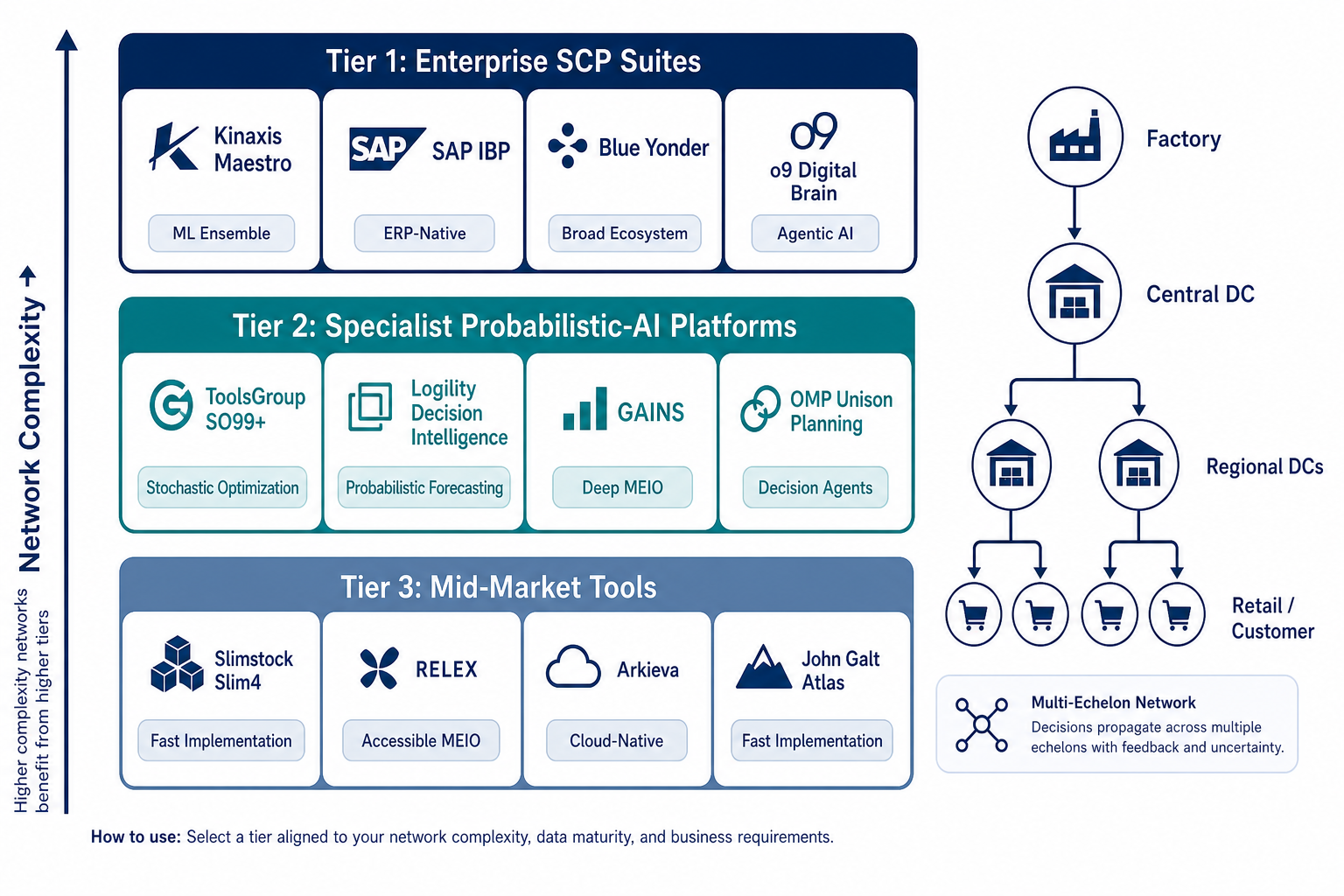
Q2 2026 MEIO Market Context: 157 Vendors, One Critical Distinction
Gartner's Supply Chain Planning solutions market lists 157 vendors as of March 2026. That figure is useful for understanding market scale, but it obscures the distinction that matters most for MEIO platform selection: the difference between true simultaneous multi-echelon optimization and single-echelon inventory planning applied sequentially across network nodes.
Single-echelon inventory optimization manages stock at each stage separately — a warehouse optimization runs independently from a factory optimization. True MEIO simultaneously optimizes inventory balance across all echelons and locations in a single model, accounting for upstream protection and downstream replenishment interactions. The practical consequence: single-echelon stacking can produce locally optimal decisions that are globally suboptimal, particularly in networks with more than two stocking tiers.
This article does not re-explain MEIO techniques or safety stock methodology. Readers who need that foundation should start with the AI Multi-Echelon Inventory Optimization use-case reference before returning here. Readers looking for adoption benchmark data behind the 157-vendor market count should consult the Gartner 2024 Supply Chain Technology Adoption Report. What follows is a structured vendor landscape — organized by tier, AI technique, and implementation conditions — for practitioners actively shortlisting MEIO platforms in Q2 2026.
Three-Tier Segmentation: Why Tier Matters More Than Quadrant Position
The MEIO platform market does not organize neatly by analyst quadrant position. A vendor can hold a Gartner Magic Quadrant Leader position in the broad Supply Chain Planning category while offering MEIO as a shallow module add-on within a larger planning suite. Conversely, a specialist platform with narrower ecosystem coverage may deliver materially deeper simultaneous multi-echelon optimization.
The three-tier framework used in this article segments vendors by three practical selection drivers: MEIO algorithmic depth (simultaneous vs. sequential optimization), ERP and ecosystem integration breadth, and implementation complexity relative to organizational data readiness. These dimensions map more directly to deployment outcomes than quadrant position alone.
| Tier | Vendors | MEIO Depth | AI Technique | ERP Ecosystem | Typical Buyer |
|---|---|---|---|---|---|
| Tier 1 — Enterprise SCP Suites | Kinaxis Maestro, SAP IBP, Blue Yonder, o9 Digital Brain | Module within broader suite; depth varies by vendor | ML ensemble, scenario modeling | Broad — SAP, Oracle, Microsoft native or certified | Large enterprise on SAP or Oracle seeking unified planning platform |
| Tier 2 — Specialist Probabilistic-AI Platforms | ToolsGroup SO99+, Logility Decision Intelligence, GAINS, OMP Unison Planning | Simultaneous cross-echelon optimization; platform core | Stochastic/probabilistic forecasting, agentic AI | Narrower out-of-box; deeper for target connectors | Organizations with complex multi-echelon networks and mature data foundations |
| Tier 3 — Mid-Market and Accessible Tools | Slimstock Slim4, RELEX Platform, Arkieva Enterprise, John Galt Atlas | Accessible MEIO entry points; 2–4 echelon focus | ML, cloud-native optimization, agentic data management | Cloud-native; ERP integration varies by vendor | Mid-market distributors, retailers, organizations with moderate network complexity |
Tier 1: Enterprise SCP Suites — Kinaxis Maestro, SAP IBP, Blue Yonder, o9 Digital Brain
Enterprise SCP suites are the default shortlist entry for large organizations already running SAP or Oracle ecosystems. Their primary value proposition is unified planning coverage — demand, supply, inventory, and S&OP within a single platform — with certified or native integration into major ERP environments. MEIO is typically available as a module within this broader planning architecture, not as the platform's algorithmic core.
Kinaxis Maestro applies ML ensemble modeling and concurrent planning to supply chain scenarios, enabling rapid what-if analysis across the network. Its strength is scenario speed and supply-demand balancing at scale; buyers should specifically test the depth of simultaneous multi-echelon inventory policy optimization — not just supply constraint modeling — in any proof-of-value engagement.
SAP IBP is the natural default for organizations running SAP S/4HANA or ECC, offering tight data integration and a shared planning data model across demand, supply, and inventory modules. MEIO functionality exists within the inventory optimization module, but the depth of simultaneous cross-echelon policy optimization relative to specialist platforms should be validated against the buyer's specific network topology before selection.
Blue Yonder Supply Chain Planning covers demand forecasting, replenishment, and inventory optimization within its planning suite. The platform has deep retail and CPG deployment history. As with other Tier 1 vendors, buyers evaluating Blue Yonder specifically for MEIO should request demonstrations scoped to simultaneous multi-echelon policy optimization rather than relying on suite-level positioning.
o9 Digital Brain positions its platform around a unified digital planning model with ML-driven demand sensing, scenario modeling, and integrated business planning capabilities. The platform's strength is cross-functional planning data integration and executive scenario visibility; MEIO algorithmic depth relative to Tier 2 specialists should be tested directly.
| Vendor | MEIO Positioning | AI Approach | ERP Ecosystem Strength | Primary Buyer Profile |
|---|---|---|---|---|
| Kinaxis Maestro | MEIO within concurrent planning suite | ML ensemble, scenario modeling | Broad; SAP, Oracle, Microsoft certified | Large enterprise, complex supply networks |
| SAP IBP | Inventory optimization module within IBP suite | ML, integrated S/4HANA data model | Native SAP; strongest for S/4HANA and ECC shops | SAP-ecosystem enterprises |
| Blue Yonder SCP | Replenishment and inventory optimization within planning suite | ML forecasting, replenishment optimization | Broad; retail and CPG ERP connectors | Large retail, CPG, manufacturing |
| o9 Digital Brain | Inventory within unified digital planning model | ML demand sensing, scenario modeling | Broad; flexible data integration layer | Large enterprise, IBP and S&OP focus |
Tier 2: Specialist Probabilistic-AI Platforms — ToolsGroup SO99+, Logility Decision Intelligence, GAINS, OMP Unison Planning
Tier 2 platforms are built around MEIO as a platform core, not a module add-on. Their competitive differentiation is algorithmic depth: simultaneous cross-echelon optimization, probabilistic demand modeling that represents the full range of possible demand outcomes rather than a single forecast, and automated safety-stock policy recalculation across every node in the network. The trade-off is narrower out-of-box ERP ecosystem coverage compared to Tier 1 suites.
ToolsGroup SO99+ applies probabilistic forecasting and machine learning algorithms to multi-echelon inventory modeling, continuously recalculating optimal stock targets and reorder points for every node in the network. The platform's approach treats the supply chain as a connected system rather than optimizing each stage independently. Implementation best practices from ToolsGroup recommend starting with clean ERP and WMS data, running scenario testing, and piloting one business unit before scaling.
Logility Decision Intelligence Platform, operated under Aptean, is positioned as an end-to-end AI-native planning platform with deep vertical expertise. Logility/Aptean holds Gartner Magic Quadrant Leader recognition in both Discrete and Process Industry Supply Chain Planning for 2026 — one of only four vendors named a Leader in both MQ reports according to the platform's public homepage. The AppCentral AI platform is described as delivering answers, automating tasks, and connecting planning decisions across silos.
GAINS focuses on inventory optimization and supply chain planning with a track record in complex, multi-echelon distribution environments. The platform targets organizations where inventory policy decisions — safety stock, reorder points, order quantities — need to be recalculated frequently across large SKU-location populations.
OMP Unison Planning is powered by UnisonIQ, OMP's AI orchestration framework. UnisonIQ features always-on decision agents and a generative AI assistant, positioning OMP at the intersection of deep MEIO optimization and agentic AI architecture. The platform's decision agents are designed to continuously monitor and adjust inventory policies rather than waiting for periodic planning cycles.
- Simultaneous cross-echelon optimization is the defining capability of Tier 2 platforms — verify this specifically, as it is the primary differentiator from Tier 1 module-based approaches.
- Probabilistic demand modeling (representing demand uncertainty as a distribution, not a point forecast) directly improves safety-stock policy precision — this is the mechanism behind the inventory reduction outcomes cited by specialist vendors.
- Automated policy recalculation across all SKU-locations distinguishes continuous optimization from periodic review cycles; ask vendors how frequently policies are recalculated and what triggers a recalculation.
- ERP integration depth for Tier 2 vendors varies significantly by connector — validate the specific integration path for your ERP version before assuming connectivity.
| Vendor | Core MEIO Capability | AI Differentiator | Agentic AI | Buyer Profile |
|---|---|---|---|---|
| ToolsGroup SO99+ | Simultaneous multi-echelon optimization; probabilistic forecasting | Probabilistic demand modeling; continuous policy recalculation | Decion decision intelligence fabric (verify GA status) | Complex multi-echelon networks; mature data foundation |
| Logility Decision Intelligence | End-to-end AI-native planning; MEIO within decision-centric architecture | Deep vertical AI; AppCentral AI platform for task automation | AppCentral AI platform connects across silos | Mid-to-large enterprise; discrete and process industry |
| GAINS | Inventory optimization; safety stock and reorder policy automation | ML-driven policy recalculation at scale | Not prominently featured in public descriptions | Complex distribution networks; large SKU-location populations |
| OMP Unison Planning | Multi-echelon planning powered by UnisonIQ AI orchestration | Always-on decision agents; generative AI assistant | UnisonIQ decision agents (continuous monitoring) | Complex manufacturing and distribution; enterprise |
Tier 3: Mid-Market and Accessible Tools — Slimstock Slim4, RELEX, Arkieva, John Galt Atlas
Tier 3 platforms offer faster time-to-value, cloud-native scalability, and accessible MEIO entry points for organizations with moderate network complexity — typically two to four echelons and fewer than 100,000 active SKU-locations. The trade-off relative to Tier 2 is shallower simultaneous multi-echelon optimization depth; the advantage is shorter implementation timelines and lower data readiness prerequisites.
Slimstock Slim4 explicitly targets mid-sized and large organizations, blending people, data, and AI with agentic data management and cloud-native ERP integration. The platform's agentic data management capability addresses a common implementation blocker — master data quality — by automating data cleansing and enrichment as part of the planning workflow. Slim4 is positioned for organizations that need ERP integration without a lengthy systems integration project.
RELEX Platform focuses on retail and supply chain optimization, with demand forecasting and replenishment automation as its primary capabilities. RELEX has strong deployment history in grocery, fashion, and specialty retail — environments where promotional lift modeling, seasonal demand patterns, and store-level replenishment are central planning problems. For organizations evaluating RELEX for seasonal demand environments, the AI-assisted dynamic safety stock optimization for seasonal SKUs use-case reference provides relevant context on seasonal policy recalculation requirements.
Arkieva Enterprise targets manufacturing and distribution organizations with demand planning, inventory optimization, and production scheduling capabilities. The platform is positioned for mid-market manufacturers who need integrated planning without the complexity of a full enterprise SCP suite deployment.
John Galt Solutions Atlas is modular and cloud-based, with configurable demand planning, inventory optimization, and scenario modeling components. Atlas emphasizes quick time-to-value and adaptability to customers' unique business challenges, making it relevant for organizations that need to deploy incrementally rather than committing to a full platform replacement.
| Vendor | Primary Focus | MEIO Entry Point | AI Capability | Implementation Speed | Buyer Profile |
|---|---|---|---|---|---|
| Slimstock Slim4 | Inventory planning; ERP integration for mid-to-large organizations | Multi-echelon replenishment with agentic data management | Agentic data management; cloud-native ML | Faster — cloud-native, ERP integration focus | Mid-to-large distributors and retailers; ERP-centric organizations |
| RELEX Platform | Retail and supply chain replenishment optimization | Demand-driven replenishment across retail network echelons | ML demand forecasting; promotional lift modeling | Moderate — retail-specific configuration | Grocery, fashion, specialty retail; omnichannel |
| Arkieva Enterprise | Manufacturing and distribution planning | Inventory optimization within integrated planning suite | ML demand planning; inventory policy optimization | Moderate — manufacturing configuration | Mid-market manufacturers and distributors |
| John Galt Atlas | Modular cloud-based demand and inventory planning | Configurable inventory optimization module | ML forecasting; scenario modeling | Fast — modular deployment path | Mid-market; organizations deploying incrementally |
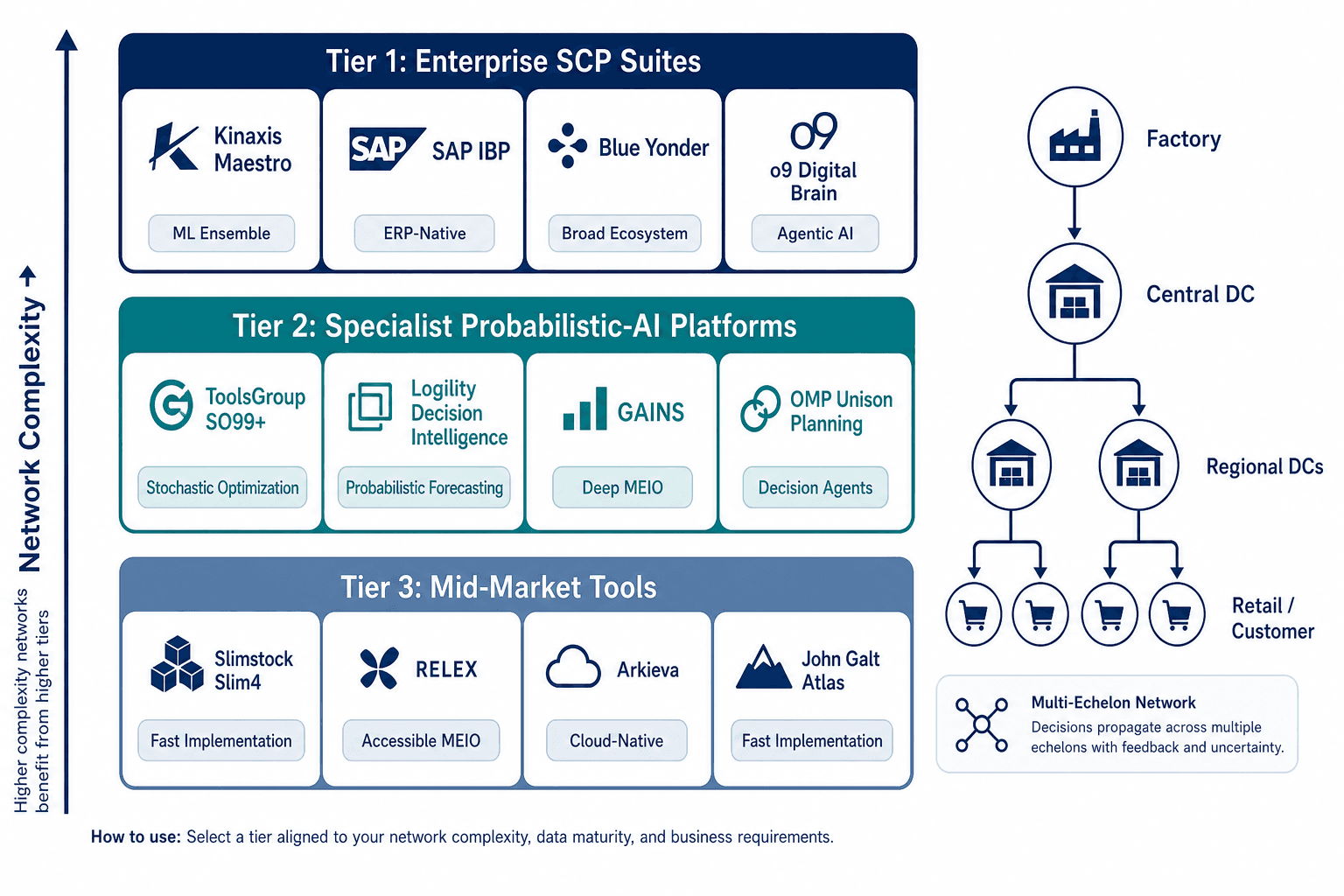
AI Technique Comparison Across Tiers: Stochastic, Probabilistic, ML Ensemble, and Agentic
The AI technique used by a MEIO platform directly affects what planners can trust, how decisions are explained, and how much autonomous execution is appropriate. Evaluating vendors on technique — not just on claimed outcomes — is a prerequisite for assessing planner adoption risk and governance requirements.
Stochastic and probabilistic optimization, applied by ToolsGroup SO99+ and reflected in OMP UnisonIQ's architecture, models demand as a probability distribution rather than a point forecast. This means the system calculates safety stock policies against a range of possible demand outcomes — producing more defensible inventory targets in high-variability environments. The quality of probabilistic MEIO output depends heavily on the quality of the demand signal feeding it; readers evaluating this approach should review the AI demand sensing for short-lifecycle SKUs use-case reference for detail on demand signal quality requirements.
ML ensemble and scenario modeling, characteristic of Kinaxis Maestro and o9 Digital Brain, applies multiple model types to generate concurrent planning scenarios. The strength of this approach is speed of scenario evaluation and cross-functional planning integration. The limitation for MEIO specifically is that scenario modeling and simultaneous multi-echelon policy optimization are not the same capability — verify which is native and which is approximated.
Agentic AI and decision intelligence fabric architectures represent the Q2 2026 competitive frontier. Rather than generating a plan for human review, agentic systems execute routine inventory decisions continuously within defined guardrails. ToolsGroup's Decion platform is described as a decision intelligence fabric connecting probabilistic planning, scenario reasoning, and agentic automation for continuous supply chain steering. OMP UnisonIQ's always-on decision agents and Logility's AppCentral platform follow a similar architectural direction. Slim4's agentic data management applies agent-based automation to data quality rather than decision execution.
Generative AI copilots — embedded in planning workflows to triage forecast exceptions, narrate inventory trade-off decisions, and explain replenishment recommendations in plain language — are moving from pilots to production across all three vendor tiers in 2026. The highest-value use cases pair generative AI with optimization engines: the optimization engine calculates the decision, the generative AI layer explains it to planners in business terms and documents the rationale.
| AI Technique | Representative Vendors | Planner Trust Implication | Explainability | Autonomous Decision Scope |
|---|---|---|---|---|
| Probabilistic / stochastic optimization | ToolsGroup SO99+, OMP UnisonIQ | High — uncertainty is modeled explicitly, not hidden | Moderate — distributional outputs require planner training | Policy recalculation; reorder point adjustment |
| ML ensemble + scenario modeling | Kinaxis Maestro, o9 Digital Brain | Moderate — scenario outputs are intuitive but model internals vary | High for scenarios; lower for model internals | Scenario generation; exception flagging |
| Agentic AI / decision intelligence fabric | ToolsGroup Decion, OMP UnisonIQ, Logility AppCentral | Requires governance design — autonomous execution needs defined guardrails | Depends on implementation — audit trail is critical | Routine replenishment execution within guardrails |
| Generative AI copilot | All tiers — embedded in planning workflows | High — natural language explanations improve planner adoption | High — explanations are the primary output | Exception triage, decision documentation, scenario setup |
| Agentic data management | Slimstock Slim4 | Moderate — data quality automation reduces manual effort | Low for data processing; high for inventory recommendations | Data cleansing, master data enrichment |
Key Evaluation Dimensions: What to Test Before Shortlisting
Feature checklists are an unreliable shortlisting tool for MEIO platforms. Most vendors can mark 'yes' to multi-echelon optimization on an RFP template. The practical realities of demand variability, network topology, and data quality rarely surface in feature-level responses. Four dimensions separate MEIO platforms in production deployment.
1. Multi-Echelon Network Modeling Depth
The central technical question: does the platform simultaneously optimize inventory policies across all echelons in a single model, or does it optimize each echelon sequentially and aggregate the results? Ask vendors to demonstrate their optimization approach on a network topology that matches your own — number of echelons, stocking node count, and lead time variability profile. Request that they show how the model handles upstream protection stock changes propagating to downstream safety stock policies.
2. ERP and WMS Integration Connectors
Integration is the most frequently underestimated implementation variable. A platform with strong MEIO algorithms but unreliable data flows from ERP, WMS, TMS, and order management systems will produce degraded inventory policies — because the model is only as good as the inventory position, open order, and lead time data feeding it. Validate the specific connector version for your ERP release, not just the named ERP platform. Ask for customer references on the same ERP version and network size.
3. AI Explainability and Planner Trust Design
Planner adoption is the leading cause of MEIO implementation underperformance after go-live. If planners cannot understand why the system is recommending a safety stock target change, they will override it — negating the optimization. Evaluate how the platform explains inventory policy recommendations: does it surface the demand distribution, lead time variability, and service-level trade-off that drove the recommendation? Does the generative AI layer, if present, produce explanations that planners find credible and actionable?
4. Implementation Data Requirements
Specialist MEIO platforms typically require 18–36 months of demand history at the item-location level, current inventory positions, open orders, replenishment lead times, and — critically — lead time variability data. Lead time variability is a data prerequisite that many organizations discover they do not have in usable form until vendor engagement begins. The AI for supplier lead time variability prediction use-case record covers how AI can be used to generate lead time variability estimates when historical supplier performance data is incomplete.
- 18–36 months of demand or shipment history at the item-location decision level (specialist platforms); 12 months minimum for mid-market platforms with less precise multi-echelon policies.
- Current inventory positions by location — on-hand, in-transit, on-order — updated at the frequency the platform recalculates policies.
- Replenishment lead times by supplier-item-location, with variability distributions where available.
- Service-level policies by SKU segment or customer class — the model needs to know the target, not just optimize for a uniform service level.
- Order constraints — minimum order quantities, order multiples, supplier capacity limits — that bound the optimization.
- Clean item-location master data — master data quality is consistently identified as the hidden implementation blocker that vendor demos do not surface.
For proof-of-value evaluations, the recommended approach is to test vendors against the same representative planning scenarios — seasonal demand surges, new product introductions, intermittent demand items, allocation during shortages — using a consistent dataset and scoring rubric. Prioritize three to five measurable outcomes (service level, inventory value, planning cycle time) and score each vendor against those outcomes, not against a feature checklist.
Q2 2026 Differentiating Trend: Agentic AI and Decision Intelligence Fabrics
The most significant competitive differentiation in the Q2 2026 MEIO market is not a new optimization algorithm — it is a shift in how inventory decisions are executed. Traditional planning platforms generate recommendations on a batch cycle (daily, weekly) for planners to review and approve. Decision intelligence fabric architectures aim to replace that batch cycle with continuous, agent-driven execution for routine decisions, while escalating exceptions to planners.
ToolsGroup's Decion platform is the most concretely described Q2 2026 example of this architecture. Decion is positioned as a decision intelligence fabric that connects probabilistic planning, scenario reasoning, and agentic automation — designed to continuously steer inventory decisions toward defined outcomes rather than generating a plan for periodic human review. OMP's UnisonIQ decision agents operate on a similar always-on principle. Logility's AppCentral platform is positioned to deliver answers, automate tasks, and connect decisions across planning silos.
The operational implication of continuous inventory steering is significant: replenishment decisions that previously required planner review and approval are executed autonomously within defined guardrails. This changes the governance requirements substantially. Organizations evaluating platforms with agentic execution capabilities need to define, before go-live, the decision boundaries within which agents operate autonomously, the escalation triggers that route decisions to planners, and the audit trail requirements for autonomous replenishment actions.
- Define autonomous decision boundaries explicitly: which SKU segments, echelons, and order value thresholds fall within autonomous execution scope, and which require planner approval.
- Require a complete audit trail for every autonomous replenishment decision — including the demand signal, inventory position, policy parameters, and model version that produced the recommendation.
- Design escalation triggers before go-live: what demand anomaly, lead time spike, or inventory position deviation causes the agent to escalate rather than execute.
- Plan for autonomy expansion over time: start with a narrow autonomous decision scope and expand as planner trust in the system's decision quality is established through observable outcomes.
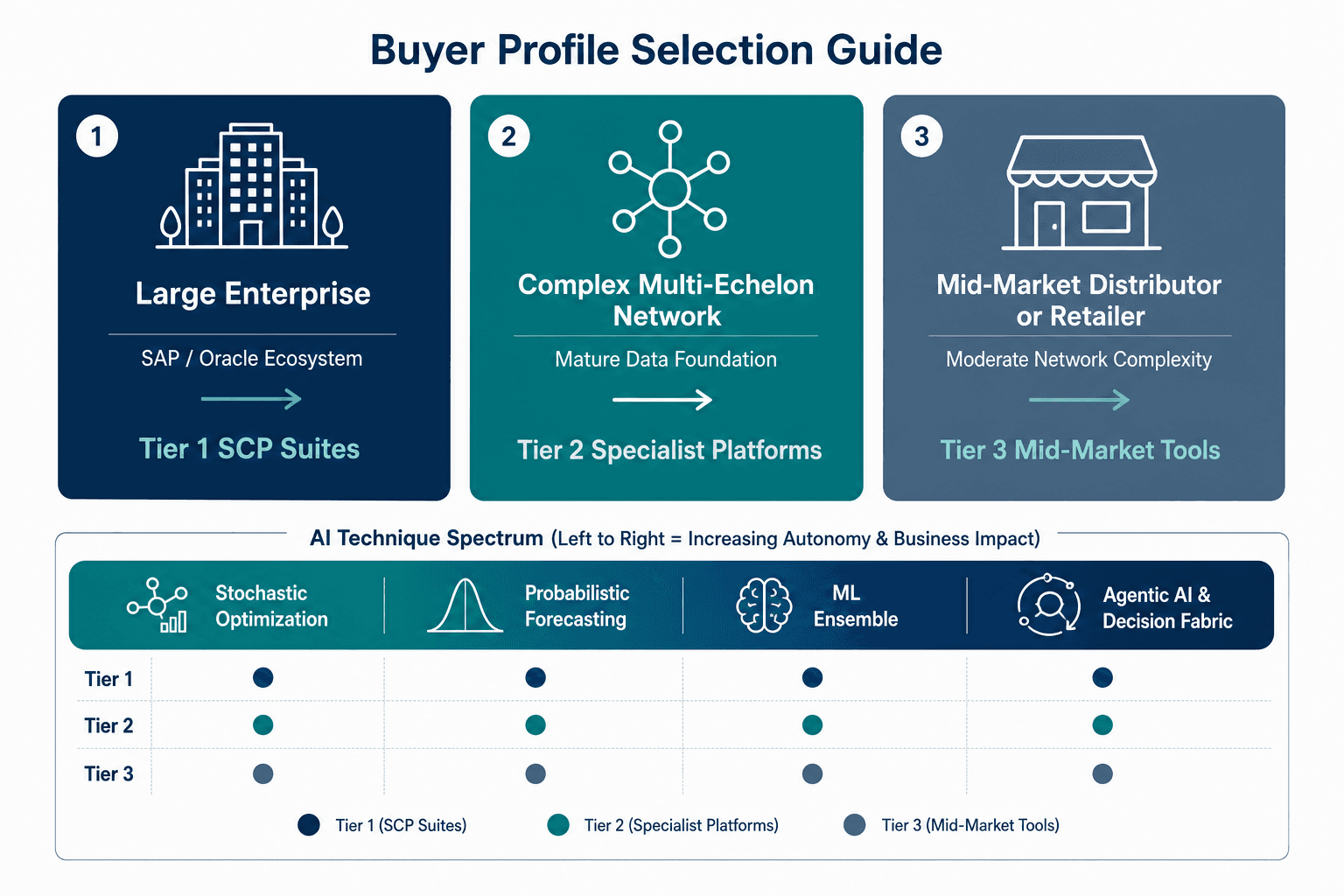
Selection Guidance by Buyer Profile
Effective MEIO platform selection maps to three buyer profiles defined by network complexity, data readiness, and ERP ecosystem — not by organizational size alone. The following guidance is a starting framework; industry-specific applicability (spare parts, pharma, retail, manufacturing) is covered in the AI Multi-Echelon Inventory Optimization by Industry Vertical guide.
| Buyer Profile | Recommended Tier | Primary Vendors to Evaluate | Key Selection Criteria | Proof-of-Value Focus |
|---|---|---|---|---|
| Large enterprise on SAP or Oracle ecosystem with unified planning mandate | Tier 1 — with explicit MEIO module depth scrutiny | Kinaxis Maestro, SAP IBP, Blue Yonder, o9 Digital Brain | MEIO module depth (simultaneous vs. sequential); ERP native integration; S&OP and supply planning integration | Test simultaneous multi-echelon policy optimization on representative network topology using your ERP data |
| Organization with complex multi-echelon network (4+ echelons), high SKU-location volume, and mature data foundation (24+ months clean item-location history) | Tier 2 — specialist probabilistic-AI platforms | ToolsGroup SO99+, Logility Decision Intelligence, GAINS, OMP Unison Planning | Simultaneous optimization depth; probabilistic modeling; lead time variability handling; ERP connector reliability | Run probabilistic MEIO against your highest-variability SKU segments; measure safety stock policy precision vs. current state |
| Mid-market distributor, retailer, or organization with moderate network complexity (2–4 echelons, <100K active SKU-locations), shorter data history, faster time-to-value requirement | Tier 3 — mid-market accessible tools | Slimstock Slim4, RELEX Platform, Arkieva Enterprise, John Galt Atlas | Implementation speed; cloud-native ERP integration; replenishment automation depth; vertical fit (retail vs. distribution vs. manufacturing) | Evaluate replenishment automation quality and ERP integration reliability; test on seasonal demand scenarios if applicable |
Proof-of-Value Framework for All Tiers
Regardless of tier, structure any proof-of-value engagement using the same dataset and scoring rubric across all evaluated vendors. The recommended minimum dataset:
- 18–36 months of item-location demand or shipment history (use 12 months minimum for Tier 3 evaluations, with the understanding that policy precision will be lower).
- Lead times and lead time variability by supplier-item-location — if lead time variability data is unavailable, flag this as a data gap before vendor engagement.
- Service-level policies by SKU segment or customer class.
- Current inventory positions by location.
- Three to five representative planning scenarios: at minimum, a high-variability SKU segment, a seasonal demand pattern, and an intermittent demand item population.
Score vendors against three to five pre-defined outcomes — service level achievement, inventory value reduction, planning cycle time — using the same scenarios and dataset. Require vendors to explain, in plain terms, how their model handles seasonality, sparse history, demand shocks, and lead time variability. Backtesting on your own data using consistent train and test periods is the most reliable signal of production performance.
Comments
Join the discussion with an anonymous comment.