
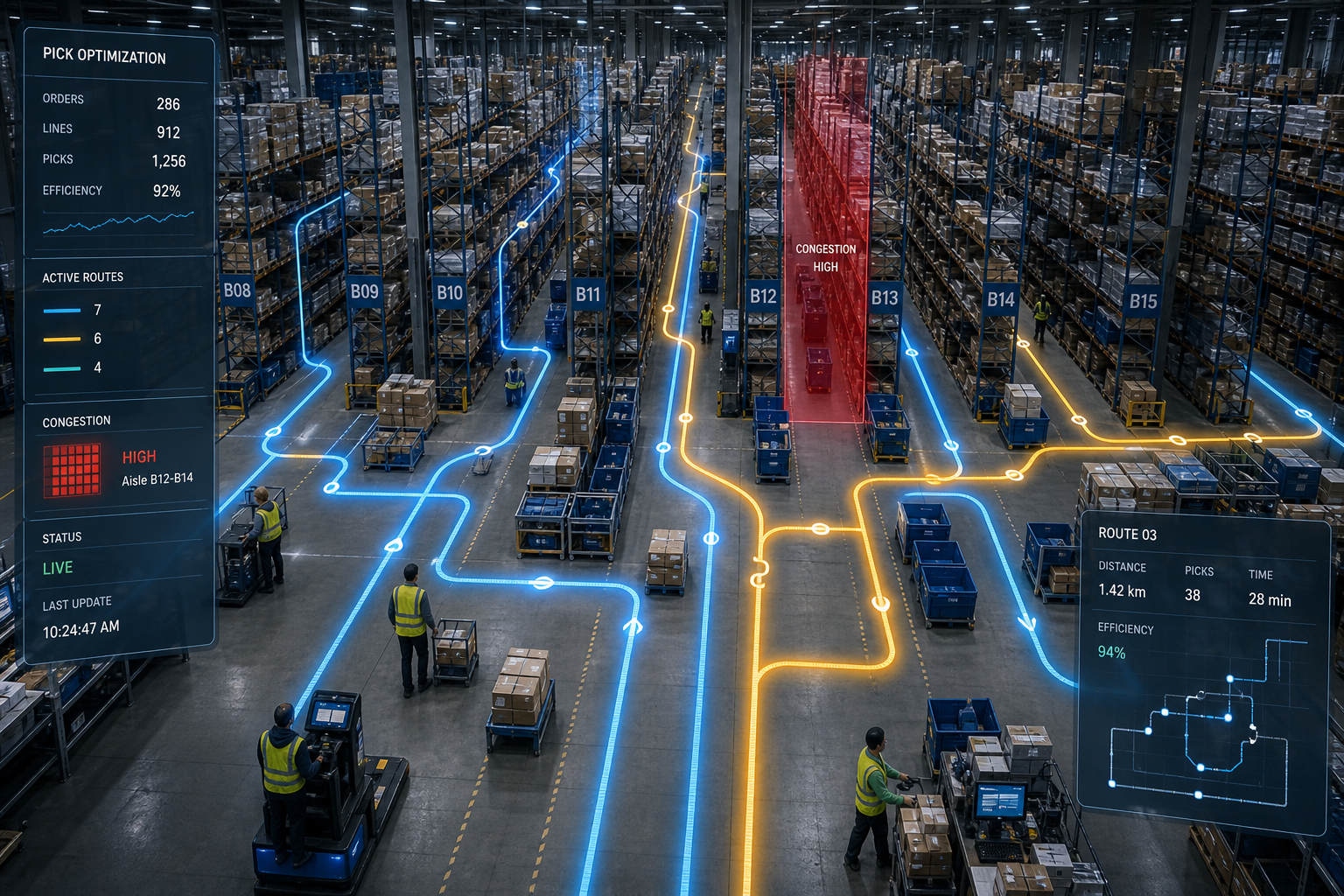
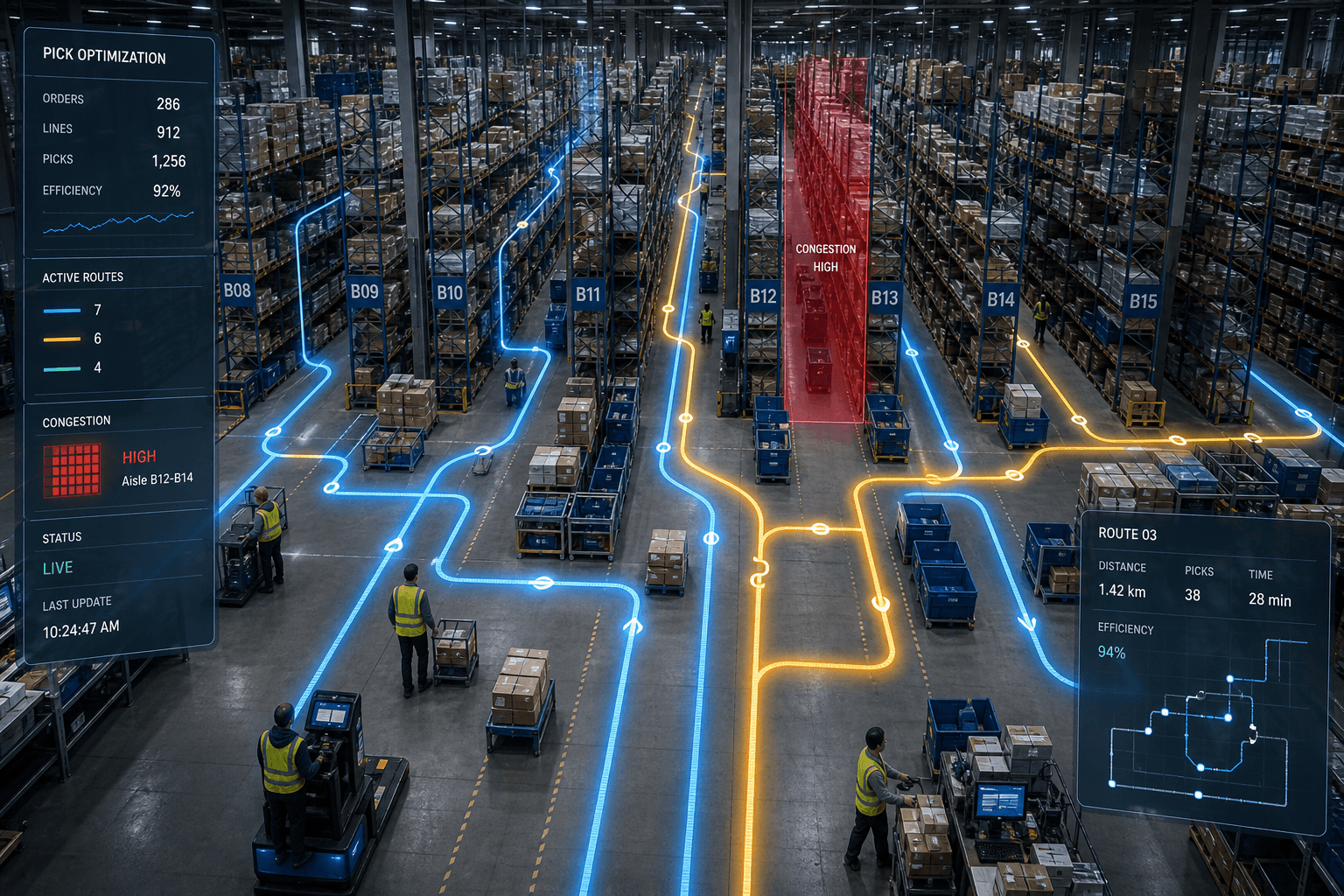
What Separates AI Pick Path Optimization from Static Heuristics
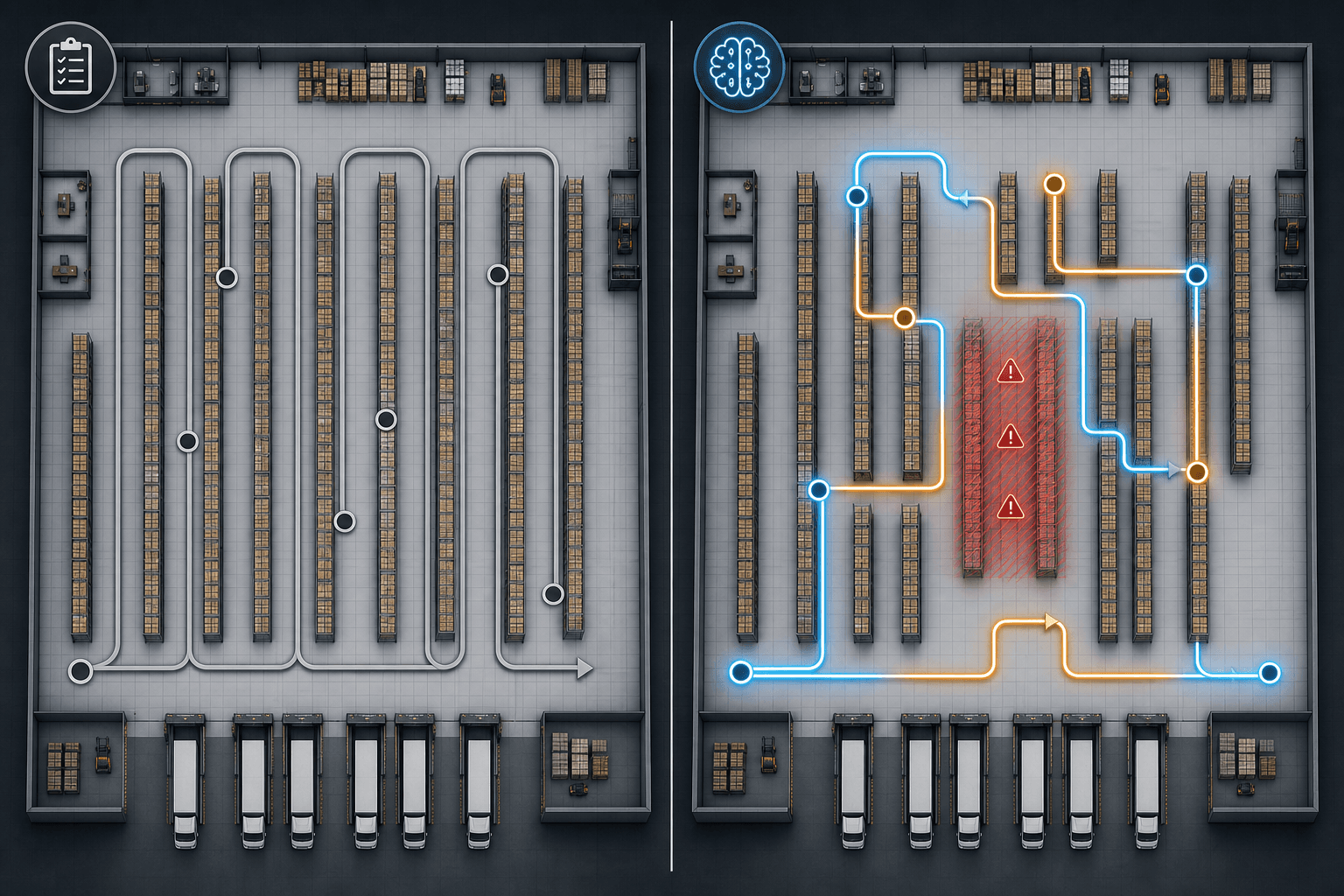
Most warehouse management systems ship with one or more fixed traversal heuristics — S-shape, return, largest gap, or midpoint. These rules assign a pick sequence based on a predetermined logic applied uniformly to every order, regardless of what is happening on the floor at that moment. They are fast to configure, easy to explain to pickers, and sufficient for low-complexity environments.
AI-based pick path optimization does something structurally different. Instead of applying a fixed traversal rule, it solves a combinatorial problem: given a set of orders, a physical layout, current congestion state, and picker or equipment constraints, what sequence and path minimizes total travel distance and time? The solution changes with each order release cycle, each congestion event, and each shift in pick density.
The practitioner-relevant distinction is not which algorithm name appears in the vendor datasheet. It is whether the system adapts its routing decisions based on real-time conditions or whether it applies the same rule regardless of what is happening in the aisles. A system that recalculates routes around a congested zone mid-shift is operating in a different regime than one that runs the same S-shape pattern on every pick wave.
Two named implementations with published customer outcomes are currently verifiable. Infor WMS Velocity Suite, launched April 2026, minimizes total walking distance across pick runs, monitors historical traffic patterns to reroute pickers around busy aisles, and tailors routing by equipment type — accounting for aisle width, one-way rules, and turning radius. Lucas Systems Dynamic Work Optimization uses order, inventory, and location data from WMS and other systems to define optimal pick sequences and travel paths in real time, applying a virtual facility model that accounts for order priority, product dimensions, and user permissions.
| Approach | How routing is determined | Adapts to real-time conditions? | Primary limitation |
|---|---|---|---|
| S-shape heuristic | Pickers traverse every aisle in a serpentine pattern regardless of pick locations | No | Excessive travel in low-density pick scenarios |
| Return heuristic | Picker enters aisle, picks, returns to main aisle before next | No | Inefficient when picks are clustered across multiple aisles |
| Largest gap heuristic | Picker turns around at the largest gap between picks in an aisle | No | Requires accurate gap calculation; degrades with dense picks |
| AI combinatorial optimization | Solves path as a combinatorial problem per order set, incorporating layout and constraints | Yes — recalculates per wave or in real time | Requires data prerequisites and WMS/ERP API integration |
| Congestion-aware rerouting | Monitors aisle traffic and dynamically redirects pickers away from congestion | Yes — continuous | Requires real-time positioning or traffic sensing data |
Why High-Velocity DCs Are the Primary Applicable Environment
The economic case for AI pick path optimization is not uniform across DC types. It is strongest where the conditions that cause static heuristics to fail are most pronounced. Those conditions cluster in high-velocity distribution centers — operations processing hundreds to thousands of orders per day with variable order profiles, dense pick activity, and meaningful aisle congestion.
Four operational characteristics define the high-velocity context where AI optimization consistently outperforms static rules:
- Pick density. When a large number of picks are concentrated in a shift, the combinatorial problem of sequencing them efficiently becomes non-trivial. Static heuristics that were calibrated for average conditions underperform during peak periods when pick density spikes.
- Order profile variability. High-velocity DCs serving e-commerce or omnichannel fulfillment face order profiles that change substantially across hours and days. A fixed routing rule optimized for one order mix degrades when the mix shifts. Adaptive systems recalculate for each release cycle.
- Aisle congestion. When multiple pickers or equipment are active simultaneously, aisle congestion becomes a measurable drag on throughput. Static heuristics route pickers into congested zones because they have no awareness of current traffic. Congestion-aware systems reroute around bottlenecks in real time.
- SKU velocity distribution. Operations with a wide range of SKU velocities — where a small percentage of items account for the majority of picks — benefit most from routing that concentrates travel around high-velocity zones rather than traversing the full facility uniformly.
Technique Taxonomy: What Each Approach Does and What It Requires
AI pick path optimization is not a single technique. Several distinct approaches are deployed in production environments, and each has different operational requirements and different points where it adds value over heuristics. The taxonomy below is organized by what each approach does for the practitioner, not by algorithm mechanics.
Combinatorial ML Optimization
This approach treats pick path assignment as a combinatorial problem solved per order release. Given a set of picks, a facility layout, and operational constraints, the system identifies the sequence and path that minimizes total travel. It differs from heuristics in that the solution is computed rather than rule-applied — the route for 40 picks in a given wave is not predetermined by a traversal pattern but calculated based on the specific locations and constraints of those 40 picks.
Requirements: bin-level location accuracy, a digital layout model with aisle constraints, and sufficient order history for the system to learn pick frequency patterns. The algorithm needs to know where everything is and what the physical constraints are before it can solve the routing problem.
Simultaneous Batch-Plus-Route Optimization
Most WMS batch optimization and route optimization are handled sequentially: first, orders are grouped into batches; then, a route is calculated for each batch. The problem with sequential optimization is that the batch grouping was made without knowing the route implications, which means the batch may be efficient on paper but inefficient to execute.
Optimizing picking in isolation might create a great pick route that results in terrible pallet stacking. Simultaneous optimization avoids local optimum traps where you win on one metric and lose on another.
Simultaneous batch-plus-route optimization solves both problems jointly — it determines which orders to group and what path to take at the same time. Optioryx describes this as mathematically superior to sequential approaches because it avoids local optima where gains on one metric come at the cost of another. This is where ML adds the most measurable value over rule-based systems — the joint optimization space is too large for fixed heuristics to navigate effectively at scale.
Congestion-Aware Dynamic Rerouting
Rather than solving the path problem once at order release, congestion-aware systems monitor aisle traffic continuously and update pick directions mid-execution. If an aisle becomes congested, the system redirects active pickers to an alternative path to the same picks.
Infor WMS Velocity Suite implements this via historical traffic pattern monitoring and real-time rerouting. The requirement is a mechanism for detecting congestion — either through task load data from the WMS, picker location tracking, or equipment telemetry. Without a congestion signal, the system cannot reroute around problems it cannot see.
ML-Driven Equipment Routing
In facilities using forklifts, reach trucks, or order pickers with different physical constraints, routing must account for equipment-specific parameters: aisle width, one-way traffic rules, turning radius, and load height restrictions. ML-driven equipment routing incorporates these constraints into the optimization model so that routes are physically executable by the assigned equipment type.
This approach requires equipment profile data and a layout model that encodes physical constraints per aisle segment. The Springer Nature case study of Kairos Logic's deployment at Sienzi Lojistik — a Turkish 3PL using forklift-based picking for automobile parts — is one of the few peer-reviewed accounts of this approach in production, and it documents both the gains and the failure patterns in detail.
Data Prerequisites: Three Minimum Conditions
AI pick path optimization does not require a sophisticated WMS, a data lake, or years of historical records. But it does require three specific data inputs to function as described. Absence of any one of them significantly caps what the optimization can achieve — not because the algorithm is weak, but because the problem it is solving becomes under-constrained.
- Accurate bin-level location data. The optimizer needs to know exactly where each SKU is stored — not just the aisle or zone, but the specific bin or slot. If location data is at the zone level or frequently out of sync with physical reality (due to informal putaway practices or delayed WMS updates), the calculated route will not match the actual pick environment. This is the most commonly degraded data condition in warehouses that have grown organically.
- At least one month of historical pick run data. The system needs order history to identify pick frequency patterns, understand which SKUs are co-picked, and learn congestion patterns by time of day and shift. One month is the documented minimum threshold from Optioryx; less than this and the algorithm is optimizing against an insufficient pattern base, which limits both batch grouping quality and route prediction accuracy.
- A digital layout model with aisle constraints. The optimizer needs a machine-readable representation of the facility: aisle dimensions, one-way restrictions, cross-aisle locations, staging areas, and any physical barriers. Without this model, the system cannot distinguish a traversable path from an impassable one, and route calculations will produce paths that are not executable on the actual floor.
Integration Requirements and the API Failure Pattern
Real-time pick direction — the core value of AI optimization over static heuristics — requires that the optimizer communicate with the WMS and ERP in real time. That communication happens through APIs. If the API connection is absent, delayed, or incompatible, the optimizer cannot deliver route instructions to pickers as conditions change. It is reduced to a batch planning tool, which limits its advantage over conventional wave planning.
The most detailed peer-reviewed account of this failure pattern comes from a 2025 Springer Nature case study by Kordestani et al. documenting Kairos Logic AB's AI batch order picking system deployed at Sienzi Lojistik in Turkey. The AI optimizer required a new API protocol that the ERP developer — Select — had not previously built. Integration was prolonged significantly because there was no direct technical communication channel between the Kairos Logic developer and the Select ERP engineer. Each issue required routing through intermediaries, compounding the delay.
Legacy WMS systems with no API present a harder constraint. Without an API, real-time pick direction requires custom integration workarounds — typically involving data export and re-import cycles — that introduce latency and break the real-time feedback loop the optimizer depends on. US Tech Automations identifies WMS systems with no API as a condition where the optimization math may not justify deployment at all.
The Slotting Interdependency: Why Routing Gains Have a Ceiling
Pick path optimization and slotting are not independent problems. The physical location of SKUs in the facility sets the upper bound for what any routing algorithm can achieve. If the 20 fastest-moving SKUs are distributed across 15 different aisles because slotting was last reviewed two years ago, the optimizer must route pickers through those 15 aisles regardless of how sophisticated its path calculation is. The algorithm cannot move inventory.
Optioryx data indicates that most warehouses are 30–50% suboptimally slotted after one year of changing demand patterns. SKU velocity rankings shift with seasonality, promotions, and product lifecycle changes, but slotting assignments often remain static. The result is that high-velocity items occupy positions optimized for a demand profile that no longer exists.
Documented Failure Patterns and Applicability Limits
The Sienzi/Kairos Logic deployment documented in the Springer Nature study is one of the few peer-reviewed accounts of an AI pick path optimization deployment that reports both outcomes and failure patterns with specificity. The case involved forklift-based picking at a Turkish 3PL handling automobile parts — a context that differs from a high-velocity e-commerce DC, but the failure patterns it documents are structurally generalizable.
The study also references the widely cited finding that 85% of AI projects fail to achieve their initially planned benefits — a figure that contextualizes why applicability conditions and failure patterns deserve equal weight alongside performance claims.
- Sorting complications from batch-driven process changes. Batch picking combines orders from multiple customers into a single pick run, which requires a downstream sorting step to separate items by order. At Sienzi, the existing labeling approach was not designed for multi-order batches, causing sorting chaos at the collection point. Management had not conducted a pre-implementation review of downstream process impacts. The sorting problem was not a technology failure — it was an operational design failure that the implementation team did not anticipate.
- Picker resistance to instructed routing. Pickers at Sienzi initially refused to follow the instructed routing sequences, perceiving the system as removing their autonomy and judgment. This is a documented change management failure mode, not a technology failure. Pickers who have developed efficient informal routes over years of experience will not automatically defer to system-generated instructions, particularly if those instructions are not explained or if the system's logic is opaque to them.
- Poor pre-implementation review of downstream processes. The Sienzi case documents that the implementation team did not adequately map how batch picking would affect downstream steps — sorting, labeling, staging, and dispatch. AI optimization changes picking behavior, and those behavioral changes propagate through the rest of the fulfillment flow. Reviewing only the picking step in isolation is a documented implementation failure pattern.
- API protocol mismatch. As described in the integration section above: the AI system required a new API protocol that the ERP developer had not previously implemented, and the absence of direct technical communication between the AI developer and the ERP engineer prolonged the integration significantly.
- Sub-threshold order volume. US Tech Automations documents that operations processing fewer than 100 orders per day may not generate enough combinatorial complexity to justify AI optimization over a well-configured heuristic. Below this threshold, the implementation cost and integration overhead typically exceed the operational gain.
- Constantly changing SKU mix without re-tuning. Operations with a frequently changing SKU mix — seasonal assortments, promotional catalogs, or high new-product introduction rates — need the optimization model re-tuned as the mix shifts. Without re-tuning, the algorithm's learned patterns become stale and benefits degrade.
Performance Range, KPIs, and Payback Conditions
Published performance figures for AI pick path optimization vary substantially across sources, and that variance is meaningful — it reflects real differences in baseline optimization state, facility type, order volume, and picking strategy. Presenting any single figure as a universal benchmark misrepresents what the data actually shows.
| Source | Reported gain | Operation context | Baseline condition |
|---|---|---|---|
| Infor / Coram | 25% travel distance reduction, 15% faster picking | European bathroom fixtures manufacturer, retail and professional markets | Previously using static pick routes; not a typical high-velocity e-commerce DC |
| Lucas Systems | 30–70% travel reduction; some customers >100% productivity improvement | High-volume operations including e-commerce; waveless order release supported | Not specified per customer; range reflects variation across deployment base |
| Optioryx | 20–55% walk distance reduction | Manual warehouse environments broadly | High end (55%) occurs in warehouses with no prior optimization |
| US Tech Automations | 20–40% travel reduction; 20–30% labor cost reduction | 200–500 orders/day operations (Tier 2–3 implementation) | Payback of 2–4 months documented at this volume tier |
The consistent pattern across all published sources is that gains are largest in operations that were previously unoptimized or using paper-based picking. An operation that already runs a well-configured S-shape heuristic with good slotting will see smaller marginal gains than one moving from clipboard-based picking to AI-optimized routing.
KPIs Practitioners Should Track
Measuring the impact of pick path optimization requires tracking metrics that are directly affected by routing decisions — not just aggregate throughput, which can be influenced by many other factors simultaneously.
- Travel distance per pick (feet or meters per pick event) — the primary metric that routing optimization directly controls.
- Orders per picker-hour — the throughput metric that captures the combined effect of routing, batching, and pick density.
- Pick cycle time (time from order release to pick completion) — captures both routing efficiency and downstream sorting/staging speed.
- Congestion incidents per shift — a process metric for operations using congestion-aware rerouting; tracks whether the system is successfully avoiding bottlenecks.
- Mis-pick rate — a quality metric that can degrade if routing instructions are unclear, batch sizes are too large, or picker resistance causes deviation from instructed sequences.
For mid-volume operations in the 200–500 orders-per-day range, US Tech Automations documents a payback period of 2–4 months at Tier 2–3 implementation cost. This figure assumes the three data prerequisites are met at deployment, that the WMS API integration is functional from day one, and that slotting was reviewed before or alongside the optimization deployment. Operations that require significant data remediation or custom API development before go-live will see longer payback timelines.
Comments
Join the discussion with an anonymous comment.