


Why Autonomous Procurement AI Deployments Stall at the Organizational Layer
The dominant failure mode in autonomous procurement AI is not a technology problem. It is an organizational one. Vendors deliver working systems. Pilots demonstrate measurable results. And then deployment stalls—sometimes for months, sometimes permanently—because the organization around the technology was never prepared to absorb it.
The data makes this pattern concrete. Gartner projects that over 40% of agentic AI projects will be canceled by the end of 2027—not because the technology failed, but because of unclear business value, inadequate risk controls, and governance gaps. The Hackett Group's 2025 CPO Agenda research (paywalled; cited in procurement industry literature) finds that only approximately 4% of procurement AI pilots reach meaningful large-scale deployment. That gap between pilot success and production scale is where organizational readiness failures live.
McKinsey's research on procurement AI transformation identifies what they call "pilot purgatory"—the state in which organizations have proven a pilot works but cannot embed it in their core processes and teams' ways of working. Even after effectiveness is demonstrated, adoption fails to scale. McKinsey's analysis is direct: organizations that successfully scale AI spend as much time on people and processes as on technology—adapting their operating model, upskilling their teams, and actively managing organizational change.
Why This Is Not Standard IT Change Management
Generic IT change management frameworks—Kotter's 8-step model, Prosci's ADKAR—were designed for technology adoption scenarios where the system being deployed supports human decisions. Autonomous procurement AI is categorically different: it replaces human decisions in defined categories, which creates three organizational disruptions that generic frameworks do not address.
- Spend authority reassignment. When an AI system executes a purchase order, selects a supplier, or triggers a contract renewal, it is exercising authority that previously belonged to a named individual. That authority transfer must be explicitly designed, documented, and sanctioned—not assumed. Generic change management does not have a framework for authority reassignment.
- Procurement accountability to internal stakeholders and suppliers. Procurement professionals carry accountability to internal budget owners, finance, legal, and to supplier partners. When AI makes a sourcing decision that a supplier disputes or a budget owner questions, the accountability chain must be traceable. Generic frameworks treat accountability as a communications problem; in autonomous procurement, it is a governance design problem.
- Ongoing compliance exposure. Procurement decisions carry regulatory, contractual, and audit implications. An autonomous system that makes purchasing decisions without embedded policy controls creates compliance exposure that accumulates in production—not just at deployment. This requires continuous governance, not a one-time change management campaign.
These three dimensions mean that procurement change management requires a procurement-specific framework—one built around authority design, accountability traceability, and compliance continuity, not just communication plans and training schedules.
The Five Organizational Readiness Dimensions
Before any autonomous procurement AI pilot is initiated, the organization needs an honest assessment across five readiness dimensions. These are not sequential prerequisites—they are parallel conditions that must all reach a minimum threshold before deployment is safe to proceed.
The conceptual foundation for this framework comes from what Ivalua calls the "Orchestration Before Intelligence" principle: AI agents cannot operate effectively in chaotic or fragmented process environments. Clean data, unified workflows, and policy-driven logic must exist before AI agents are introduced. Organizations that skip this foundation do not get slower AI—they get AI that amplifies existing process failures at scale.
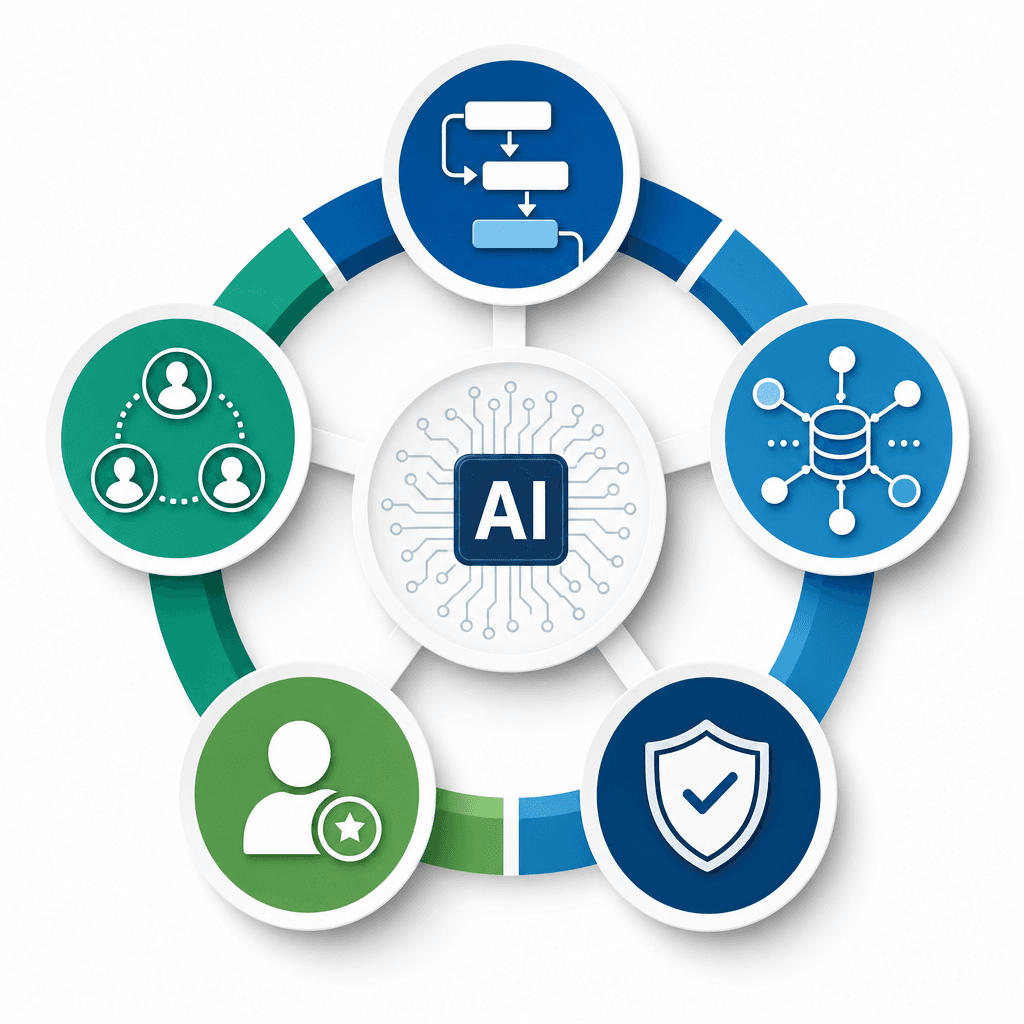
| Readiness Dimension | What It Requires | Key Failure Indicator |
|---|---|---|
| Process Standardization | Core procurement workflows (intake, approval, supplier onboarding, PO issuance) are documented, consistently followed, and not dependent on individual judgment for routine steps. | Significant process variation across categories, business units, or geographies that the AI system would need to accommodate rather than execute. |
| Data Orchestration Readiness | Supplier master data is centralized and deduplicated. Spend data is categorized consistently. Historical transaction data is accessible and attributed to the correct cost centers and categories. See also: data readiness requirements for specific use cases such as AI supplier risk scoring. | Supplier records exist in multiple systems with no single source of truth. Spend data requires manual reconciliation before analysis. |
| Governance Design | Spend authority thresholds are defined and documented. Escalation paths for exceptions are mapped. Compliance rules are embedded in policy documents, not held informally by experienced buyers. | Approval authority exists in informal practice rather than documented policy. No defined escalation path for AI-generated decisions that fall outside parameters. |
| Role Clarity | RACI assignments for AI-assisted and AI-autonomous decisions are defined. Exception handling roles are named. The boundary between AI authority and human authority is explicit. | Ambiguity about who is accountable when an AI decision is challenged by a supplier or internal stakeholder. No named exception handler for out-of-parameter situations. |
| Stakeholder Alignment | Finance, legal, category management, and key internal budget owners understand what the AI will and will not decide autonomously. Supplier-facing relationship owners have a communication plan for key suppliers. | Finance or legal has not reviewed the autonomous decision scope. Key internal stakeholders believe the AI will handle categories it is not designed to handle. |
Stakeholder Authority Mapping: Who Loses, Who Gains, Who Must Be Designed In
Authority mapping is the most politically sensitive and most frequently skipped step in autonomous procurement AI planning. Organizations that skip it discover the gap during their first production incident—when an AI decision is challenged and no one knows who is accountable.
The mapping exercise should identify four distinct stakeholder categories and their relationship to the AI deployment:
| Stakeholder Category | Relationship to AI Deployment | Required Action Before Deployment |
|---|---|---|
| Category Managers (affected categories) | Lose routine transaction authority within defined thresholds. Gain exception handling responsibility and strategic relationship management scope. | Role redesign conversation. Documented new authority boundaries. Skills gap assessment for exception judgment and AI oversight. |
| Finance / Accounts Payable | Gain new audit trail requirements. Existing approval workflows may be bypassed for AI-executed POs. | Must review and approve the AI's authority scope. Audit trail design must be confirmed before go-live. |
| Legal / Compliance | Ongoing exposure if AI executes contracts or commitments outside approved templates or thresholds. | Must define the policy guardrails embedded in the AI system. Must be consulted on escalation criteria. |
| Internal Budget Owners | May not recognize AI-generated POs in their spend reports. May question decisions without a human contact to escalate to. | Communication plan required. Must know who to contact for exceptions. Feedback loop into AI parameter review must be defined. |
| Key Suppliers | May experience changes in relationship contact frequency, negotiation style, or order pattern predictability. | Relationship owners must communicate changes. Escalation contact for AI-generated orders must be named. |
The supplier-facing dimension deserves specific attention. Long-term supplier relationships are built on trust, predictability, and the ability to have a conversation when something goes wrong. An autonomous system that changes order patterns, triggers contract clauses, or selects alternative suppliers without human context can damage relationships that took years to build. Supplier communication planning is not a soft consideration—it is a deployment prerequisite.
Phased Change Management Sequence: From Readiness Audit to Autonomy Expansion
The change management sequence for autonomous procurement AI has five distinct stages. Each stage has a defined entry condition and a defined exit criterion. Organizations that compress or skip stages are the primary source of the pilot purgatory pattern—they reach production with unresolved organizational issues that prevent scale.
- Pre-Deployment Readiness Audit. Assess all five organizational readiness dimensions against the go/no-go criteria (see the self-assessment section below). Identify gaps. Remediate before proceeding. A 'no' on governance design or data traceability is a hard stop, not a risk to accept.
- Governance Design. Define spend authority thresholds for AI-autonomous decisions. Map escalation paths. Assign exception handler roles. Document the audit trail requirements. This stage produces the governance architecture that the AI system will operate within. Consult the Human-in-the-Loop Design Patterns for Autonomous Procurement AI framework as the primary resource for this stage.
- Governed Pilot with Human-in-the-Loop. Deploy the AI system in a defined category scope with human review of all AI-generated decisions before execution. This stage is not a technology test—it is an organizational calibration. The goal is to validate authority thresholds, identify exception patterns, and train exception handlers before autonomous execution begins. Supplier risk scoring and indirect spend categories with high data maturity are common starting points; see the AI Supplier Risk Scoring implementation guide for mid-market procurement teams for a use-case-level reference.
- Production Handoff with Documented Authority Thresholds. The transition from AI-assisted to AI-autonomous execution is an explicit governance handoff event. It requires a documented decision—not gradual drift. The handoff document should specify: the category scope, the spend thresholds within which the AI executes autonomously, the escalation criteria, the exception handler assignments, and the review cadence. All named stakeholders must sign off before autonomous execution begins.
- Autonomy Expansion Zones. After the initial production scope has been stable for a defined review period (typically 60–90 days), the organization can evaluate expanding AI authority to additional categories, higher spend thresholds, or additional decision types. Each expansion is a new governance handoff event, not an automatic extension of existing authority.
Role Redesign: From Transactional Buyer to AI Orchestrator and Exception Authority
The most common organizational anxiety about autonomous procurement AI is that it eliminates procurement jobs. The practitioner evidence does not support this framing. JAGGAER's analysis of autonomous procurement agent deployment is direct: for the foreseeable future, autonomous procurement agents will transform procurement jobs rather than eliminate them. The talent risk is not displacement—it is a shortage of procurement professionals with the skills to operate effectively in the transformed role.
Three capabilities that procurement professionals uniquely provide—and that AI cannot replace—define where the transformed role concentrates: emotional intelligence and trust-building with suppliers, abstract and divergent thinking for novel sourcing problems, and strategic vision and business alignment for category strategy. These are precisely the capabilities that autonomous AI frees procurement professionals to exercise more fully by removing routine transaction processing from their workload.
Gartner projects that at least 15% of day-to-day work decisions will be made autonomously through agentic AI by 2028, up from effectively zero in 2024. That shift creates three distinct emerging roles in procurement organizations:
| Emerging Role | Primary Responsibilities | Skills Gap to Address |
|---|---|---|
| AI Orchestrator | Configures AI decision parameters. Monitors AI performance against defined thresholds. Manages the feedback loop between AI outputs and policy updates. Owns the governance review cadence. | Data literacy. Understanding of AI model behavior and drift. Ability to interpret AI decision logs and identify systematic errors. |
| Exception Handler | Reviews and resolves AI-flagged decisions that fall outside autonomous authority. Makes escalation calls. Documents exception patterns for parameter refinement. | Judgment under ambiguity. Understanding of the policy guardrails the AI operates within. Ability to distinguish a genuine exception from a parameter calibration issue. |
| Strategic Relationship Manager | Manages supplier relationships that require human trust-building and negotiation. Handles strategic sourcing for high-complexity or high-risk categories outside AI scope. Represents procurement in cross-functional planning. | Elevated negotiation and relationship skills. Category expertise for complex sourcing. Ability to articulate AI-generated insights in business terms to internal stakeholders. |
For teams evaluating which routine supplier evaluation tasks are appropriate for AI handling—and therefore which activities procurement professionals can be freed from—see AI-Assisted Supplier Selection for Indirect Spend for a use-case-level analysis of technique applicability and known failure modes.
Procurement-Specific Resistance Patterns and How to Address Them
Resistance to autonomous procurement AI is real, but it is rarely rooted in the fear of job loss that change management communications typically try to address. The three resistance patterns most common in procurement organizations are more specific—and require more specific countermeasures.
- Accountability ambiguity. When an AI system makes a sourcing decision that turns out to be wrong—wrong supplier, wrong price, wrong timing—procurement professionals reasonably ask: who is accountable? If the answer is unclear, resistance to the system is rational self-protection. Countermeasure: Design and publish the accountability framework before deployment. Name the exception handler. Specify the audit trail that makes AI decisions reviewable. Make clear that the AI orchestrator role carries accountability for system configuration, not for individual AI decisions made within defined parameters.
- Supplier relationship anxiety. Experienced procurement professionals have invested years in supplier relationships. They worry—often correctly—that an AI system optimizing on price and delivery metrics will damage relationships built on trust, flexibility, and long-term mutual investment. Countermeasure: Define the categories and decision types where AI operates autonomously, and make explicit which supplier relationships remain in human hands. Strategic suppliers, preferred partners, and relationships with active negotiations should be outside AI autonomous scope. Communicate this scope to both internal teams and key suppliers before deployment.
- Compliance exposure fear. Procurement professionals who have lived through audit cycles know that autonomous decisions without traceable rationale create liability. They are not wrong to be concerned. Countermeasure: End-to-end decision traceability is a non-negotiable deployment requirement, not an optional feature. Every AI-generated decision must produce an auditable record of the inputs, the policy rules applied, and the output. Legal and compliance teams must review and approve the audit trail design before the system goes live. This turns compliance anxiety into a governance design requirement that strengthens the deployment.
Organizational Readiness Self-Assessment: Go / No-Go Criteria for Pilot Initiation
The following checklist is adapted from Ivalua's pre-deployment readiness framework and expanded to cover all five organizational readiness dimensions. Each criterion is binary. A 'no' response is not a risk to manage—it is a gap to close before proceeding.
| Readiness Criterion | Go / No-Go | Remediation if 'No' |
|---|---|---|
| Core procurement intake workflows are documented and consistently followed across the pilot category scope. | Go if yes. No-go if no. | Document and standardize intake workflows before deployment. Identify and resolve process variation across business units. |
| Policy-based approval thresholds are defined in writing and accessible to the AI system configuration team. | Go if yes. No-go if no. | Work with finance and legal to formalize approval authority in documented policy. Do not proceed with informal thresholds. |
| Supplier master data for the pilot category is centralized, deduplicated, and has a defined owner responsible for ongoing accuracy. | Go if yes. No-go if no. | Complete supplier data remediation before pilot initiation. Identify the data owner and establish a maintenance process. |
| RACI assignments for AI-assisted and AI-autonomous decisions are documented and have been reviewed by all named roles. | Go if yes. No-go if no. | Complete RACI design and conduct role briefings. Do not proceed without named exception handlers who have accepted their accountability. |
| Risk and compliance rules applicable to the pilot category are embedded in policy documents and available for AI system configuration. | Go if yes. No-go if no. | Engage legal and compliance to formalize rules. This is a hard stop—compliance rules that exist only in experienced buyers' heads cannot be embedded in an AI system. |
| End-to-end decision traceability requirements have been defined and reviewed by legal or compliance. | Go if yes. No-go if no. | Define audit trail requirements before deployment. Confirm the AI system can produce the required record format. |
| Finance, legal, and key internal budget owners have been briefed on the AI's autonomous decision scope and have confirmed understanding. | Go if yes. No-go if no. | Conduct structured stakeholder briefings. Do not proceed with passive awareness—active confirmation of scope understanding is required. |
| Key suppliers in the pilot category have been notified of the deployment and have a named escalation contact for AI-generated orders. | Go if yes. No-go if no. | Complete supplier communication before go-live. Identify the escalation contact and confirm the supplier has the information. |
Common Failure Patterns and Recovery Paths
Autonomous procurement AI deployments fail in recognizable patterns. Understanding the failure type determines the recovery path. The following taxonomy is organized by the primary gap that caused the failure, not by the symptom that surfaced it.
| Failure Pattern | How It Manifests | Recovery Path |
|---|---|---|
| Governance Gap | The AI executes a decision that stakeholders contest. No documented authority threshold or escalation path exists. The incident escalates to senior leadership without a resolution framework. Deployment is paused pending governance design that should have preceded it. | Pause autonomous execution. Complete the governance design work that was skipped. Document authority thresholds, escalation paths, and exception handler assignments. Restart with the governed pilot stage, not the production handoff stage. |
| Data Fragmentation | The AI makes systematically poor decisions in a category because supplier data is incomplete, inconsistent, or drawn from multiple unreconciled systems. Exception rates are high. Human reviewers begin overriding AI decisions routinely, negating the value of the system. | Reduce the AI's autonomous scope to categories with verified data quality. Initiate a data remediation project for the affected category before re-expanding scope. Do not attempt to train the AI on fragmented data—fix the data first. |
| Stakeholder Misalignment (Pilot Purgatory) | The pilot demonstrates measurable results, but the organization cannot agree on the production scope, authority thresholds, or which categories to expand to. The pilot runs indefinitely without a production handoff decision. McKinsey's 'pilot purgatory' pattern: the technology works, but the organizational decision-making to scale it does not. | Identify the specific stakeholder group blocking the production decision. In most cases, the blocker is unresolved accountability ambiguity or unaddressed compliance concern—not genuine disagreement about the technology. Address the underlying organizational issue directly. Set a defined decision deadline with named decision authority. |
| Scope Overreach | The initial pilot scope is too broad—too many categories, too many decision types, or spend thresholds set too high. Exception rates overwhelm the exception handler capacity. Human reviewers cannot keep pace, and autonomous execution begins without adequate oversight. | Narrow the scope immediately. Return to a category and threshold level where exception rates are manageable. Build exception handler capacity before expanding scope. Use the exception pattern data from the overreach period to refine AI parameters before re-expanding. |
The pilot purgatory pattern deserves particular attention because it is the most common and least recognized failure mode. Organizations in pilot purgatory often believe they have a technology problem—the AI needs more training, the integration needs refinement, the model needs tuning. In most cases, the actual problem is an unresolved organizational decision about authority, accountability, or scope. No amount of technical refinement resolves an organizational decision that has not been made.
Comments
Join the discussion with an anonymous comment.