


Vendor Snapshot
SAP Integrated Business Planning is a cloud-based supply chain planning platform built on SAP HANA, positioned as the primary planning layer for enterprises running SAP S/4HANA. As of 2025, the platform serves more than 30,000 daily active users across 79 countries and 24 industries, processing 8.1 trillion planning points and 20,000 forecast algorithms annually. SAP's official product page separately reports that more than 1,000 companies worldwide use IBP — a figure that reflects distinct enterprise accounts rather than individual user logins. These two metrics measure different things and should not be conflated.
On third-party review platforms, IBP holds a Gartner Peer Insights rating of 4.8/5.0 (No. 1 rated in the supply chain planning category, 51 reviews in the prior 12 months), a TrustRadius score of 8.4/10 (2026 Buyer's Choice Award, 107 reviews), and a G2 rating of 4.3/5.0 with Leader designation (251 reviews). SAP IBP is also widely reported as a Leader in the Gartner Magic Quadrant for Supply Chain Planning Solutions. The specific 2026 quadrant position should be verified directly against the official Gartner report before use in any internal business case, as ChainSignal did not have direct access to the 2026 MQ document.
| Dimension | Detail |
|---|---|
| Platform type | Cloud SaaS on SAP HANA — no on-premise deployment option |
| Daily active users | 30,000+ across 79 countries and 24 industries (2025) |
| Planning scale | 8.1 trillion planning points; 20,000 forecast algorithms processed annually |
| Enterprise accounts | 1,000+ companies worldwide (SAP official product page) |
| Gartner Peer Insights | 4.8/5.0, No. 1 rated in supply chain planning (51 reviews, as of Nov 2025) |
| TrustRadius | 8.4/10, 2026 Buyer's Choice Award (107 reviews) |
| G2 | 4.3/5.0 Leader designation (251 reviews) |
| Gartner Magic Quadrant | Leader in Supply Chain Planning Solutions (2026 MQ — verify against official report) |
| Primary target segment | Enterprise ($3B+ revenue), SAP S/4HANA-committed organizations |
| Industries served | Pharma, chemicals, CPG, consumer goods, global manufacturing, automotive, aerospace, retail |
For evaluators building a shortlist that includes full-suite WMS and TMS capabilities alongside planning, the Blue Yonder full-suite vendor profile covers a platform with broader warehouse and transportation execution coverage as a structural reference point.
Platform Architecture and Module Map
SAP IBP covers six primary planning domains within a single cloud environment: Sales and Operations Planning (S&OP), demand planning and forecasting, supply response and replenishment, inventory optimization, Demand-Driven MRP (DDMRP), and telescopic multi-horizon planning. All modules share a common data foundation on SAP HANA, eliminating the platform switching that characterized earlier generations of disconnected planning tools.
The most architecturally significant development in the current release cycle is the Harmonized Planning Area (HPA), introduced in the 2508 release under the I_SAPIBP2 data model. Prior to HPA, IBP maintained a structural separation between time-series planning (demand forecasting, statistical baselines, aggregate supply planning) and order-based planning (specific purchase orders, production orders, sales orders). Planners had to reconcile these two views manually — a significant source of latency and error in S&OP cycles.
HPA unifies both planning modes into a single master data foundation. Planners can now move between aggregate consensus plans and specific order-level decisions within the same environment, with the system maintaining consistency automatically. This eliminates the manual reconciliation step that previously delayed operational response to strategic plan changes.
Telescopic planning, enabled by the HPA foundation, creates a continuous multi-horizon view within a single planning model. The long-term horizon (12–24 months) operates at aggregate resolution for S&OP; the short-term horizon (daily/weekly) operates at detailed order-level resolution. When a short-term disruption occurs — a supplier delay, a demand spike — its impact on the long-term plan is visible immediately, rather than surfacing only at the next monthly S&OP review cycle.
| Module | Primary Function | Key AI Capability |
|---|---|---|
| Demand Planning | Statistical and ML-based demand forecasting, demand sensing, consensus planning | XGBoost demand sensing, ARIMAX, automatic change-point detection, ABC/XYZ segmentation |
| Supply Response | Multi-level supply planning across locations and bills of material | MILP mathematical optimization for supply allocation and constrained replenishment |
| Inventory Optimization | Safety stock, reorder point, multi-echelon inventory policy setting | Probabilistic simulation with 10,000+ runs, ML-based lead-time prediction |
| S&OP | Collaborative sales and operations planning with scenario simulation | Scenario comparison, what-if analysis, Joule transactional interaction |
| DDMRP | Demand-driven replenishment with buffer management | Buffer level analytics, flow management across decoupling points |
| Telescopic Planning | Continuous multi-horizon planning from strategic to operational | Unified HPA data model maintaining consistency across all planning horizons |
The release cadence follows a quarterly schedule: 2502, 2505, 2508, and 2511. The 2508 release introduced HPA and GenAI Forecast Explainability. The 2511 release extended Forecast Explainability further. Organizations on annual upgrade cycles risk missing capability milestones that are cumulative — each release builds on the prior architecture.
AI and Machine Learning Capability Layers
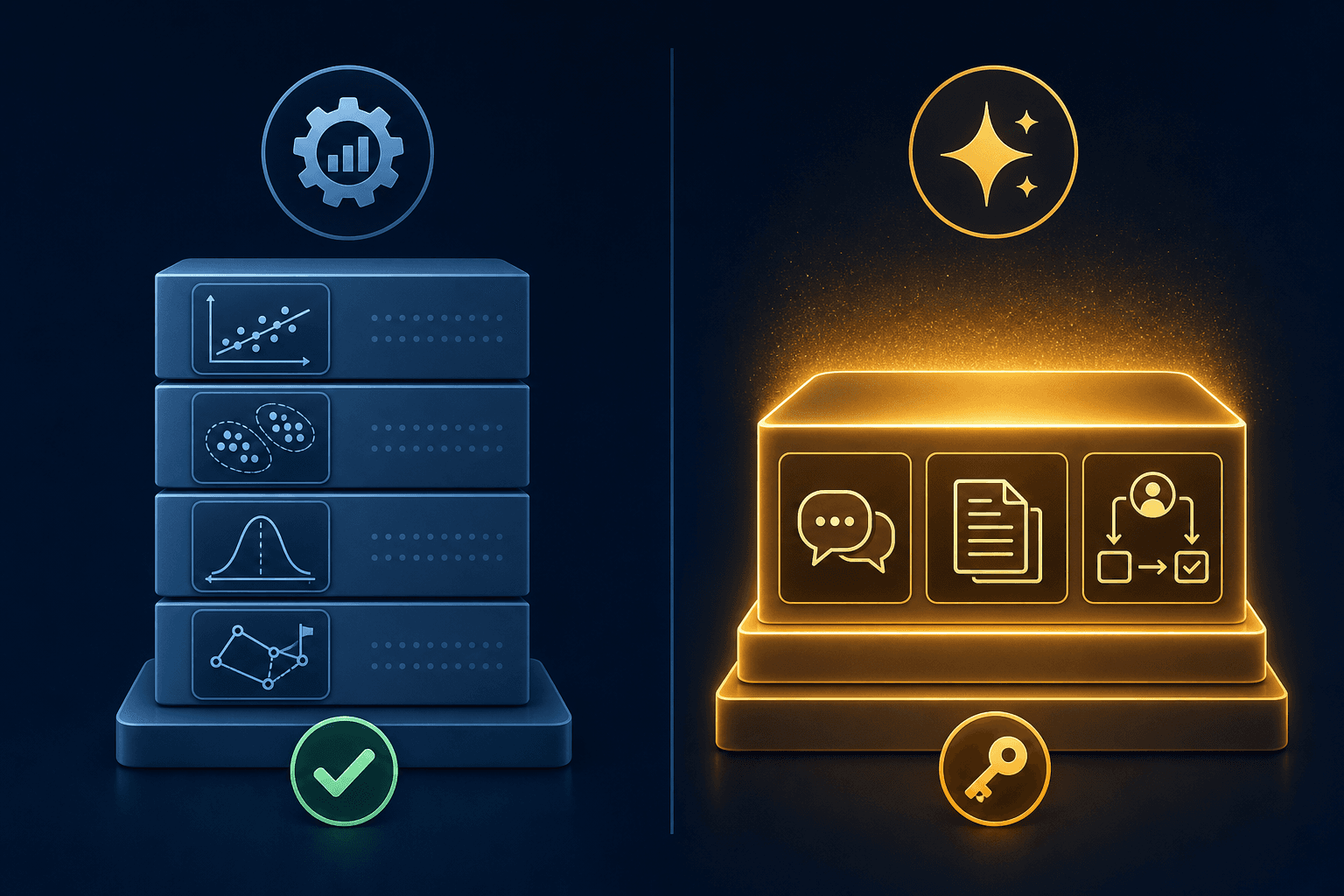
A common evaluator misconception is that all AI features described in SAP IBP marketing materials are available under standard IBP licensing. They are not. IBP's AI capabilities divide into two distinct tiers with different licensing prerequisites. Conflating the two leads to budget miscalculations and unmet expectations at go-live.
Tier 1: Embedded AI — Available Within Current Licensing
A substantial portion of IBP's AI intelligence is embedded directly in the solution modules and available to customers within their existing licensing. In practice, many organizations significantly underutilize these capabilities — often because they were not activated during implementation or because planners were not trained on them.
- XGBoost-based demand sensing — integrates short-horizon external signals (POS data, weather, promotions) to adjust statistical baselines at daily or weekly granularity. See the demand sensing vs. demand forecasting implementation guide for definitional grounding on how demand sensing differs from statistical forecasting.
- ARIMAX and statistical forecasting — multiple algorithm families with automatic model selection across the product portfolio.
- Automatic change-point detection — identifies structural breaks in demand history (product launches, distribution changes, COVID-era distortions) without manual intervention.
- K-means clustering for ABC/XYZ segmentation — automatically classifies SKUs by volume and variability to drive differentiated planning policies.
- ML-based lead-time prediction — replaces static lead-time assumptions with dynamically updated predictions based on supplier and logistics history.
- MILP supply optimization — Mixed-Integer Linear Programming in the Response and Supply module for constrained supply allocation across locations and bills of material.
- Probabilistic inventory simulation — runs 10,000+ simulation iterations to set safety stock and reorder point policies under demand and supply uncertainty. Cross-referenced in the AI safety stock optimization use case for multi-echelon deployment evidence.
Tier 2: Premium and GenAI Layer — Requires SAP BTP
The Joule AI copilot operates in three distinct interaction modes within IBP:
- Informational mode — planners query IBP data and enterprise documents using natural language. Document Grounding enables Joule to access SharePoint-hosted content (planning policies, exception reports, supplier communications) within the same conversational context, without switching applications.
- Navigational mode — Joule moves the planner across SAP applications based on intent, reducing the multi-step navigation overhead in complex S/4HANA environments.
- Transactional mode — Joule executes planning jobs, queries master data, builds what-if scenarios, and initiates simulation runs directly from the conversational interface. This is the mode with the most direct planning workflow impact.
Forecast Explainability via GenAI, introduced in the 2508 release and extended in 2511, allows planners to ask IBP why a specific forecast changed — receiving a natural language explanation of the contributing factors (algorithm selection, change-point detection, external signal weighting) rather than navigating raw model outputs. This addresses a long-standing adoption barrier: planners who distrust algorithmic forecasts they cannot interpret.
AI Agents for autonomous scenario execution represent the leading edge of the current capability set. A documented deployment at a Fortune 50 global semiconductor company illustrates the pattern: IBP was used to automate scenario planning for demand swaps and cancellations, reducing analysis that previously took hours to approximately 10 minutes per scenario. The same deployment used IBP as a data backbone for conversational AI and predictive analytics in downstream phases. This case is sourced from an EY-authored article and is treated as an illustrative reference, not an independently verified outcome.
| AI Capability | Tier | Licensing Prerequisite | Release Availability |
|---|---|---|---|
| XGBoost demand sensing | Embedded | Standard IBP licensing | Current |
| ARIMAX / statistical forecasting | Embedded | Standard IBP licensing | Current |
| Change-point detection | Embedded | Standard IBP licensing | Current |
| ABC/XYZ K-means segmentation | Embedded | Standard IBP licensing | Current |
| ML lead-time prediction | Embedded | Standard IBP licensing | Current |
| MILP supply optimization | Embedded | Standard IBP licensing | Current |
| Probabilistic inventory simulation (10,000+ runs) | Embedded | Standard IBP licensing | Current |
| Joule copilot (3 interaction modes) | Premium/GenAI | SAP BTP required | Current (BTP-gated) |
| Forecast Explainability via GenAI | Premium/GenAI | SAP BTP required | 2508 / 2511 releases |
| GenAI Planning Assistance in Excel add-in | Premium/GenAI | SAP BTP required | Current (BTP-gated) |
| AI Agents — autonomous scenario execution | Premium/GenAI | SAP BTP required | Current / 2026 roadmap |
| Harmonized scenario management | Roadmap | SAP BTP required | 2026 roadmap |
| Proactive planning insights | Roadmap | SAP BTP required | 2026 roadmap |
| VMI and co-/by-product planning on HPA | Roadmap | HPA + BTP | 2026 roadmap |
| HANA Execution Engine (HEX) acceleration | Roadmap | Platform update | 2026 roadmap |
For a cross-platform comparison of how Joule's architecture compares to Kinaxis's concurrent planning engine and o9's Enterprise Knowledge Graph, the AI architecture comparison across Kinaxis Maestro, SAP IBP, and o9 Digital Brain covers that topic at depth. This profile focuses on SAP IBP-specific architecture rather than restating the cross-platform comparison.
Target Customer Profile and Ideal-Fit Conditions
SAP IBP's differentiated value is tightly conditional on SAP ecosystem investment. This is not a general-purpose supply chain planning platform that happens to integrate well with SAP — it is an ERP-native platform whose primary advantages disappear or become cost burdens in non-SAP environments. Evaluators should apply this lens before investing in a detailed proof-of-concept.
Best-Fit Profile
- Enterprises with $3B+ revenue running SAP S/4HANA (private cloud, on-premise, or ECC) as the primary system of record — IBP's native integration eliminates the data pipeline overhead that ERP-agnostic competitors must bridge via connectors.
- Organizations migrating from SAP APO or SAP ECC before the December 2027 end of mainstream maintenance deadline. IBP is the natural migration path, and the architectural continuity reduces the scope of replatforming compared to switching to a non-SAP planning tool.
- Industries with complex multi-tier planning requirements: pharmaceuticals (batch and regulatory planning), chemicals (co-product and by-product planning), CPG and consumer goods (promotional planning, demand sensing at shelf level), and global manufacturing with multi-plant, multi-country supply networks.
- Organizations with existing SAP Ariba, SAP Transportation Management, or SAP Business Network deployments — these integrations are native and low-overhead, compounding the ecosystem value.
Moderate-Fit Zone
Mid-market enterprises in the $1B–$3B revenue range present a more complex fit assessment. IBP is priced and architected for enterprise scale. Organizations in this range risk paying for capabilities they will not fully utilize — industry patterns suggest 30–40% platform utilization is common in mid-market IBP deployments. If the organization is deeply SAP-committed and growing toward enterprise scale, IBP may still be the right long-term investment. If it is not, the cost-to-value ratio warrants scrutiny.
Weakest-Fit Conditions
Non-SAP enterprises and organizations running fragmented multi-ERP environments (Oracle EBS, Microsoft Dynamics, legacy ERPs) should evaluate SAP IBP with caution. Integration via SAP Integration Suite is technically possible but significantly more complex than native SAP-to-SAP connectivity. In these environments, ERP-agnostic platforms are architecturally better suited. The o9 Solutions vendor profile and the Kinaxis Maestro vendor profile cover those alternatives for non-SAP evaluation contexts.
| Fit Category | Conditions | Recommended Action |
|---|---|---|
| Strong fit | $3B+ enterprise, SAP S/4HANA as primary ERP, pharma/chemicals/CPG/global manufacturing | Include on shortlist; proceed to detailed proof-of-concept |
| Strong fit — migration | Currently on SAP APO or ECC, planning migration before Dec 2027 ECC maintenance end | IBP is the natural migration path; evaluate scope and timeline |
| Moderate fit | $1B–$3B enterprise, SAP-committed but not yet at full S/4HANA deployment | Assess utilization risk; consider phased single-module deployment to validate ROI |
| Weak fit | Non-SAP primary ERP (Oracle, Dynamics, legacy) | Evaluate o9 or Kinaxis first; IBP integration complexity will add significant cost and timeline |
| Weak fit | Fragmented multi-ERP environment | ERP-agnostic platforms better suited; IBP's native integration advantage does not apply |
Key Integrations
Integration depth is the primary structural differentiator between SAP IBP and ERP-agnostic planning platforms. The distinction between native SAP integrations and non-SAP integrations is not a minor technical detail — it is a cost and timeline multiplier that evaluators must price into their total program estimate.
Native SAP Integrations — Low Overhead
- SAP S/4HANA (private cloud, on-premise, and ECC) — real-time integration (RTI) for master and transactional data; SAP Cloud Integration (CI) for ETL processes. This is the core integration that drives IBP's planning accuracy advantage in SAP environments.
- SAP Ariba — procurement and supplier data integration for supply-side planning inputs.
- SAP Transportation Management (TM) — inbound and outbound logistics constraints surfaced in supply response planning.
- SAP Business Network — supplier collaboration, order confirmation, and supply chain visibility data.
- SAP Analytics Cloud (SAC) — reporting, dashboarding, and financial planning integration for S&OP financial reconciliation.
- SAP Supply Chain Control Tower — exception management and real-time supply chain visibility layer built on IBP planning data.
Non-SAP ERP Integration — Significantly More Complex
Integration with Oracle EBS, Oracle Cloud ERP, Microsoft Dynamics 365, or other non-SAP ERPs is technically supported via SAP Integration Suite. However, this integration path is not equivalent to native SAP connectivity. Non-SAP ERP integration requires custom data mapping, ongoing maintenance as both systems evolve, and significantly more implementation effort.
Deployment Model and TCO Reality
SAP IBP is delivered exclusively as cloud SaaS on SAP HANA. There is no on-premise deployment option. This is a hard constraint for organizations with data residency requirements or IT policies that restrict cloud-hosted planning data — those requirements must be resolved before evaluation proceeds.
SAP does not publicly disclose IBP pricing. The cost ranges below are derived from third-party analysis and represent observed industry ranges, not official SAP pricing. They should be treated as directional inputs for budget modeling, not as quoted figures.
| Cost Component | Observed Range | Notes |
|---|---|---|
| Annual license | $400,000–$700,000 | Third-party observed range; varies by module scope and user count |
| Implementation (SI fees) | $700,000–$1,500,000 | Single-phase deployment; complex multi-module or global rollouts higher |
| Integration (non-SAP ERP) | $300,000–$500,000 | Applies to non-SAP ERP connections; native S/4HANA integration significantly lower |
| 3-year TCO (large enterprise) | $2,000,000–$7,000,000 | Third-party observed range for large manufacturers |
| 3-year TCO (Fortune 500 scale) | $5,000,000–$15,000,000+ | Complex global deployments with multiple modules and geographies |
| SAP BTP (GenAI features) | Not verified | Required for Joule and GenAI capabilities; pricing not confirmed from official SAP sources |
Implementation Timeline Expectations
- Single module deployment (e.g., demand planning only): 6–9 months to go-live.
- Full multi-module deployment: 12–24 months to go-live.
- Process maturation post go-live: an additional 12–24 months before the organization reaches stable, optimized planning workflows.
- 30–45% of SAP IBP projects exceed their original timeline or budget — a documented pattern across implementation reports, not an outlier risk.
- ROI materialization: measurable improvements in inventory savings and forecast accuracy typically emerge in months 9–18 post go-live, with full financial ROI recognizable within 12–24 months of go-live under well-executed programs.
For a side-by-side implementation cost and program risk comparison across SAP IBP, Kinaxis Maestro, and o9 Solutions, the implementation profile and deployment cost comparison covers all three platforms with structured multi-vendor TCO data.
Implementation Risks and Known Failure Modes
Industry data shows 30–45% of SAP IBP projects exceed original timelines or go significantly over budget. Seven failure mode categories recur across documented implementations. Understanding these patterns before program design — not after go-live — is the primary use of this section.
1. Data Quality and Migration
In real-world IBP migrations, 22–28% of historical records are typically inconsistent at the point of data extraction — inconsistent material codes, missing plant assignments, duplicate master data records. These issues do not surface until migration begins. Organizations that do not run a data quality assessment before the implementation contract is signed routinely discover scope additions mid-project. Allocating a pre-implementation data audit as a standalone workstream is standard practice in well-run programs.
2. Change Management Underinvestment
Organizations with formal SAP IBP training programs achieve 85–90% user adoption. Organizations without structured training see 40–50% adoption — meaning 40–60% of planners revert to spreadsheets or bypass the system within 6–12 months of go-live. Industry best practice recommends allocating 15–20% of the total implementation budget to training and change management. This is routinely underfunded in initial program budgets.
3. Non-SAP ERP Integration Complexity
As noted in the integration section, non-SAP ERP connections via SAP Integration Suite can triple implementation timelines. This is the single largest source of timeline and budget variance in IBP programs at organizations that are not fully on S/4HANA. If the integration architecture includes Oracle or Dynamics as data sources, the integration workstream must be scoped and resourced as a primary program track, not a secondary IT task.
4. Master Data Governance Failures
IBP's planning accuracy is directly dependent on the quality of master data: product hierarchies, location structures, bill-of-materials relationships, and customer hierarchies. Organizations without a functioning master data governance process before go-live will find that planning outputs degrade over time as master data drifts. Establishing governance ownership — not just data quality at migration — is a prerequisite for sustained IBP performance.
5. Scope Creep
IBP's breadth — covering demand, supply, inventory, S&OP, DDMRP, and financial planning — creates persistent pressure to expand scope during implementation. Each module addition extends the timeline and introduces new data and integration requirements. Programs that define a phased scope with locked module boundaries in Phase 1 consistently outperform programs that attempt full-suite deployment in a single wave.
6. System Performance and Planning Run Optimization
Planning run performance — the time required to execute supply optimization, scenario simulation, or inventory policy recalculation — degrades when planning areas are poorly configured, when historical data volumes are excessive, or when the HPA migration has not been completed. Organizations should establish planning run time benchmarks during UAT and build performance optimization into the go-live acceptance criteria.
7. Post Go-Live Sustainability
A significant number of IBP deployments achieve a functional go-live and then plateau — planners use 30–40% of available capabilities, embedded AI features remain unconfigured, and the platform does not evolve with the quarterly release cycle. Post go-live sustainability requires a dedicated IBP center of excellence or at minimum a named platform owner with budget authority to manage upgrades, expand AI feature activation, and drive continuous adoption improvement.
Competitive Positioning: Where SAP IBP Wins and Where It Does Not
This section provides a concise positioning map for evaluators who are actively comparing IBP against Kinaxis Maestro or o9 Solutions. It does not replicate the full analysis available in the dedicated comparison articles — it surfaces the conditions under which each platform's architecture is better suited.
| Condition | SAP IBP | Kinaxis Maestro | o9 Solutions |
|---|---|---|---|
| Primary ERP is SAP S/4HANA | Strong advantage — native integration, no connector overhead | Functional via integration | Functional via integration |
| Migrating from SAP APO / ECC | Natural migration path, architectural continuity | Requires full replatforming | Requires full replatforming |
| Complex volatile supply chains (auto, aerospace, high-tech) | Capable but not primary design target | Strong — concurrent planning, sub-second what-if recalculation | Strong — EKG-based scenario modeling |
| Multi-ERP or non-SAP environment | Significant integration complexity | ERP-agnostic architecture | ERP-agnostic architecture |
| Commercial + financial planning alongside supply chain | SAP Analytics Cloud integration required | Limited native commercial planning | Strong — integrated business planning across commercial and financial |
| AI-native architecture priority | Embedded AI strong; GenAI gated by BTP | Concurrent planning engine differentiated | Enterprise Knowledge Graph (EKG) as AI foundation |
| Pharma / chemicals / CPG regulatory depth | Strong — multi-tier, batch, co-product planning | Capable | Capable |
| GenAI copilot as primary evaluation criterion | Joule available but requires BTP licensing | AI capabilities embedded differently | AI capabilities embedded in EKG |
For evaluators where volatile supply chains, automotive, aerospace, or high-tech discrete manufacturing with sub-second concurrent recalculation requirements are the primary driver, the Kinaxis Maestro vendor profile covers that platform's differentiated concurrent planning architecture in detail.
For evaluators in multi-ERP or non-SAP environments, or where commercial and financial planning breadth alongside supply chain is a priority, the o9 Solutions vendor profile covers o9's Enterprise Knowledge Graph architecture and multi-ERP integration posture. Evaluators should also be aware that o9 filed a legal complaint in November 2025 alleging that former executives took confidential IP to SAP. This matter remains active as of Q2 2026 — the outcome is uncertain and monitoring is recommended for evaluators with active SAP IBP or o9 shortlisting decisions.
For a structured three-way analysis of AI architecture, platform selection criteria, and deployment fit across all three platforms, the Kinaxis Maestro vs. SAP IBP vs. o9 Digital Brain AI architecture comparison provides the full framework.
Buyer Decision Framework
The following conditions are structured as a go/no-go qualification aid for evaluators who have completed initial market scanning and are deciding whether to invest in a detailed SAP IBP proof-of-concept or RFP process.
- SAP S/4HANA is the primary ERP and the organization is committed to the SAP ecosystem long-term → IBP is a strong shortlist candidate. Proceed to module scoping and proof-of-concept design.
- The organization is migrating from SAP APO or SAP ECC before December 2027 → IBP is the natural migration path. Evaluate migration scope, timeline, and HPA readiness as primary workstreams.
- GenAI features (Joule, Forecast Explainability) are a primary evaluation criterion → Confirm SAP BTP licensing cost and commercial structure directly with SAP before including these capabilities in the business case. Do not assume they are included in standard IBP licensing.
- The primary ERP is Oracle, Microsoft Dynamics, or a legacy non-SAP system → Evaluate o9 Solutions or Kinaxis Maestro first. IBP's integration complexity in non-SAP environments substantially reduces its cost-to-value ratio.
- Total 3-year program budget is below $2M → Reassess scope. A full IBP deployment at this budget level typically requires a single-module phased approach. Confirm whether a phased deployment delivers sufficient value to justify the platform commitment.
- The organization is in the $1B–$3B revenue range without full S/4HANA deployment → Model utilization risk explicitly. 30–40% platform utilization is a documented pattern at this scale. A single-module pilot with defined expansion criteria is a lower-risk entry point than a full-suite commitment.
- Volatile supply chain with sub-second what-if recalculation as the primary planning requirement → Evaluate Kinaxis Maestro as the primary candidate. IBP's planning run architecture is not optimized for this use case.
Comments
Join the discussion with an anonymous comment.